
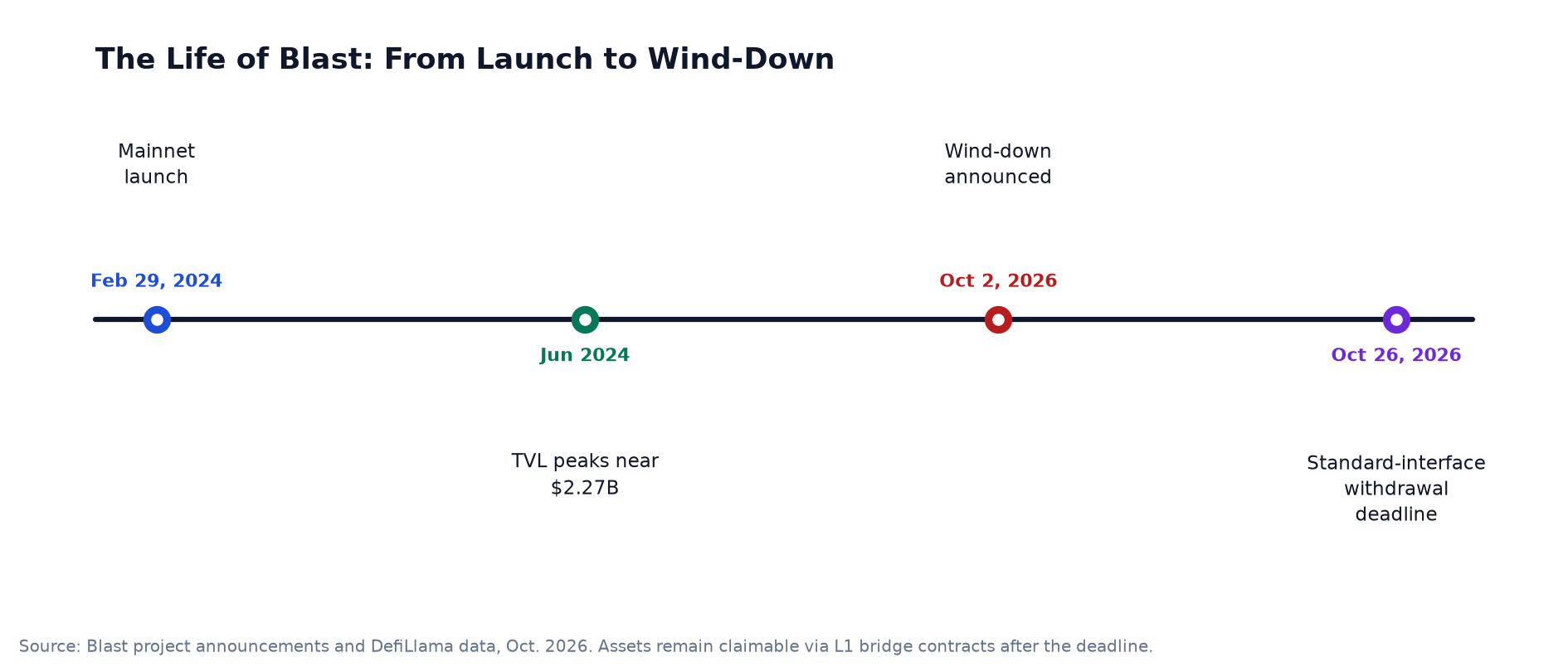
On October 2, 2026, the Ethereum Layer 2 network Blast announced it is winding down. The reason was not a hack, a lawsuit, or a governance fight. It was arithmetic: the cost of running the chain had grown larger than the revenue the chain produces, and the team said there was no credible path back to sustainability. “The economics of operating the chain no longer make sense,” the announcement read.
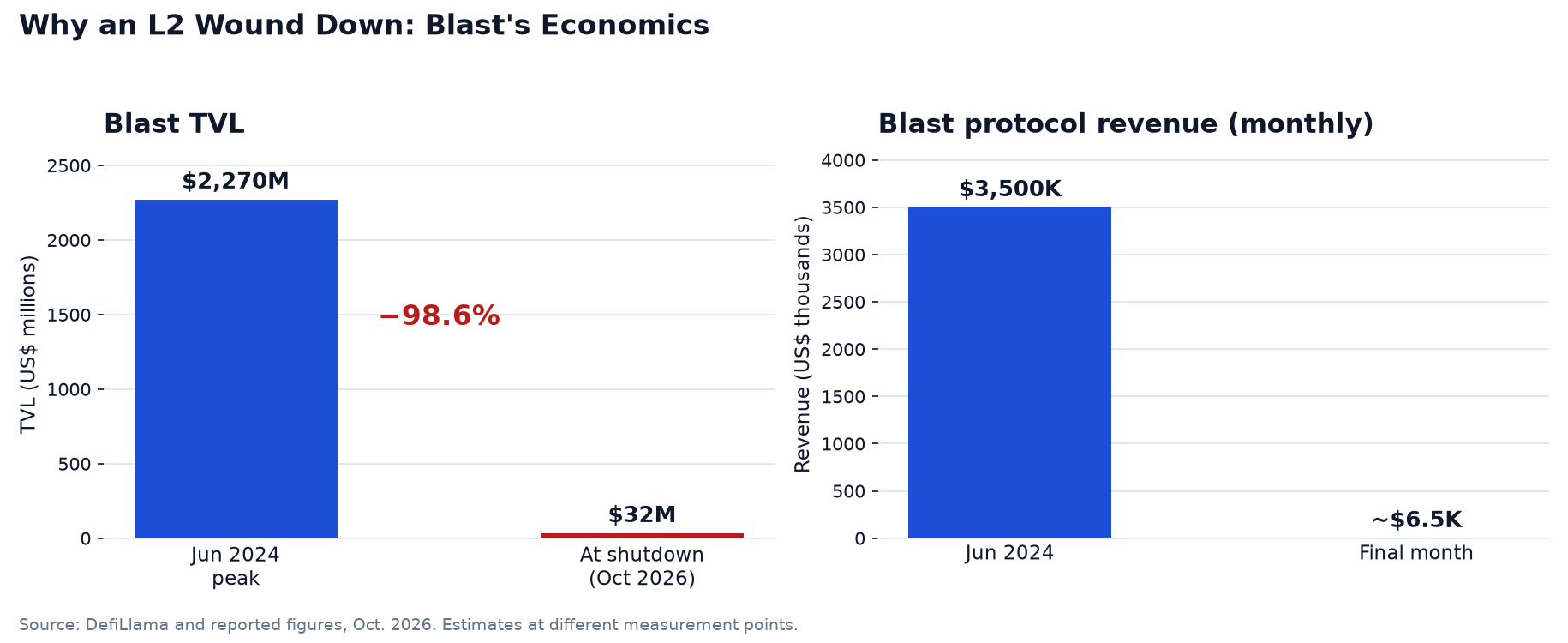
The numbers behind that sentence are stark. Blast’s total value locked (TVL) fell from a peak of roughly $2.27 billion in June 2024 to about $32 million at shutdown — a decline of more than 98%. Monthly protocol revenue collapsed from around $3.5 million to roughly $6,500. A network that had attracted over a billion dollars in deposits before it even launched cannot cover its own bills.
Blast is the clearest test yet of a question every Layer 2 faces and few discuss openly: what happens when a rollup’s incentives bring capital in but its economics cannot keep it? This article covers what Blast announced, the numbers, exactly what users must do before October 26, and what the shutdown reveals about the L2 business model.
Key takeaways
- Blast announced its wind-down on October 2, 2026, citing operating and maintenance costs that exceed the L2’s revenue, with no credible path to sustainability.
- TVL fell from ~$2.27 billion (June 2024) to ~$32 million — over 98% — and monthly revenue from ~$3.5 million to roughly $6,500.
- BLAST fell roughly 17–41% on the news, with market cap near $17–24 million versus ~$468 million at peak.
- Users should withdraw via Blast’s standard interface before October 26, 2026; afterward, funds require direct interaction with Blast’s bridge contracts on Ethereum.
- Blast is the poster child of the “points-and-airdrop” L2 era: incentives attracted capital fast but could not retain it.
What Blast announced
The message was short and unambiguous. Blast said it had launched with the goal of building a self-sustaining chain for users and developers, and that the economics no longer worked. There was no announcement of a sale, a rescue, or a pivot — just a wind-down and a withdrawal window.
That is a different kind of failure from the ones crypto usually celebrates. There was no exploit and, as of the announcement, no obvious insolvency of user funds: the complaint was that the business of running a chain did not pay, even as the technology ran fine. For a sector that measures success in TVL and transactions, it is a reminder that a Layer 2 is also a small infrastructure company with fixed costs and a P&L.
The numbers behind the shutdown
- TVL: ~$2.27 billion at the June 2024 peak, down to roughly $32 million by the wind-down, a drop of over 98%. One report noted ~$63–65 million remained in the bridge, with about $51 million not yet withdrawn, including ~$46.6 million in staked ETH held via Lido.
- Revenue: about $3.5 million in June 2024 versus roughly $6,532 in the final month — another report cited about $110 in the last 24 hours. Either way, the revenue line rounds to zero.
- Token: BLAST fell roughly 17–41% on the news to around $0.00024, with a market cap near $17–24 million against roughly $468 million at its peak. Korean exchanges Upbit and Bithumb flagged BLAST as a caution item.
The revenue figure is the one to sit with. A chain whose monthly revenue is measured in thousands of dollars cannot fund validators, sequencers, bridges, and engineering — the fixed expenses of running a network — no matter how much TVL it once had.
What users must do — and by when
The withdrawal process has three stages:
- Lido unwind (~1 week). Blast first exits its Lido-staked positions. During this period, withdrawals are temporarily paused.
- 24-hour delay. Once the Lido exit completes, withdrawal wait times drop from seven days to 24 hours.
- Until October 26, 2026. Users can withdraw normally through the standard Blast interface, including balances in the Blast web app.
After October 26, funds are not lost — they remain withdrawable — but require direct interaction with Blast’s bridge smart contracts on Ethereum L1, which the team describes as not beginner-friendly. Blast promised to publish detailed instructions before the deadline. The practical takeaway is simple: if you have assets on Blast, do not wait for the deadline to pass.
Why L2 economics are hard
A Layer 2 earns money from the fees users pay to transact on it, minus the cost of settling and posting data to the base chain (Ethereum). When usage is high, that spread can be healthy. When usage falls, the spread narrows toward zero while the fixed costs of operating a chain do not.
Blast had an extra twist. It launched with a promise of native yield: ETH deposited on Blast was staked through Lido, and stablecoins were routed to yield sources like MakerDAO, so users could earn while their assets sat idle. That design attracted deposits rapidly, but it also made Blast’s value proposition look like a yield product rather than a place to build. When the yield story stopped being enough, users had little reason to stay — and, crucially, little reason to transact on Blast rather than simply hold.
The result is the pattern every L2 is measured against: high total value, low activity, and revenue that never scales with the headline number.
The points-and-airdrop lesson
Blast’s origin explains its ending. It launched its mainnet on February 29, 2024, founded by Tieshun Roquerre (“Pacman”), the creator of the Blur NFT marketplace, and drew over $1.1–2 billion in deposits before mainnet by promising native yield plus a points-and-airdrop program. It became the reference case for the “points-and-airdrop era” of L2s.
The lesson is not that incentives are bad. It is that incentives change the composition of your users. Capital that arrives for a yield or an airdrop is capital that leaves when the incentive stops, unless it finds something to do in the meantime. Blast attracted the kind of capital that had somewhere else to be.
What it means for the wider L2 market
Blast is unlikely to be the last L2 to face this arithmetic. Ethereum’s rollup-centric roadmap produced dozens of L2s, each with its own sequencer, bridge, and cost base, competing for a finite pool of users and transactions. In that environment, the marginal chain that cannot fund itself has a choice: subsidize indefinitely, merge, or wind down and return the assets.
For users, the practical lesson is operational: know where your assets live, whether the chain that holds them can pay for itself, and what the exit path looks like. For the market, the deeper point is that a rollup’s TVL is not its health. Revenue, activity, and sustainability are different numbers, and Blast just showed how far apart they can drift.
How a rollup makes — or loses — money
A rollup’s revenue model is a spread. It charges users a fee to transact and pays to post the resulting data and proofs back to Ethereum. The difference is its gross margin. Two forces have squeezed that spread across the industry: competition pushed user fees down, and Ethereum’s own upgrades — cheaper blob space in particular — pushed the cost of posting data down too. But cheaper data posting only helps if there is data to post.
That is the trap Blast fell into. When activity is high, the spread can fund a team and a sequencer. When activity falls, fees fall toward zero while the cost of running the chain — engineering, infrastructure, bridges, monitoring, security — stays roughly fixed. A rollup with strong usage can absorb this; a rollup with high deposits and low usage cannot, because deposits do not transact. Blast’s TVL and its revenue diverged by two orders of magnitude, and revenue is the number that pays the bills.
The comparison nobody wants to make
The uncomfortable implication is that the rollup-centric roadmap produced more chains than the market can sustain. Ethereum’s design pushed activity to L2s, and an incentive boom — points, airdrops, native yield — funded a long tail of them. That tail is now being tested on the only metric that ultimately matters to an infrastructure operator: can you cover your costs?
This does not mean L2s are a failed idea; the largest have genuine usage and durable revenue. It means the distribution is winner-take-most, and chains near the bottom are structurally unprofitable regardless of how much capital once passed through them. Blast is less an anomaly than the first loud admission of a condition many small L2s share.
What makes a rollup defensible
If revenue is the test, the question becomes what actually produces it. Three things separate the L2s that endure from the ones that do not:
- Sustained applications. Chains that host products users return to — exchanges, lending markets, payment flows — generate fees that persist. Chains that host a yield wrapper do not.
- Sticky liquidity with a purpose. TVL deployed into activity behaves differently from TVL parked for an incentive. The former pays fees; the latter leaves.
- A cost structure the revenue can carry. A lean sequencer and bridge footprint survives a quiet quarter; a heavy one does not.
Blast had the third problem the moment the first two faded. Its native-yield design made it good at attracting capital and indifferent at producing usage, and its cost base was fixed. That is a recipe for exactly the outcome that arrived on October 2.
What Blast got right — and what the token proves
It is worth being fair to the decision. Winding a chain down in an orderly way, with a withdrawal window and published instructions, is a better outcome than letting a subsidy lapse into an outage. The team chose disclosure over denial, which is more than some projects manage.
The BLAST token, though, makes a point that applies well beyond Blast. The token fell roughly 17–41% and settled near a market cap in the tens of millions, far below its peak near $468 million. A chain’s token and a chain’s usage are not the same asset: one trades on expectation, the other on activity. Blast’s token had a market long after its network stopped generating meaningful revenue, and the gap between the two closed on October 2. For anyone holding an L2 token, the lesson is to watch the chain’s revenue and activity, not just its TVL or its token chart.
There is also a market-structure point. A wind-down returns assets to Ethereum, which reinforces the base chain but shrinks the set of venues where users can transact cheaply. If more small L2s follow Blast, the immediate effect is consolidation — activity and liquidity concentrating into fewer chains — and the longer-term question is whether that makes the survivors stronger or simply pushes users back to mainnet. Blast’s exit is one data point; the next few wind-downs will show which way the arrow points.
What to watch
- Whether other small L2s follow. Blast’s exit sets a template — wind-down plus a withdrawal window — that others under similar pressure may copy.
- How cleanly the migration lands. Whether users withdraw before October 26, and how many need the L1 bridge directly.
- Whether the capital stays on Ethereum or leaves entirely. Assets returning to L1 reinforce the base chain; assets moving to fiat or other chains tell a different story about L2 demand.
FAQ
Is Blast being hacked or insolvent?
No. The stated reason is economics, not a security incident or a failure to back assets. Operating costs exceeded revenue, and the team said there was no credible path to sustainability.
Will I lose my funds if I miss October 26?
No. Funds are not lost after the deadline, but they require direct interaction with Blast’s bridge smart contracts on Ethereum L1, which is not beginner-friendly. Blast said it will publish instructions before the deadline.
Why did Blast fail?
Because a chain needs revenue to cover fixed costs, and Blast’s revenue fell to near zero as usage declined. Its native-yield and points design attracted capital quickly but did not turn that capital into sustained on-chain activity.
What was Blast’s peak?
TVL peaked near $2.27 billion in June 2024, and the BLAST token reached a market cap around $468 million. Both fell by well over 90% before the wind-down.
Does this mean Layer 2s are failing?
Not all of them. It means the long tail of L2s competes for finite usage against fixed costs, and some cannot cover their bills. Larger, more active chains are in a different position; the marginal ones are not.
Could Blast have been saved?
Not easily, and not by users. The problem was structural: revenue had to cover a fixed cost base, and it did not. A subsidy could have prolonged operations, but unless activity returned it would only have delayed the same decision. The team judged there was no credible path to sustainability — a statement about the model, not the technology.
Bottom line
Blast did not break; it stopped paying. A network that raised over a billion dollars in deposits and peaked near $2.27 billion in TVL wound down because its monthly revenue fell to thousands of dollars against fixed operating costs. The immediate task for users is mechanical — withdraw before October 26 — but the lasting lesson is about incentives: capital drawn in by yield and airdrops does not stay unless it finds a reason to transact. The next L2 to face this arithmetic will cite Blast, and the market will have a template for what an orderly wind-down looks like.
Sources
- ForkLog — Blast to shut down L2 network after 98% drop in TVL
- Incrypted — Blast announced its shutdown due to unprofitable economic model
- Tangem — Blast Layer 2 network to shut down — withdraw by October 26
- Yahoo Finance — Blast L2 winds down, sets Oct. 26 withdrawal deadline
- ChainCatcher — Layer 2 network Blast announced it will cease operations


