


Gate.io is the oldest of the exchanges usually named in the same breath as the largest global venues, and the reason it appears in that list is not scale. It is the venue that lists the longest tail of assets, which means it is often the first place a newly launched token can be traded and often the only large venue where a very small coin has a market at all. That is a real service and a real business, and it comes with a cost that is stated on the order book rather than in the marketing: the price of access to a long tail is a thin market, and a thin market is where retail orders lose the most money without noticing.
This article sets out what Gate.io is, why the long tail is the product rather than a side effect, what a thin market actually does to the price you pay, where the fees and the exit cost sit, and which of the questions a depositor should ask survive the venue’s pitch. The angle is not whether the exchange is good or bad; it is what a customer is really buying when the selling point is the number of listings.

What Gate.io is
Gate.io has been operating since 2013, which makes it one of the few surviving venues from the era before the first large boom, and its longevity is a genuine fact about its operational discipline. It grew by listing a very large number of assets, including many that larger venues either could not or would not list, and it built a reputation among traders who wanted early access to small tokens. Alongside the spot market it runs derivatives, an earn product, a token and a surrounding ecosystem, but the listings are what the venue is known for.
The age of the venue matters for a reason that is easy to miss. Every exchange that has operated for more than a decade has lived through at least one full market cycle of boom, collapse and recovery, and has had to keep settling, paying and operating through it. That is a different kind of evidence from a large user count, and it is the closest thing this industry has to a track record. It does not mean the venue is safe; it means it has been tested in ways a two-year-old venue has not.
The corporate structure follows the familiar pattern: a customer-facing entity that depends on the customer’s jurisdiction, a set of licenses that apply to some activities in some places, and terms of service that define the actual rights. As always, the legal entity you are a customer of, not the brand, is what a court would look at.
The long tail is the product
The defining feature of the venue is the shape of its asset list, and the shape is worth seeing rather than reading. In any market, a small number of assets carry most of the value and a large number carry very little, and an exchange that lists deeply into the second group is deliberately serving the part of the market the big venues leave out.
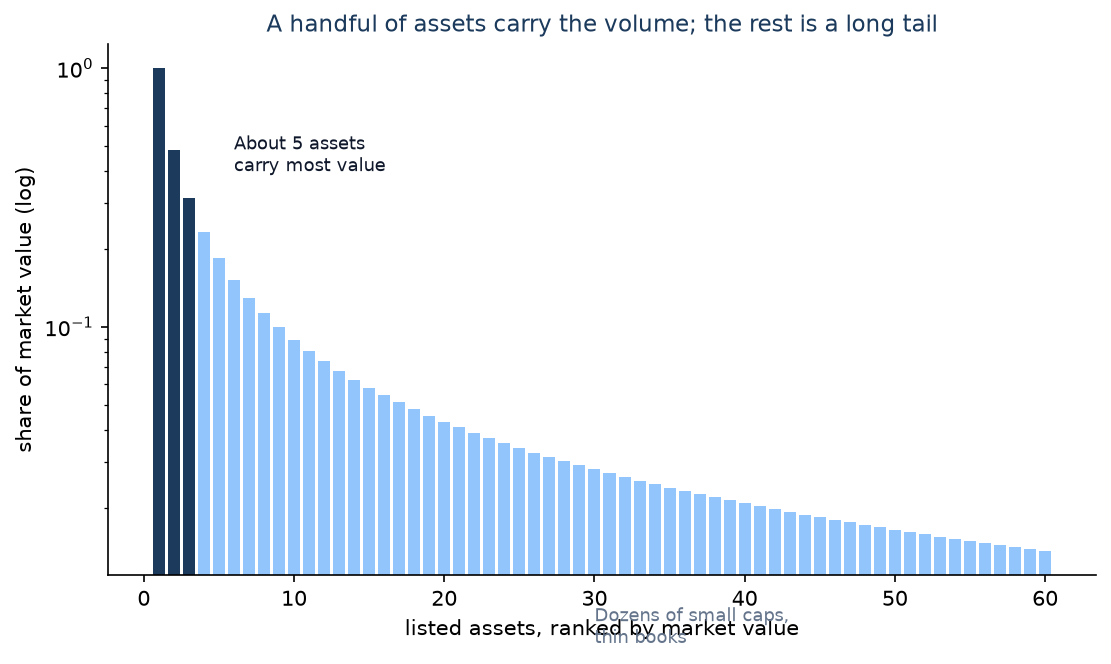
There are two honest reasons a venue would build its identity on the tail. The first is differentiation: the largest venues compete on liquidity for the top few hundred assets, and a venue that cannot win that fight can win a different one by being the place where the next thousand assets have a market. The second is revenue structure: a newly listed small token often generates fees and volume out of proportion to its size, because early trading in a new asset is active and the users are motivated. A listings business is a real business, and it is not a criticism to say so.
The cost is carried by the customer, and it shows up in three places. The first is research: a venue that lists thousands of assets cannot have vetted each one to the standard a short list would allow, so the diligence is pushed onto the buyer of the token. The second is quality: a long list includes assets that are illiquid, assets that are abandoned, and assets that are outright fraudulent, and the venue’s listing is not a statement that any particular one is sound. The third is the market itself, which is the subject of the next section.
What a thin market does to your price
A liquid market absorbs an order without moving the price; a thin market does not. On a listings-heavy venue, a large share of the listed assets trade in books that are shallow enough that a modest order can be filled at several prices, and the gap between the best price and the average price you actually pay is called slippage. It is invisible on a price chart and it is real money out of the order.
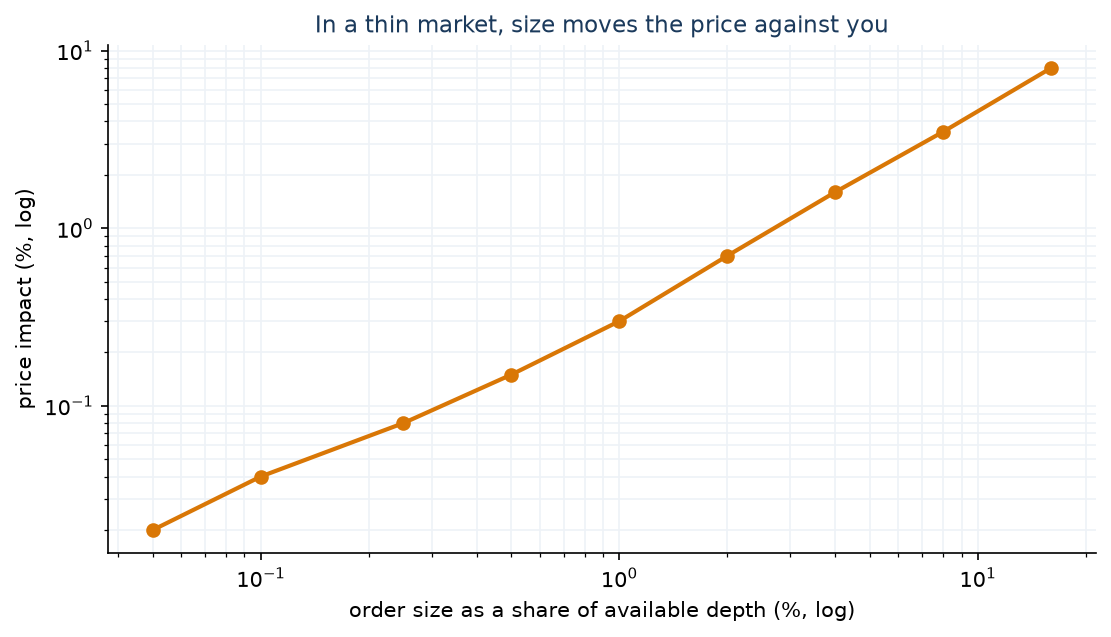
There are three practical consequences. First, the round trip costs more than the fee schedule suggests: if the spread is wide and the book is thin, you can lose several percent on the entry and several more on the exit before any move in the underlying. Second, the headline price on a chart may not be reachable at the size you want, so a token that “went up” may have gone up only on a very small quantity. Third, an illiquid asset is hard to exit in a hurry, which matters most when everyone is trying to exit at once, and a listing that is easy to buy is not always easy to sell.
None of this is a reason the venue should not list the assets. It is a reason a buyer should treat the depth of the order book as part of the price, and should size a position against the liquidity rather than against the conviction. On a listings-heavy exchange, the order book is the most important page and the price chart is the least.
The venue’s token and the surrounding ecosystem
Like its peers, Gate.io issues a token, and it does the same set of jobs: a discount on fees, a unit inside the surrounding ecosystem, and a way to link the customer’s attention to the venue’s valuation. The analysis is the one that applies to every native token in this industry. A discount paid in the exchange’s own token is a rebate received in exposure, because keeping the discount means holding the asset whose value depends on the venue’s health, so the token belongs in the same mental bucket as a balance on the exchange rather than in a separate one.
The surrounding ecosystem, including a chain and a set of launch mechanisms, adds a second layer of the same kind of risk: the value of an early-stage token depends on the success of a long project, and a listing is not a promise that the project will reach it. The useful discipline is to count the token and the platform balance as a single exposure to the venue, because in a stress event they move together.
Fees and the exit cost
The fee schedule is the familiar maker-taker structure with volume tiers, and the same caveat applies as everywhere: the headline rate is for a small account, the effective rate depends on how you trade, and the native token discount is exposure rather than a free lunch. What is worth more attention on a listings-heavy venue is a cost that a fee table does not show, which is the spread and the slippage discussed above. On a thin asset, the difference between the best bid and the best ask can be several times the trading fee, so the fee schedule is a small part of the true cost of a round trip.
The exit cost is the other number to weigh. Deposit and withdrawal terms, the listed assets that are supported for withdrawal, and the processing times are all part of the price of using the venue, and on a long tail some of the smaller assets may not be withdrawable to every network or may carry unusually high withdrawal fees. A position that cannot be moved off the venue cheaply is closer to a claim on the venue than to a holding in a wallet, whatever the label says.

The record, read as a pattern
The venue’s decade of operation is the most useful part of its record, because surviving several cycles is evidence of operational competence that a newer venue simply does not have. That history should be read as a pattern rather than a score. The pattern shows a venue that has kept operating through collapses in the wider market, which speaks to its own risk management, and it also shows a listings-first venue that has repeatedly brought to market assets whose quality varied widely, which speaks to the diligence burden it places on its customers. Both halves of the pattern are true at once, and neither cancels the other. Our framing of the general risk appears in ten checks a ranking cannot do for you and in the mechanics of exchange failure and the order of claims.
What “is Gate.io safe” really asks
The question again has several answers. The first is platform security: whether the venue’s keys and code can be attacked, and how it responds. The second is the legal status of a balance: whether it is segregated and how a court would treat a claim. The third is the venue’s operational resilience through a cycle, which the long history speaks to. The fourth is the safety of the assets it lists, which is emphatically not the venue’s job on a listings-heavy exchange, because the listing is a market and not an endorsement. The fifth is your own behaviour: how much you leave, how you size positions against liquidity, and whether you can leave when you want to.
The distinction worth keeping
Gate.io is an old, listings-heavy venue whose product is access to a tail of small assets that larger exchanges leave alone. The access is genuinely useful and the diligence is genuinely shifted onto the buyer. The order book, not the price chart, is where the true cost of a purchase lives, because a thin market charges a spread and a slippage that no fee table displays. The token is a position in the venue, not a separate asset. And a venue that has operated for more than a decade has demonstrated something a new venue has not, without demonstrating that it cannot fail.
What follows is not a verdict, and it is not advice to trade there or to avoid it. It is the recognition that the phrase “the exchange with the most listings” is a description of a business model rather than a claim about safety, and that the person who understands the model is the person who can decide, calmly and in advance, how much of it they want to use. For the mechanics behind any of it, the references below are the place to start.
How a listing actually gets made
A listing is a decision by a company, and understanding the decision is the fastest way to understand what a listing means. There are broadly three routes. The first is an application, where a project submits a token and the venue evaluates it on criteria the venue does not publish in full; the second is a paid arrangement, where a project pays a fee, often in tokens, for the listing; the third is a community mechanism, where holders vote with the venue’s own token or with a deposit. Many venues use a mixture, and the mix is a business decision rather than a consumer-protection one.
The consequence is that a listing carries less information than a customer assumes. It certifies that a project filled in a form and met a commercial threshold, and it does not certify that the token has a sound team, a real product, a credible token distribution or any prospect of liquidity. On a listings-heavy venue, where the volume of listings is the point, the threshold must be lower than on a venue that lists a handful of assets a month, simply because the same team cannot vet thousands of tokens to the same depth. The listing is a market, and the diligence is a cost the venue has chosen not to carry, which means it is a cost the buyer carries instead.
The research burden, and how to carry it
If the venue is not carrying the diligence, someone has to, and the practical version of that work is shorter than it sounds. The first question is the team: whether the people behind the token are identifiable, whether they have a history, and whether the project depends on one anonymous developer with a large share of the supply. The second is the distribution: how much of the supply the insiders hold, how it unlocks over time, and what happens to the price when a large unlock arrives. The third is the code: whether the contract has been audited, by whom, and whether it has any ability to mint unlimited supply, pause transfers or change the rules after launch.
The fourth question is the market, and on this venue it is the one that matters most. How deep is the order book, how wide is the spread, and how much can you buy or sell before the price moves? A token with a beautiful whitepaper and a shallow book is a trap whose trap is disclosed only in the order book, and the disclosure is in numbers rather than words. The fifth question is the exit: whether the token can be withdrawn at all, to which network, and at what fee. A position that cannot leave the venue is a claim on the venue, whatever the token is called.
The specific risks of an old venue
Longevity is a genuine asset and it is not a free one, and the specific risks of an old venue are different from the risks of a new one. The first is history: a venue that has operated for more than a decade has a record of every listing, every incident and every jurisdiction it has entered and left, and some of that record will be unflattering. The second is accumulated obligation: an old venue holds accounts, tokens and legal arrangements from earlier eras of the industry, and those carry their own exposure. The third is technical debt: a system that has been extended for a decade is not the same as one designed last year, and the operational risks of an old matching engine are not the same as those of a new one.
None of those is a reason to prefer a new venue, whose risks are simply different. The point is that age should be read as a specific kind of evidence, which is evidence about survival and operations, and not as a general certificate. A venue that has survived several cycles has shown it can keep running, and the same history that proves the competence also records the moments when the competence was tested. The useful move is to read the record as a pattern of what the venue does under stress, because that is the behaviour that will be repeated.
Frequently asked questions
Is Gate.io the oldest major exchange?
It has been operating since 2013, which makes it one of the longest-running venues still active and one of the few that has lived through several full market cycles. Longevity is evidence of operational competence, not a guarantee against failure.
Why does Gate.io list so many more assets than larger exchanges?
Because the long tail is its product. A venue that cannot win the liquidity fight for the top few hundred assets can differentiate by giving the next thousand a market, and newly listed small tokens generate fees and volume out of proportion to their size. The diligence that a short list implies is pushed onto the buyer.
Are the assets listed on Gate.io vetted?
A listing is a market, not an endorsement. On a listings-heavy venue the list is too long for the same depth of vetting a short list would allow, and it includes illiquid, abandoned and occasionally fraudulent assets. Treat the listing as the start of your own research rather than the end of it.
Why does the price I get differ from the chart?
Because the chart shows the last trade and your order walks the book. In a thin market a modest order fills at several prices, and the difference between the best price and your average fill is slippage. On small assets, the spread and slippage can exceed the trading fee many times over.
Can I always move a listed asset off the exchange?
Not necessarily. Some smaller assets are supported for withdrawal only on certain networks, and withdrawal fees on them can be high. A position that is expensive to withdraw behaves more like a claim on the venue than like a holding in a wallet.
Does a proof of reserves cover the assets I hold there?
It shows the asset side of the balance sheet at a point in time and says nothing about liabilities, so read it as half a document and combine it with segregated custody, audited accounts and a record of paying withdrawals under stress. The framework is set out in our explainer on exchange failure.
A note on the numbers in this article
This article deliberately avoids quoting specific listing counts, fee percentages and reserve totals. Listing counts change weekly, fee tiers change with promotions and token holdings, and reserve totals are published by the venue at intervals of its own choosing. What does not change quickly is the structure: a long tail of assets implies thin books, thin books imply spread and slippage, a listings business shifts diligence onto the buyer, a native token is a position in the venue, and the exit cost decides what you keep. Memorise the structure and verify the live figures at the source before you act.
Two things this article is not
The first thing it is not is a verdict on the venue. The long-tail model is a legitimate business that serves a real need, and the exchange that runs it has survived longer than most of its peers. The second thing it is not is a claim that a long tail is inherently bad. Access to early-stage assets is exactly what many participants want, and a venue that refuses to list anything outside the top hundred has simply made a different choice. The point of the analysis is narrower: a listings-heavy exchange sells access, the access has a cost measured in spread and slippage and diligence, and a customer who understands the cost can decide whether the access is worth it. On a venue where the selling point is the number of listings, the order book is the document that tells the truth, and the person who reads it before buying is the person the model rewards.
Sources and further reading
The failure mechanics referenced here are in what happens to your crypto when an exchange fails, and the general checklist is in ten checks a ranking cannot do for you. For the custody side, see the explainer on private keys and seed phrases and what a crypto wallet actually holds. The difference between a claim and a coin is developed in why a stablecoin is a receipt, and the structure of a decentralised alternative appears in our map of what DeFi reproduces.


[…] count. What you pay, if you trade the tail, is the thin book. I took that trade-off apart in our earlier piece on what a long-tail listings exchange costs you. Here I only want the […]