


A yield on a dollar token is a price, and like every price it is paid for something. The useful question about any quoted rate is not whether it is high but what the payer is buying with it, because the answer determines what happens to the rate when conditions change. Four sources exist, they behave differently under stress, and only one of them is genuinely free of risk — which is why that one is the one a holder is legally prevented from collecting.
That prohibition is the entry point to the whole subject rather than a footnote to it. The largest pool of income in this category is the interest earned on the reserves backing the tokens, and the framework signed into law in the United States in July 2025 requires issuers to hold those reserves in high-quality liquid assets while prohibiting them from paying yield to holders. Everything a holder can actually earn therefore comes from somewhere else, and the somewhere else is always a risk that somebody is being paid to take.
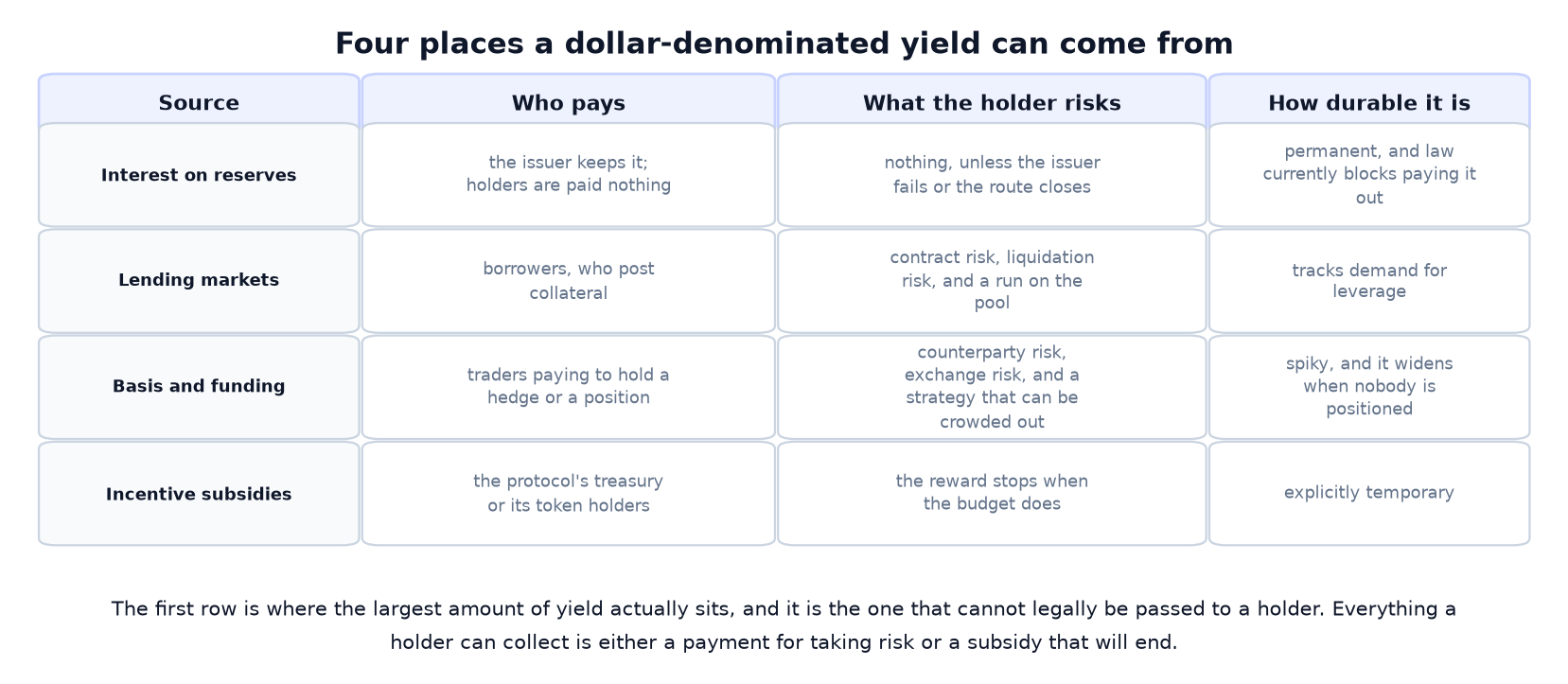
Source one: the reserve interest nobody is allowed to pay you
A dollar token is backed by a portfolio, and that portfolio earns income. The portfolio is short-term government bills and cash equivalents, so the income is a function of short-term rates, and it belongs to the issuer because the issuer owns the assets and the holder owns a claim on them. The arrangement is described precisely elsewhere in this market: the token is a liability that pays nothing while it sits, and the interest on the dollars behind it is the issuer’s revenue.
The prohibition on passing that interest to holders was not an accident of drafting. The intent is to keep a payment instrument from becoming an unregulated deposit product, and the reasoning is that a token which pays a floating rate and can be redeemed on demand is functionally a money market fund with fewer obligations attached. Making it illegal to pay the yield is the cleanest way to prevent that, and it has a visible consequence: competition among issuers moved to distribution, to fees, and to the rewards paid to the businesses that put tokens into circulation rather than to the holders themselves.
For a reader the conclusion is narrow and important. A rate that is being paid to a holder on a dollar token is never coming from the reserve. It is coming from one of the three sources below, each of which has a payer who can stop paying.
Source two: lending to someone who posted collateral
The second source is the oldest in the category and the easiest to describe. A pool holds dollar tokens, borrowers post collateral worth more than they borrow, and the interest they pay is distributed to the depositors in the pool. The rate is not set by an administrator; it rises as the pool’s available liquidity falls, because the protocol is trying to attract deposits and discourage further borrowing at the same time.
What the depositor is actually holding is a claim on a pool of over-collateralised loans, and the risks are the ordinary ones attached to that position. The collateral can fall faster than the protocol can liquidate it, which turns a fully secured loan into a partial one. The contract can have a flaw, which is a risk that has materialised repeatedly in this market and never in the collateral rules themselves. And the depositors are collectively exposed to a run: if enough of them withdraw at once, the pool’s liquidity is exhausted and the rate spikes rather than the withdrawal being honoured.
One feature distinguishes this source from the others in a way that matters during stress. The rate responds to demand for leverage, so it is highest exactly when the market is most euphoric and lowest when nobody wants to borrow. A falling rate on a lending pool is a statement about positioning rather than about the safety of the pool.
Source three: being paid to hold a hedge
The third source is a trade rather than a product. When the price of a token for future delivery is above the price for immediate delivery, a holder can buy the asset and sell the future, collect the difference as it converges, and repeat. The same logic applies to perpetual futures through their funding mechanism, where one side of the market pays the other periodically to keep the contract anchored to spot.
What the participant is being paid for is the service of taking the other side of somebody else’s hedge. A miner who wants to lock in a price, a treasury that wants protection, or a trader who is simply long and willing to pay for leverage all end up transferring income to whoever is willing to hold the offsetting position. The rate is therefore a measure of how eager one side is, and it can be positive, negative, or unavailable depending on which direction the market is leaning.
Three risks attach, and each has bitten in practice. The first is counterparty and venue risk, because the futures leg sits on an exchange that holds margin and can fail or freeze. The second is basis risk, which is the risk that the two legs do not converge as expected, particularly in the final hours. And the third is crowding: a trade that everyone runs becomes a trade whose spread is arbitraged away, and the strategies that survive are the ones with credit relationships and capital rather than the ones with a user interface.
Source four: a subsidy that will end
The fourth source is not income at all. A protocol with a treasury and a token can pay depositors to deposit, either by minting its own token as a reward or by spending assets it holds. The headline rate this produces is frequently the highest available in the market, and the reason is simple: it is a marketing budget with a number in front of it.
Two consequences follow. The first is that the rate is not a statement about the protocol’s ability to generate returns; it is a statement about its willingness to buy deposits. The second is that the reward usually arrives in the protocol’s own token, which means the depositor is being paid in something whose price is itself dependent on the subsidy continuing. When the budget is spent or the token falls, both the rate and the value of what was already received decline together.
None of that makes subsidies dishonest, and it does not make them unprofitable for participants who understand the schedule. It does mean that the highest number on any comparison page is the number most likely to disappear, and that a reader evaluating it should ask what happens on the day it does.
The same headline, three different bets
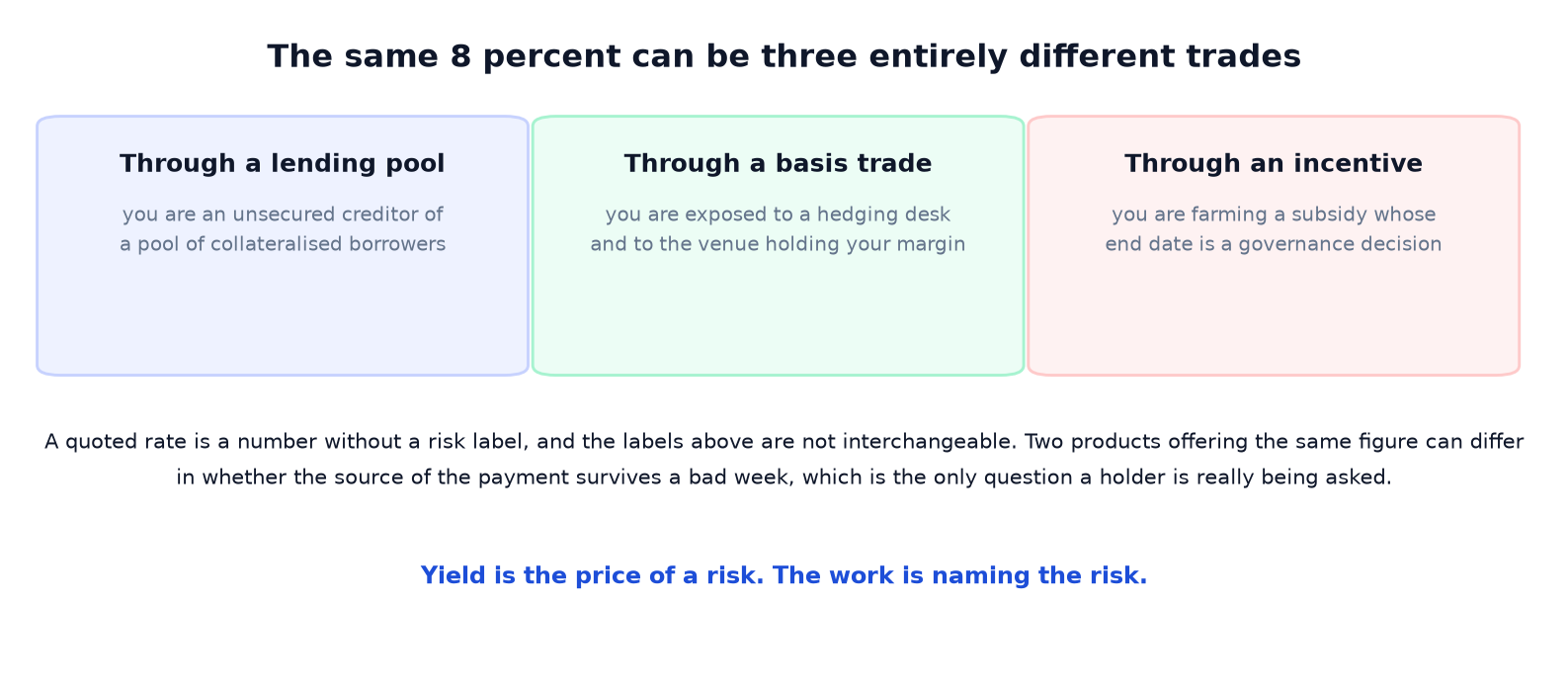
The comparison that matters is not between rates but between the risks behind them. A depositor in a lending pool is an unsecured creditor of a set of collateralised borrowers, with a contract in between. A participant in a basis trade is exposed to a hedging desk and to the exchange that holds the margin, with a strategy in the middle. A farmer of an incentive is exposed to a governance decision about a budget, with a token price attached.
Read that way, the question a holder should ask is not which rate is higher but which of those three positions they are willing to hold through a bad month. Each position has a scenario in which it loses money while the others do not, and the scenarios are not correlated: a sharp fall in the collateral’s price hurts the lending pool, a funding-rate reversal hurts the basis trade, and a treasury vote hurts the farmer. A portfolio of all three is diversified across the mechanisms even though all three are quoted in dollars.
Why a quoted rate carries no risk label
Two further features of the quoting conventions make comparison harder than it needs to be. The first is compounding: a figure described as an annual percentage yield already assumes that the rewards are reinvested continuously, which is an operation the holder may not perform, while an annual percentage rate assumes they are not. The difference between the two on the same underlying rate is real money.
The second is composition. A single number can include a base lending rate, a token reward, a temporary boost, and a referral bonus, with different expiries and different denominations, and the expiry dates are almost never printed beside the figure. A rate that is half incentive will halve on a date that is knowable and unstated, and a holder who discovers it afterwards has simply learned the definition the hard way.
Where the safe yield actually sits
The interest on reserves is real, and it is the one source in the category with no counterparty risk beyond the issuer itself and the custodian arrangement behind it. It is also concentrated by design: the issuers that hold the largest reserves earn the most on them, and the framework that governs the category ensures that this income stops at the issuer’s balance sheet.
For a holder the practical consequence is a trade-off that is rarely described as one. Holding the token and accepting no yield is the position with the fewest moving parts. Routing the same balance into any of the three mechanisms that pay a holder is a decision to take on a specific risk in exchange for a specific rate, and the decision is better made by naming the risk than by comparing the numbers.
The leverage loop, and why it looks better than it is
One structure deserves a section of its own because it is the mechanism behind the highest advertised returns in this market. A depositor who receives a receipt for a deposit can use that receipt as collateral to borrow, deposit the borrowed amount again, and repeat. Each turn adds yield and adds leverage, and the loop is functional and widely used.
What the loop does to risk is the part that gets left out. The position is now exposed to the collateral’s price, the borrowing rate, the liquidation thresholds of every protocol in the chain, and the liquidity of the receipt tokens at the moment of a forced sale. Those risks are correlated: a fall in the collateral’s value raises borrowing costs, triggers liquidations, and thins the market for the receipt tokens at the same time. The advertised rate is the sum of several protocols’ offers, and the quoted risk is the product of the conditions that would unwind all of them at once.
Where the regulation draws the line
The prohibition on paying holders is the clearest boundary in the category and it produces a visible pattern in product design. Issuers that want to pass some of the reserve income along route it to distributors rather than to holders, as equity, as rewards for driving supply, or as a fee share. Products that want to pay a holder a rate have to be structured as something other than a payment token, which is why the “yield-bearing” category is legally closer to a fund share than to a dollar bill.
That boundary is worth understanding because it determines what a holder is buying. A token whose terms describe it as a payment instrument pays nothing and can be redeemed one for one. A product that pays a floating rate is offering something a regulator may treat as a security or a fund interest, with the disclosure obligations that follow. The interface looks the same; the category does not.
Four checks before chasing a rate
Four questions reduce the field to a comparable set. What is the source of the payment — lending interest, a hedge, or a subsidy? Is the reward paid in the same asset or in a token whose value depends on the arrangement continuing? Who is the counterparty, and is the collateral or the margin held somewhere the holder can verify? And what is the exit: can the position be redeemed on demand, in what size, and through what gate?
The answers are published, though rarely together. A rate page that shows the source, the denomination of the reward, the venue holding the collateral, and the withdrawal terms is describing a product honestly. One that shows a number and a compounding toggle is not hiding anything on purpose, and it is also not telling a reader the only thing that matters.
Why the highest rates are usually the newest
Rates cluster in the same direction as age and size. A large, old pool of collateralised loans earns the market’s going rate for leverage. A new protocol with a treasury and a small user base pays above that, because the only way to acquire deposits quickly is to buy them. When a high rate appears next to an unfamiliar name, the correct reading is not that the operator has found a better investment; it is that the operator is paying an acquisition cost and has chosen to express it as a yield.
That framing makes the comparison between two rates a comparison between two businesses rather than between two numbers. One is mature and earns what the market pays for risk; the other is young and is spending to be seen. Both can be reasonable places to hold dollars. The mistake lies in reading the second as a better version of the first, which is precisely the reading that an incentive-based rate is designed to invite.
How a lending rate is actually set
The rate a depositor earns in a lending pool is not negotiated and does not track a policy rate. It is produced by a curve that links the interest rate to utilisation, which is the share of the pool that has been borrowed. At low utilisation the rate is near a floor that exists to make holding the deposit pointless and lending it worthwhile. As utilisation rises the rate climbs, slowly at first and then steeply once the pool approaches full borrowing.
The shape of that curve explains most of what a depositor observes. A quiet pool pays almost nothing because nobody wants to borrow. A busy pool pays well because the alternative for a borrower is being unable to borrow at all. And a pool near its ceiling pays a rate that looks like an opportunity and is actually a warning, because the last increment of liquidity in a pool is what allows the first depositor to leave, and a pool that is fully borrowed cannot process a withdrawal without somebody else’s debt being repaid first.
Two practical readings follow. A rate that spiked is usually the result of borrowing demand rather than of a change in risk, and a rate that fell is usually the result of repayments rather than of a deterioration. The utilisation figure, which is published alongside the rate, is the more informative of the two.
The funding rate, without the jargon
The third source of yield is the most confusing to read about and the simplest in principle. A perpetual futures contract has no expiry, so the exchange needs a mechanism to keep its price near the spot price. It uses a periodic payment between the two sides: when the contract trades above spot, the side that is long pays the side that is short, and when it trades below, the payment runs the other way.
A holder who buys the asset and sells the perpetual collects that payment when it is positive, which is most of the time in a market where leverage demand is common. The size of the payment is a direct measure of how much one side of the market wants exposure relative to the other, and it can be negative, which means the trade loses money while it is held and has to be closed or financed.
For a reader evaluating any product that advertises a yield from this source, three questions are worth asking. Which exchange is the position on, and what are the rules for margin and settlement there? What happens to the position if the funding rate stays negative for a month? And what is the venue’s record on withdrawals during stress? The answers describe a counterparty exposure that no rate page mentions, and it is the exposure that matters when the rate is at its highest.
Duration, and why this is not a savings account
The comparison a holder naturally reaches for is a deposit, and the analogy fails on the one property that matters most: a deposit promises a fixed return for a stated period, and a yield-bearing dollar position promises neither. The underlying arrangement can change, the source of the payment can stop, and the terms under which the position can be exited are set by a protocol rather than by a bank branch.
The piece that most surprises holders is that the three properties of safety, yield and immediate liquidity do not coexist. A position that pays a rate derived from lending is available to withdraw only to the extent the pool is not borrowed. A position built on a basis trade has to be unwound in two markets at once. A position farming an incentive depends on a budget. In each case, the yield exists because somebody has accepted a condition on the exit, and the condition is the price.
One accounting consequence is worth stating because it is easy to overlook. A reward paid in the protocol’s own token is income at receipt in most tax systems, regardless of what the token does afterwards, and it may have to be reported in a different line from interest earned in the same asset. The practical effect is that a high advertised rate in a volatile token can produce a tax liability larger than the cash actually collected, which is a fact that no rate table conveys.
A rate is not a return
Two adjustments separate the number on a page from what a holder keeps. The first is compounding: a figure quoted as an annual yield assumes that every payment is reinvested immediately, which requires a transaction and a fee each time. A holder who collects and holds instead of reinvesting will earn less than the quoted figure, and the difference grows with the frequency of the payments.
The second is the fee structure of the vehicle offering the rate. Management fees, performance fees and withdrawal charges are deducted inside the product, and a rate quoted gross of them is a statement about the strategy rather than about the holder. For a vault that charges a performance fee on yield, the figure a depositor experiences is the quoted rate minus a share of itself, and there is no standard for whether the quoted number reflects that.
The practical consequence is that comparison shopping on rate alone selects for the product that quotes most flatteringly rather than the one that pays most. Comparing two products properly requires the source of the yield, the denomination of the reward, the fee schedule and the exit terms, and those four items are the whole of the analysis. A rate page that provides them is doing a reader a favour; one that provides only a rate is asking the reader to guess.
Yield is the price of a risk
Every dollar-denominated rate in this market traces to a payer, and the payer is either an issuer keeping interest that the law prevents it from sharing, a borrower posting collateral, a hedger paying to lay off exposure, or a treasury buying deposits. The first is not available to holders, the second and third are payments for carrying risk, and the fourth has an end date that the marketing material tends to leave out.
The practical conclusion is a rule about reading rather than about investing. A rate is a price, a price implies a payer, and a payer implies a risk being carried by somebody. The only genuinely free yield in the category is the reserve interest, and the reason holders do not receive it is not an oversight to be worked around: it is a deliberate boundary that also happens to be the cleanest description of what a dollar token is.


