


An airdrop is usually described as a gift, and it is not one. It is a distribution mechanism in which a project allocates tokens to a set of addresses according to rules it publishes in advance, in exchange for something it wants: attention, usage, holders who will vote, or the appearance of a community that owns the network rather than a company that sells it. The recipient’s side of the trade is less obvious, which is why it is worth stating: what is being paid is time, fees, attention, and in the better-designed versions, real risk.
Understanding the mechanism rather than the giveaways is what makes the category legible. Every distribution is a rule about who qualifies, and every rule produces a predictable behaviour among people who want the tokens. The history of the last several years is largely a story of projects writing a rule, watching what it produced, and writing a different rule next time. The rules have moved from snapshots toward risk, and the reason is instructive.
What an airdrop actually is
Mechanically the operation is simple: a contract holds an allocation, an address proves it qualifies, and the tokens are transferred or unlocked. The complexity is entirely in the word “qualifies”, which is a specification that the project writes and that everyone else reads as a puzzle to be solved.
Four families of distribution exist in practice. A one-time snapshot rewards whoever held or did something before an announced date. A behaviour threshold rewards whoever did enough of something, measured on chain. A task list rewards whoever completes named actions on the project’s own product. And a commitment distribution rewards whoever is willing to lock, stake or hold through a period, which is the newest family and the one that asks the recipient to put capital at risk.
None of the four is generous or stingy in itself. Each is an attempt to buy a specific kind of participant, and the success of the attempt is measured not by how many addresses claimed but by how many of them were still there a year later, which is a statistic no announcement tends to publish.
What the project is buying, and what it is paying with
The stated motive is usually decentralisation, and the operative motive is customer acquisition. Paid marketing for a new financial product is expensive, slow and largely wasted; a token allocation converts directly into addresses holding a balance, and a balance is the precondition for every metric that follows. That is a real economic function rather than a cynical one, and it explains the size of the budgets involved.
The payment is dilution. Tokens distributed to new users reduce the share of the network held by existing holders, which makes a distribution a transfer from the current owners to a set of intended future ones. Whether that transfer creates value depends entirely on what the recipients do: if they become users, the dilution bought growth, and if they sell on the first day, it bought a headline number three months late.
The accounting version of that is worth writing down. A distribution funded from a treasury with no product is a transfer of value from holders to claimers. A distribution funded from a treasury attached to a product that the recipients then use is marketing expenditure paid in equity. The same transaction, two different outcomes, and the difference is not visible on the day the tokens move.
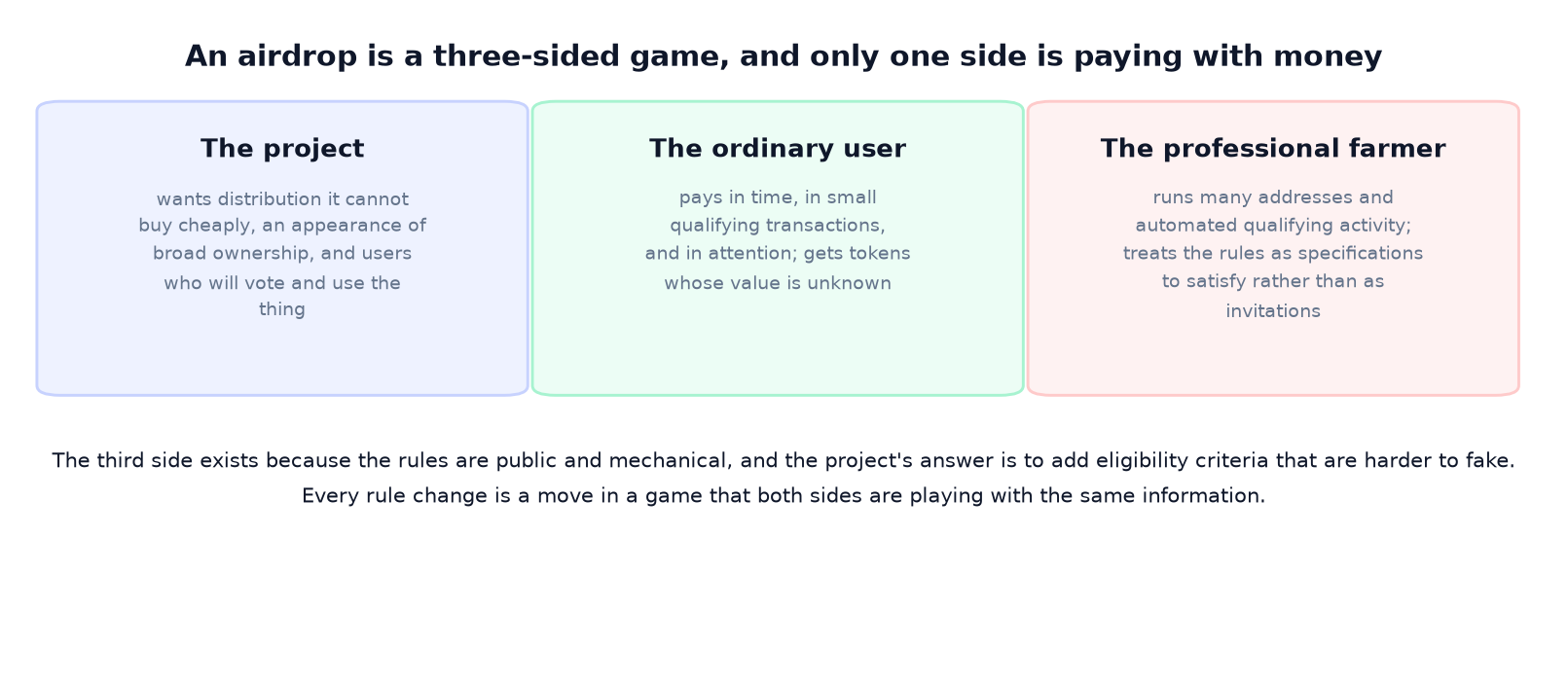
The recipient’s side of the trade
For an ordinary user the cost is not the token, which is free, but the activity required to qualify. That activity is usually a set of transactions that cost fees, plus the time to understand a specification, plus the attention to follow announcements, plus the risk that the allocation is worth nothing when it arrives. In the versions that require locking capital there is also the cost of not being able to use that capital elsewhere.
Three properties make the arrangement worse than it looks. The value of the reward is unknown at the time the work is done, so the recipient is working for an unpriced instrument. The rules can change, and projects have narrowed eligibility after the fact. And the work performed to qualify is often a transaction the user would not otherwise have made, which means the entry price includes a purchase made for the wrong reason.
Described honestly, a task-based airdrop is an unpaid internship with a lottery ticket attached, and a stake-based one is a bond purchase with an option on a bonus. That is not an argument against participating; it is the description that makes participation a decision rather than a reaction.
The professional response, and why it is inevitable
Because the rules are public and mechanical, a class of participant emerged that treats them as a specification to satisfy. The tools are ordinary: many addresses controlled by one party, automation that performs qualifying activity across all of them, and a division of labour in which some participants only supply capital and others only perform the work.
This is usually described as abuse, and the more accurate description is that it is the equilibrium of the game as written. A rule that can be satisfied mechanically will be satisfied mechanically, at scale, with a cost measured in fees. The project’s counter-move is to design criteria that are expensive to fake, and that is exactly the direction the rules have travelled.
The four rules, and what each one produces
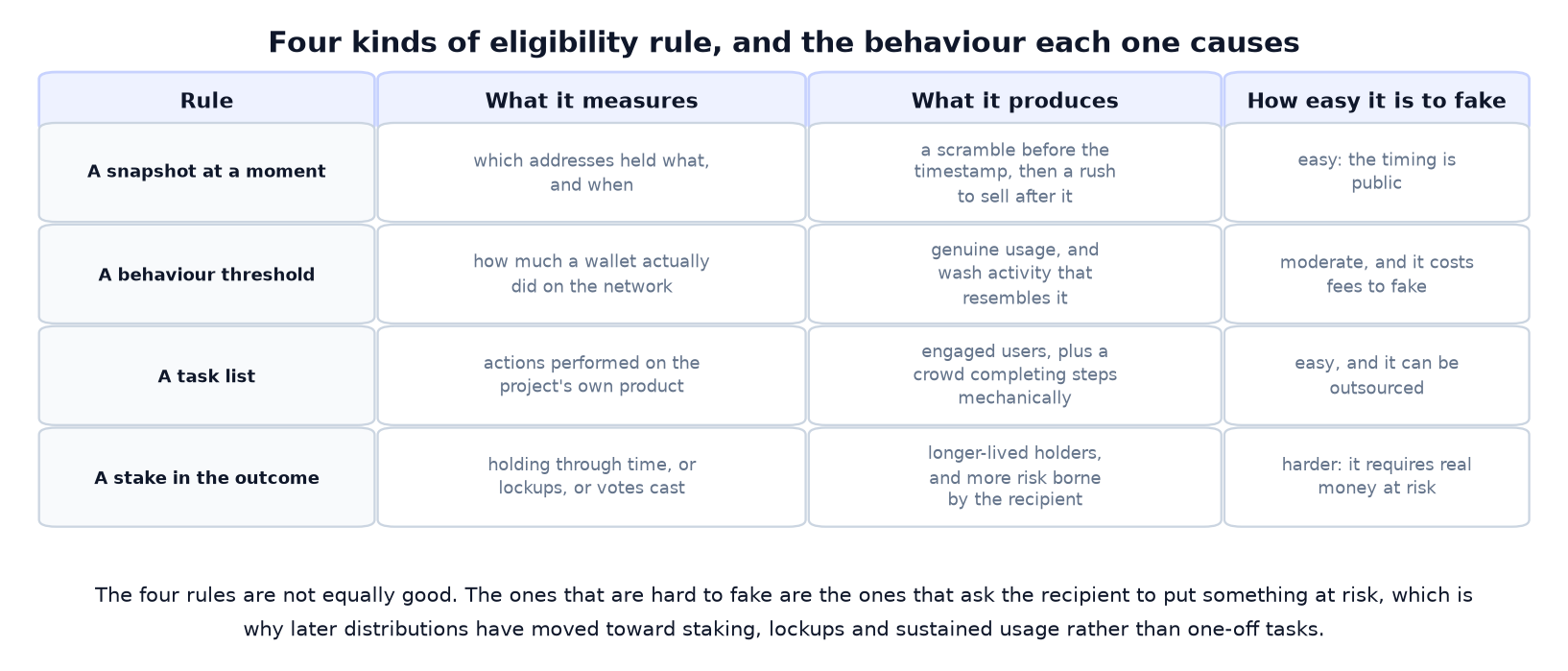
A snapshot is the easiest rule to write and the easiest to game. Because the date is announced or discoverable, capital arrives before it and leaves after it, and the pattern shows up in the price as a rise into the timestamp and a fall in the days following the claim. The distribution still produces holders on the date, which is what many projects are measuring.
A behaviour threshold is harder to fake and costs fees to satisfy, which makes it a genuine filter against the laziest participants. Its weakness is that the cheapest way to clear a threshold is often activity with no economic purpose, so the network gains transactions rather than users, and the metric that improves is the one being measured rather than the one that mattered.
A task list produces exactly what it specifies: a set of completed steps. Whether the person behind them cares about the product is untestable from the outside, which is why task-based distributions tend to produce high claim rates and low retention, and why the professional participants are most comfortable with them.
The commitment family is the newest and the most revealing. Asking a recipient to lock tokens, stake, or accept a vesting period does two things at once: it makes the reward contingent on staying, and it makes faking the participation expensive because it requires capital to be genuinely at risk. The cost is that such rules favour whoever has capital, which is the opposite of the original intent, and every project has to choose between a distribution that is hard to game and one that reaches people without money.
Sybil defence, and its uncomfortable trade-off
The detection methods are unremarkable and effective in the aggregate. Addresses funded from one source cluster together. Addresses that perform the same sequence of actions at the same time cluster together. Addresses whose balances move in the same direction on the same days cluster together. Analysis of those patterns identifies farming with reasonable precision, and the same analysis identifies ordinary users with reasonable imprecision.
That imprecision is the trade-off. Every filter strict enough to catch professional farmers also catches some real participants, and the cost of a false positive falls on a user who did exactly what the project asked. Projects manage it by weighting the criteria toward capital and tenure, which filters farmers and filters poor users at the same time.
There is no version of this that resolves. A distribution that cannot be gamed is one that requires something expensive, and anything expensive excludes the people a distribution is supposed to reach. Recognising the trade rather than pretending it away is the most useful thing a reader can take from the last five years of these events.
What happens when the tokens arrive
The claim itself is a transaction that costs a fee, and on a popular day it competes with every other claim, which means the first minutes are a congestion event in miniature. Recipients then make one of three choices: sell, hold, or use the tokens in the product that issued them, and the aggregate of those choices is a supply shock whose size is known in advance by everyone.
That predictability produces a pattern that recurs across distributions. Tokens that were never designed to be held are sold quickly by recipients who value the currency more than the governance, and the selling pressure is concentrated in the days around the claim rather than spread across the following year. Projects have responded by vesting the allocation over months, which removes the cliff and converts one large shock into a schedule of smaller ones.
The second-order effect is the one worth watching as a user. A vesting schedule publishes the dates on which supply will increase, and those dates are the only foreseeable supply events in the calendar of a young token. They are also the reason a distribution can raise the price of a token before it exists: the market prices the expectation of future buyers rather than the arrival of past ones.
The tax and legal layer
Two non-technical facts decide the real value of a distribution to its recipients. The first is taxation. In the United States the tax authority has indicated that receiving tokens in this way is generally income, measured at fair value when received, which means a recipient can owe tax on a position that has since fallen. Other jurisdictions differ, and the difference between income and capital gain treatment can exceed the value of the tokens for some recipients.
The second is classification. A distribution can be read by a regulator as a transfer of a security or as a marketing expense, and the two readings imply different obligations for the issuer and different risks for the recipient. Nothing about the mechanism changes with the reading; only the consequences do.
Telling a real one from a scam
The distribution mechanism is also a popular lure, and the counterfeit versions follow a small number of shapes. A message arrives through social media or a search advertisement claiming that an allocation is available, and the page asks for one of three things: a payment described as a gas or unlock fee, the signing of an approval that grants access to a balance, or the entry of a seed phrase into a website.
Three rules cover nearly every case. The only source that counts is the project’s own published channel, reached by typing the address rather than by clicking an advertisement. A legitimate claim never requires a payment beyond the network fee, and never requires permission to move tokens the user already holds. And any page that asks for a phrase is a theft attempt, because a phrase is the asset rather than a credential.
The third of those deserves emphasis because it is where the largest losses occur. An approval signed for a fake claim is indistinguishable from an approval signed for a legitimate one, and the tokens it exposes are not part of the airdrop at all. The mechanics of approvals and pointers are worth understanding precisely because the reward being advertised is never the thing at risk.
The mechanics of a claim
The technical implementation of a distribution is worth understanding because it determines what a recipient can and cannot do. For a large list, the project publishes a single root value derived from all qualifying addresses and amounts, and each recipient receives a proof that their address belongs in the set. The claim contract verifies the proof and pays out, which means the full list never has to be stored on the chain and the cost of the distribution is a hash rather than a database.
Three consequences follow. Eligibility is fixed at the moment the root is published, so an address that qualifies and then moves its assets is still eligible, and one that acquires the qualifying activity afterwards is not. Claiming is a transaction, so it costs a fee and competes for block space on the day it opens. And unclaimed balances stay in the contract, which means a project that publishes a short window is holding assets that nobody collected, and a project that publishes no deadline is holding them indefinitely.
That last detail produces a quieter outcome than a headline default: the distribution’s success is measured on the day it opens and its true rate is measured months later, when the unclaimed share becomes visible in the contract. The difference between the two figures is a reasonable proxy for how many recipients found the process, cared about the outcome, or were able to pay the fee.
How the rules evolved, in four phases
The history of these distributions is short and unusually legible, because every phase was a reaction to what the previous one produced. The first phase was free allocation to anyone who showed up, which required no work and produced no lasting engagement. The second phase rewarded past behaviour without announcing it in advance, which is the design that generated the most goodwill: a project looked through its own history, found the addresses that had used the product before there was anything to gain, and paid them.
The third phase turned the rules into a task list as projects tried to direct the activity rather than reward it, and that is the phase that produced the professional farmer at scale, because a published checklist is a specification. The fourth phase, which is where the field sits now, asks the recipient to accept a commitment: hold through a period, stake, vote, or accept a vesting schedule.
Read as a sequence, the phases describe a search for a rule that selects for the participant the project actually wants. Each design worked until it was gamed, and the response was to raise the cost of faking participation until the cost excluded the participants who had the least to spend. That is a real trade-off rather than a bug, and the projects that acknowledge it openly tend to be the ones whose distributions are still discussed favourably years later.
What a recipient can and cannot compute
Before participating, some parts of the calculation are available and some are not. The costs are computable: the fees required to perform the qualifying activity, the fees to claim, the capital that has to be locked and for how long, and the tax that follows the receipt in most jurisdictions. The rules are also available, which means the probability of qualifying can be estimated rather than guessed.
What cannot be computed is the value of the reward, because the token does not trade yet and its eventual price depends on supply that has not been issued. A recipient is therefore accepting a known cost for an unknown benefit, which is the same structure as any early-stage work and is worth describing that way rather than as free money.
The practical consequence is a rule about how to decide. Compare the cost against a conservative estimate of the reward rather than against the optimistic one that circulates in the period between the announcement and the claim, and treat the difference between those two estimates as the thing the market is being asked to price. A distribution that only makes sense at the optimistic valuation is a distribution that has already borrowed its returns from the future.
Two designs that aged well, and two that did not
The distributions that are still spoken about favourably have a property in common: they rewarded behaviour that had already happened, and they published the reasoning alongside the list. A project that searched its own history for addresses that had used the product when there was nothing to gain, and then explained the criteria in detail, bought two things at once. It acquired users who had already demonstrated an interest, and it earned a reputation for treating its early participants as the reason it existed.
The designs that aged badly failed in one of two ways. Task lists produced claim rates near the total and retention measured in weeks, because the activity being rewarded was the completion of instructions rather than the use of a product. And opaque criteria, even when generous, produced lasting resentment among the addresses that were excluded without explanation, which is a cost that does not show up in any metric the project tracks.
The pattern suggests a rule that costs nothing to follow. Whatever rule a project chooses, it should be published before the activity happens rather than after, and the reasoning should be stated. A distribution is a statement about what the project values, and the participants read it as one whether or not anyone intended them to.
What recipients do afterwards
The distribution is over when the tokens arrive, and the interesting measurement starts then. Recipients make one of three choices: sell, hold, or use the tokens inside the product that issued them. The proportion matters more than the total, because a distribution that produces sellers has bought a temporary price effect and a permanent dilution, while one that produces users has bought a reason for the token to exist.
Retention is the figure that no announcement publishes, and it is available to anyone with a block explorer. An address that received tokens and still holds them a year later is a different outcome from one that received and sold in the same week, and the count of each is visible in the balances. The reason the number is rarely discussed is that the second group is usually much larger, and the reason it is worth checking is that it describes the actual return on the project’s marketing expenditure rather than the headline result of it.
A distribution is a rulebook, and the rules keep changing
An airdrop is a specification for who a project wants to own it, expressed in tokens. Read that way, the history of the last several years is a sequence of attempts to write a specification that selects for the intended participant: snapshots selected for whoever was already there, behaviour selected for anyone willing to spend fees, task lists selected for anyone willing to follow instructions, and commitments selected for whoever has capital to lock.
Every one of those rules produced the behaviour it invited, and every project discovered that the behaviour it invited was not the behaviour it wanted. The honest summary is that a distribution reveals what a project is willing to pay for and that the market reveals, some months later, whether it got it. For a recipient the useful conclusion is narrower and immediate: what is being offered is not free, what is being asked for is usually activity, and the version that asks for a seed phrase or an approval is not a distribution at all.


