


When a legislature fails to pass something and an industry still ends up regulated, the regulation arrives on a calendar rather than in a vote. That is the situation in the United States at the start of October 2026. The market-structure bill died in the Senate in mid-September, and within a fortnight two agencies had sent rule drafts to the White House, two separate comment periods were running with closing dates in the same week of October, and a stablecoin framework with a statutory effective date was being implemented by three regulators at once. Nobody voted for any of it.
The calendar is therefore the most useful document in this market, and it is also the most ignorable, because its entries are procedural and none of them produces a headline as satisfying as a failed vote. What follows is that calendar, date by date, with what each date actually decides and how reversible each decision is. The distinction matters more than the politics: a rule written by an agency can be rewritten by the next administration, while a statute needs another statute, and the two are being treated as equivalent in most coverage of the industry.

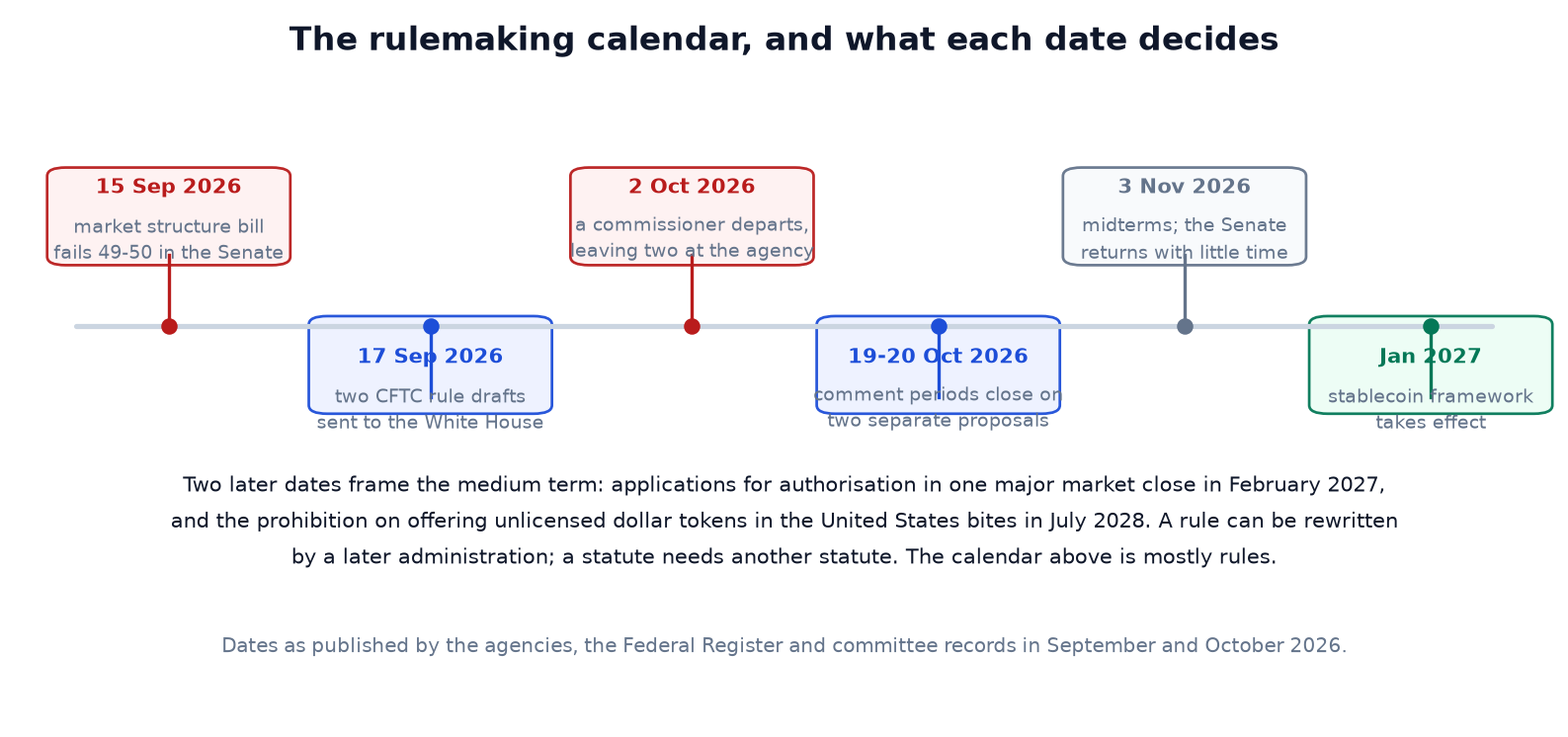
15 September: the bill dies, and the path it closed
The Digital Asset Market CLARITY Act failed a procedural vote in the Senate by 49 to 50, eleven votes short of the threshold needed to open debate. The tally was not along party lines alone: four members of the majority party voted against it, and one of them switched at the last moment specifically to preserve the ability to bring the bill back, which explains why it remains on the calendar while being effectively dead for the session. The Senate recessed at the start of October and returns only after the midterm elections in November, which leaves almost no window for revival in this Congress.
Three disputes kept it from moving, and all three are instructive about what the bill was actually about. The first was ethics language covering the officeholder’s own digital asset holdings. The second was the treatment of stablecoin yield, which is the question that also determines whether a dollar token can compete with a bank deposit. The third was the set of protections for developers of decentralised software against liability for what third parties build with their code. A prediction market that prices the bill’s passage put the odds near one in eight after the vote.
What the failure closed was the legislative path to a durable answer on a single question: whether spot markets for these assets are supervised at the federal level, and by which agency. A statute would have settled it. Without one, the question is being answered by rules, guidance, exemptive orders and litigation, each of which has a different lifespan, which is the theme of the rest of this article.
17 September: the futures regulator moves first
Two days after the vote, the Commodity Futures Trading Commission sent a pair of rule drafts to the White House budget office for interagency review — one on crypto asset transactions and one on crypto asset markets. The agency’s chair described the position bluntly, saying it was time to move and that existing statutory authority was sufficient to write market-structure rules without new legislation, while also acknowledging the limit: the agency cannot regulate spot markets absent a statute.
The drafts describe a structure in which specialised venues would be recognised as a new category of contract market, which would allow leveraged trading and continuous on-chain operation, alongside other priorities including agentic and algorithmic market design. A week later the agency published updated guidance on tokenised collateral and blockchain recordkeeping, which is the unglamorous work that determines whether a regulated institution can hold a token on its balance sheet and use it as margin.
The two agencies are also coordinating through a joint framework that sorts digital assets into five categories, from digital commodities at one end to digital securities at the other, building on a joint interpretive statement issued in March. That taxonomy is the most consequential piece of paper in the whole sequence, because it determines which regulator a given token belongs to before any rule is final. It is also, being an interpretation rather than a rule, the most easily revised.
2 October: the commission room empties
The same week brought a change that affects not the content of the rules but the process that produces them. One of the two agencies lost a commissioner, leaving it with two members; the other has been operating with a single chair since a departure at the end of 2025. Accounting for a seat that was already vacant, the two agencies together have around seven empty positions, which means roughly three people are overseeing an industry whose total market value is measured in trillions.
A thinner commission changes the character of rulemaking rather than its direction. Decisions are faster because there are fewer people to persuade, and the scope for exemptions and guidance expands because such instruments often do not require a full vote. The cost is durability: a rule written by two commissioners is easier to unwind than one written by five, and an industry that organises its compliance around a thin commission is placing a bet on the composition of the next one.
This is the part of the calendar that participants consistently underprice. The dates are fixed, but the people who implement them are not, and every argument about the substance of a rule is also an argument about who will be in the room when it is finalised.
19 and 20 October: the comment periods close
Two comment windows close in the same week, and they are the only formal opportunity for anyone outside the agencies to change the text.
| Proposal | What it would do | Comment window |
|---|---|---|
| Securities regulator’s exemptive framework for crypto assets | An exemption for small raises, a two-tier fundraising exemption modelled on the existing framework for smaller issuers, new filing forms, and a conditional safe harbour for tokens that stop being investment contracts | Closes 20 October 2026 |
| Treasury implementation of the stablecoin statute | Defines when a payment stablecoin is issued, offered or sold in the United States, which determines who needs a licence | Closes 19 October 2026 |
| Innovation exemption for tokenised listed equities | Permits trading of tokenised versions of listed stocks, in a phased list of symbols with volume caps, for a limited period | Issued 17 September 2026 |
The exemptive framework is the one worth understanding in detail, because it is a substitute for the bill that failed. It would create a narrow exemption for small raises with a ceiling in the low single-digit millions over several years, permit general solicitation, and add a larger two-tier fundraising path with ceilings of roughly twenty and seventy-five million dollars per year and ongoing reporting on new forms. It also proposes a conditional safe harbour under which an issuer can file a statement that an investment contract has ceased to exist, and it would preempt state registration requirements for offerings that qualify.
The preemption point is where the fight will be, and the reason is structural rather than doctrinal. State securities regulators lose authority under a federal exemption, and the state attorneys general who have been the most active enforcers against digital asset businesses are the same parties whose jurisdiction is being narrowed. The comment file for that proposal will be the most informative document published in this market this quarter, and it is public.
January 2027: the stablecoin framework arrives
Away from the capital markets debate, one statutory deadline is not optional. The stablecoin framework signed in July 2025 takes effect on 18 January 2027, and three regulators are writing the implementation in parallel: the central bank has proposed full-reserve backing rules plus capital and risk-management standards, the banking regulator has committed to finishing its implementing rule by November, and the Treasury is defining what counts as offering or selling a payment stablecoin in the United States.
The licensing picture has started to consolidate ahead of the deadline. One issuer holds the first final national trust bank charter, and conditional approvals have been granted to a set of exchanges, custodians and payment companies. Seven agencies missed an earlier one-year rulemaking deadline, which is why the work is compressed into the months immediately before the effective date — a pattern worth remembering, because it means the rules that matter will be finalised with less notice than the statute that required them.
The date that follows matters more for the medium term than for next year. A prohibition on offering or selling unlicensed dollar tokens in the United States takes effect in July 2028, which gives the current set of issuers two years to obtain licences or restructure. That is the only entry on this calendar with a hard cliff attached to it rather than a window.
Four instruments, ordered by how hard they are to undo
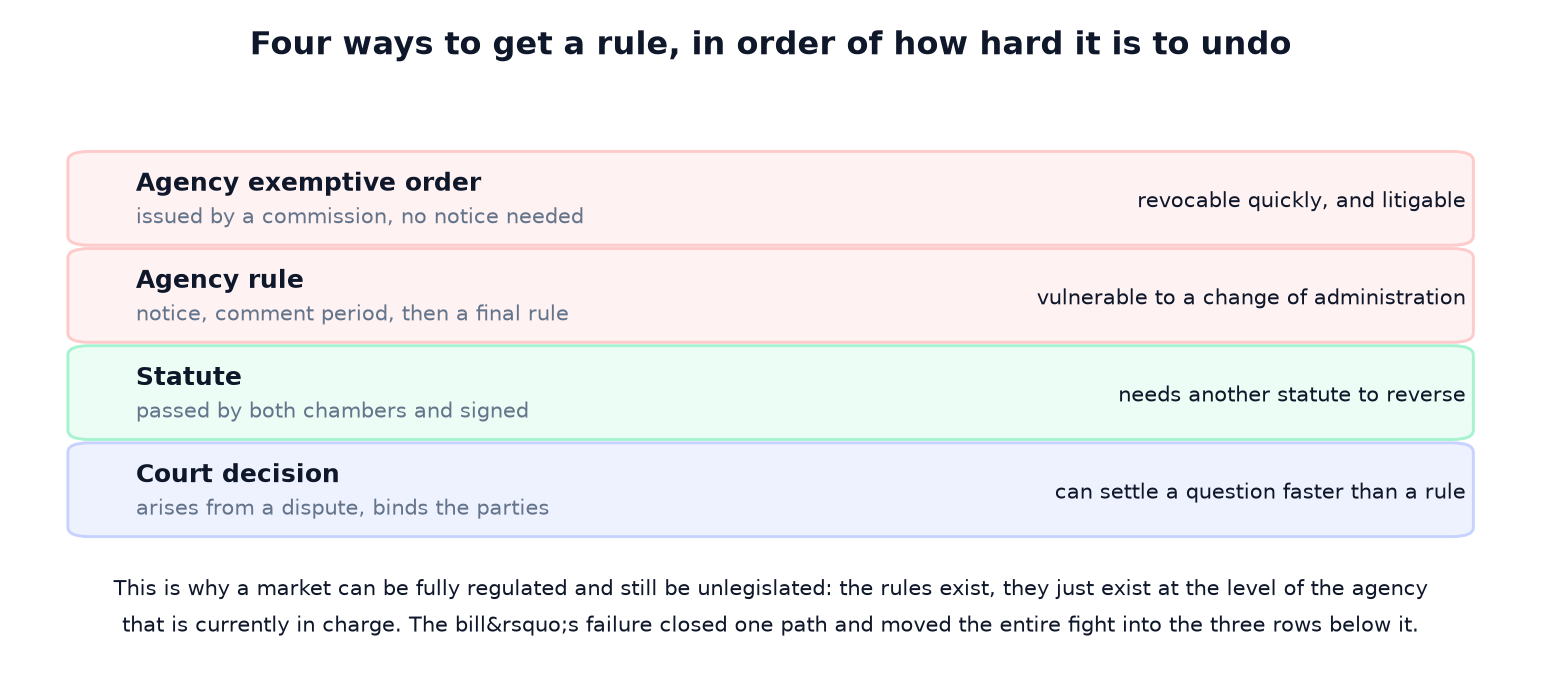
The hierarchy in that diagram explains most of what looks contradictory in the news. An exemptive order can be issued without notice and withdrawn the same way, which is why the innovation exemption for tokenised equities is best understood as a five-year experiment ending around 2031 rather than as a settlement. A rule requires notice and comment and survives until a new administration decides to reopen it, and agency action faces a higher bar for deference after recent judicial doctrine changed how much weight courts give to an agency’s reading of an ambiguous statute.
A statute is the only durable instrument, and the bill that failed was the attempt to produce one. Court decisions occupy a fourth position that is neither durable nor quick: they settle a specific question for the parties involved and create pressure elsewhere, which is what happened when an appellate court ruled in late September that sports event contracts are not swaps, contradicting the position the derivatives regulator has taken in other circuits.
State law adds a fifth layer that is easy to miss. Two statutes signed in California in late September, one barring public officials from issuing meme tokens and one on money laundering, show the pattern: state legislatures can act on narrow questions while federal legislation is stalled, and their work is not touched by an agency exemption unless the exemption preempts it.
Five sentences in a proposal that decide the outcome
A rulemaking proposal runs to hundreds of pages, and the parts that determine what a business can do are five short provisions: when the obligation begins, who and what it covers, what the limits are, whether the instrument expires, and whether it displaces state law. The exemptive framework now open for comment is a useful case because all five are visible in it, and because two of them are the reason the proposal matters more than its size suggests.
The limits are the least controversial part. A startup exemption would permit raises up to a ceiling in the low single-digit millions over several years, on a one-time basis, without exclusivity, and it would allow general solicitation rather than restricting the offer to pre-existing relationships. Above it sits a two-tier fundraising exemption modelled on the existing framework for smaller issuers, with annual ceilings in the tens of millions, ongoing reporting, and a set of new filing forms for the various stages of an offering.
The two provisions that will decide how the framework is used are the safe harbour and the preemption clause. The safe harbour lets an issuer file a statement that an investment contract has ceased to exist, which converts the hardest question in this area — when a token stops being a security — from a judgement made by an enforcer after the fact into a filing made by the issuer in advance. The preemption clause would displace state registration for offerings that qualify under the federal exemption, which is a much larger change than it appears, because it moves jurisdiction from fifty regulators to one.
A separate instrument issued in September shows the same logic applied to a different asset class: a temporary exemption permitting trading in tokenised versions of listed equities, phased from a small list of symbols to a larger one with volume caps, valid for a limited period that ends in the early 2030s. It is an experiment with a written expiry date, and experiments with expiry dates are the through-line of this entire period.
What the states add while Washington deliberates
Two statutes signed in California in late September illustrate the layer that federal action does not remove. One bars public officials from issuing meme tokens, and the other addresses money laundering through digital assets. Neither is a market-structure rule, and together they show the pattern: when federal legislation stalls, state legislatures keep legislating, and the resulting rules apply on top of whatever an agency has exempted.
The interaction is where the cost lives. If the federal exemptions ultimately include preemption, part of the state layer is displaced and a single compliance program is enough. If they do not, a business operating nationally satisfies both, which is both more expensive and more fragile, because a change in either regime resets the calculation. The comment file on the preemption provision is therefore the single most contested document in this cycle, and the participants filing against it are identifiable in advance.
The courts are the third front, and they are moving independently of both. An appellate ruling in late September held that sports event contracts are not swaps, which contradicts the position the derivatives regulator has argued in other circuits and sets up a split that only a higher court can resolve. Read alongside the states, the picture is a country where the answer to a compliance question depends on which regulator, which state and which circuit can be reached first — which is not a description of deregulation, and not a description of clarity either.
The comparison with jurisdictions that legislated
The American position is unusual rather than exceptional. In the United Kingdom, an authorisation window for crypto firms opened in October with applications accepted until late February 2027 and a new regime taking effect in October 2027, which means the deadline, the supervisor and the licence all exist in published regulation rather than in an agency’s discretionary file. The European framework has been phasing in on a similar basis, with a statutory text and staged application dates.
The structural difference is what a business receives. A jurisdiction that legislated hands out a licence: an object with a defined scope, a defined supervisor and a defined renewal. The American arrangement hands out a permit, an exemption and a body of case law, which are three different things with three different lifetimes, and it hands them out from agencies whose composition changes with each administration.
Neither arrangement is automatically better. A statutory regime is slower to correct and harder to abandon, which is a virtue if the rules are sound and a problem if they are not. The practical consequence for a firm deciding where to base an operation is that the American route offers earlier market access with a shorter half-life, while the licensed route offers a slower start and a longer horizon. That is a business decision rather than an ideological one, and it is the decision this calendar forces on anyone with an American product.
What a calendar cannot tell you
A calendar is a list of decisions that have been made about timing, and it is silent about four things that will determine the outcome anyway. The first is the content of the final rules: a comment period closing in October means a final rule some months later, and the text at that point will differ from the text on which comments were filed, in ways that are usually disclosed in a summary of comments received.
The second is litigation, which has no schedule until it does. An appellate ruling that contradicts a regulator’s position creates a split, and a split invites review, but whether review is granted and when it arrives is not on any agency’s calendar. A business modelling its compliance cost should treat that uncertainty as a risk with an unknown date rather than as a risk with no date.
The third is the composition of the bodies that will implement all of it: the seats currently empty will be filled by appointments made after the midterms, and the rules written in the meantime will be administered by whoever arrives. The fourth is the gap after the next effective date. Between the stablecoin framework taking effect in January 2027 and the prohibition on unlicensed offerings in July 2028 sits a period of about eighteen months in which the rules are binding, the licensing regime is new, and the market has not yet decided which structures survive — and that window, which appears on no official timeline, is where most of the risk in this industry currently sits.
The calendar as a market signal
Treating the calendar as information rather than as background gives three usable conclusions. The first is that the next six weeks contain the last opportunity in this Congress for anyone outside the agencies to influence the operating rules, because both comment windows close in October and the Senate does not return meaningfully before the midterms. The second is that the effective date in January 2027 is a forcing function for a specific industry — stablecoin issuers and the banks that want to hold their tokens — and that deadline will be met or missed visibly, unlike a rule that can be delayed quietly.
The third is that durability is now the variable to price. Two businesses can be fully compliant on the same day and hold very different risk: one built on an exemptive order that a future commission can withdraw, and one built on a licence required by a statute. The gap between them is not a legal technicality. It is the difference between an arrangement that survives an election and one that has to be renegotiated after it.
That is the real consequence of the failed vote, and it is not visible in the price of anything. A legislature that acts creates rules that outlast the people who wrote them. Agencies that act instead create rules that last as long as the majority that wrote them, which means every American crypto business now has a component of its regulatory risk that is really electoral risk — and an industry that spent a decade asking for clarity has been handed something different: a framework with an expiry date that nobody has written down.


[…] between a market that can be planned around and one that has to be renegotiated every few years. The rulemaking calendar described elsewhere is where that question is being […]
[…] it is the same reason the collapse of the market-structure bill mattered. Our earlier analysis of the Clarity Act’s failure and the rulemaking calendar that replaced it covers the legislative side of the same […]