


A mining facility is a power contract with silicon attached, and its economics can be written on one page. Revenue is a share of a fixed daily issuance plus whatever fees the network is paying that day. Costs are electricity, hardware depreciation, hosting and labour. The machine that converts between the two is a difficulty adjustment that re-prices the whole industry every 2,016 blocks. Everything a miner does, from siting to firmware, is an attempt to move one of those five lines, and the halving schedule is a rule that moves the revenue line against them every four years.
This article is the ledger, line by line. It is not a guide to profitability, because the answer depends on a power price and a machine model that change faster than any article survives, and it is not an explanation of why mining exists, which is a question about consensus rather than about cash. It is an accounting of what an operator actually controls, what the protocol controls, and where the boundary between those two sits.
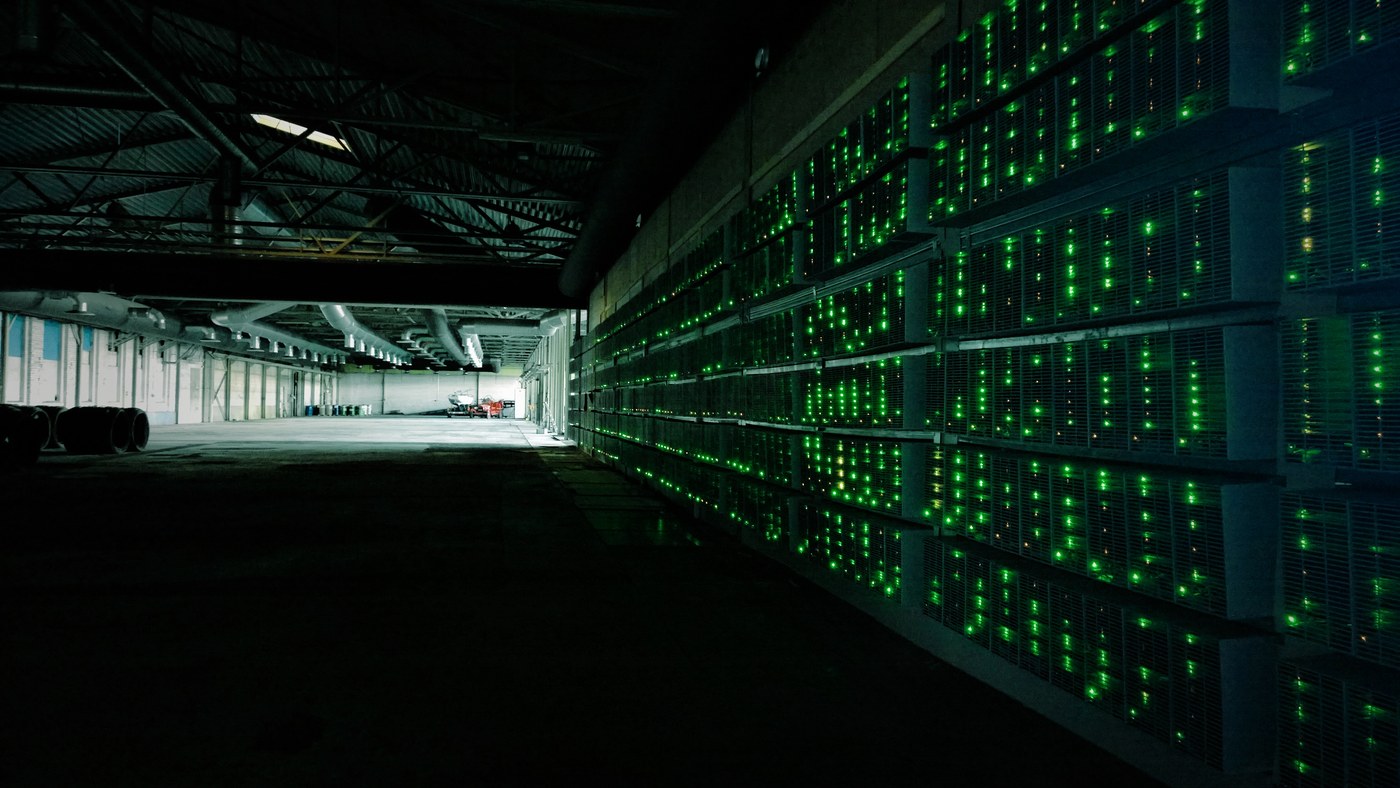
Two numbers decide whether a machine runs
The first is efficiency, quoted in joules per terahash: how much energy the machine burns to perform a trillion hashes. The second is the power price the operator pays, in currency per kilowatt hour. Those two numbers, multiplied by the reward available per block and divided by the total hash rate of the network, determine whether a machine earns more than it costs to run.
Everything else in a mining business is a consequence of those two figures. A site with cheap power can run older, less efficient machines profitably; a site with expensive power must buy the newest silicon, which costs more per unit of hash rate and depreciates faster because the next generation arrives sooner. There is no strategy that escapes the pair, which is why an operator’s real competitive asset is a signed electricity contract rather than a warehouse of equipment.
The efficiencies worth memorising are orders of magnitude rather than decimals. General-purpose processors were measured in joules per megahash. Graphics cards and programmable chips moved the unit upward by three and then six orders of magnitude. Modern machines are quoted in joules per terahash, and each generation of silicon has lowered that figure while raising the price of the machine, so the operator’s judgement is not whether a new model is better but whether the improvement pays for itself before the difficulty catches up with it.
Revenue: 144 blocks a day, and what is inside them
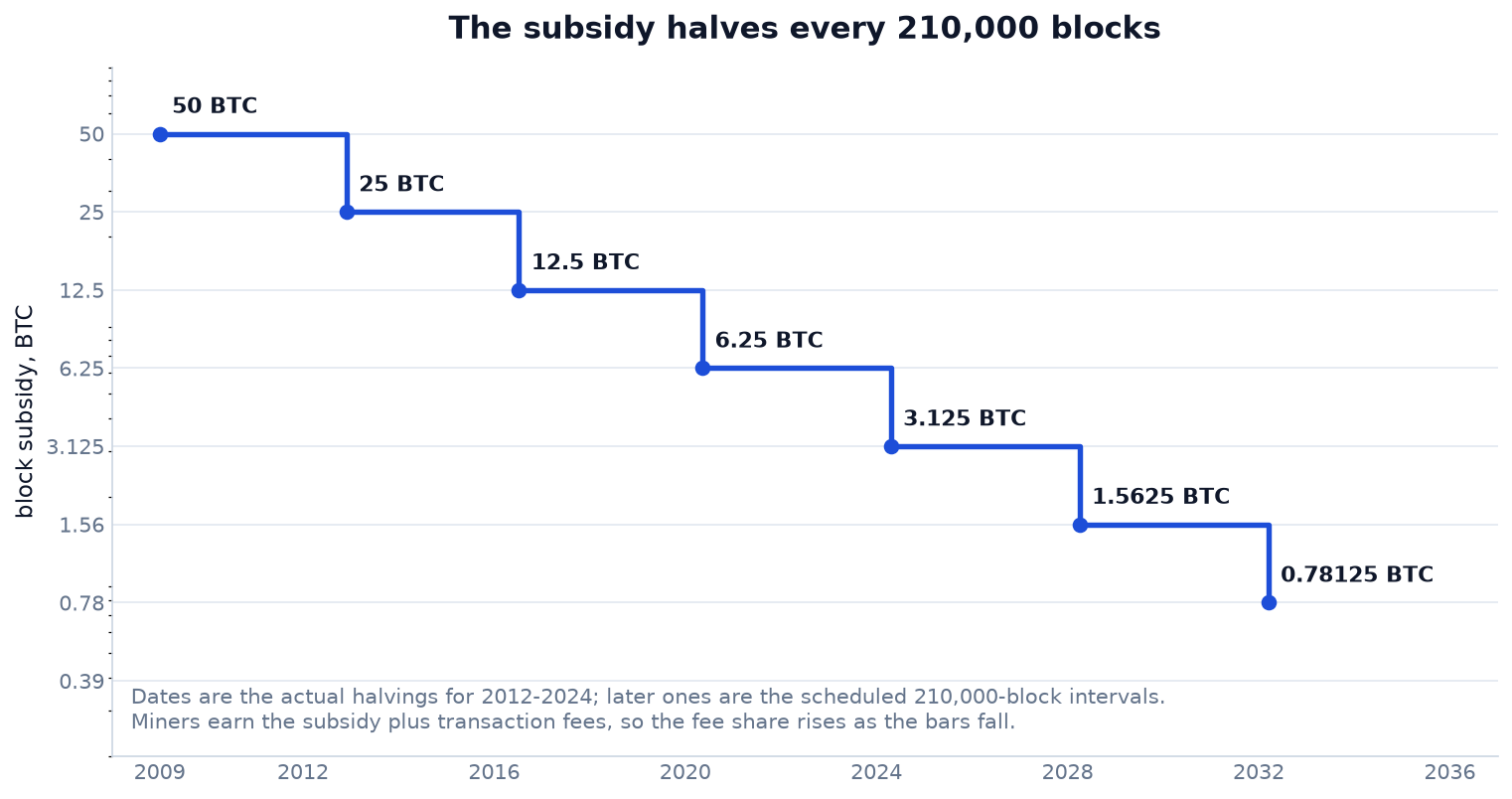
The network produces a block roughly every ten minutes, which is about 144 blocks a day, and the reward in each block is a subsidy plus the fees of every transaction it contains. The subsidy is fixed by the protocol: 3.125 bitcoin per block since April 2024, and 1.5625 after the next halving around 2028. Multiplied out, the subsidy alone issues about 450 bitcoin a day across the entire network, and that number is the same whether the network has one miner or a million.
The fee component is a market and behaves nothing like the subsidy. On a quiet day, fees add a few percent to the block reward. During a congestion event, they can multiply it, and the operator’s revenue for that window rises without any change to the machines or the power contract. This is the only line in the ledger that can move upward on its own, and it is also the only line the operator cannot influence by spending money.
Two consequential details hide in the daily issuance. The first is that fees are paid by users for block space, so the industry’s second revenue source is a function of how badly other people want to transact. The second is that issuance falls by half on a schedule published in 2009, which makes the fee line structurally more important every four years without making it any more predictable.
The share of the network is the real unit of income
No operator is paid for hash rate. Operators are paid for finding blocks, and the probability of finding one is their share of the network’s total hash rate. A facility doing one percent of the network’s work earns one percent of the block rewards in expectation, with a variance that pools exist to smooth.
That construction is what makes mining a competitive treadmill rather than a capital investment. When a site adds machines, the network’s total hash rate rises, everyone’s share falls, and the protocol then raises the difficulty to restore the ten-minute block interval. The savings from more efficient hardware are therefore distributed to the network in the form of a harder target, which leaves the industry with the same prize per round and a higher cost of participating.
The accounting consequence is that an operator’s revenue projection is a projection about everybody else. It assumes a growth rate for the network’s hash rate, because that growth is what dilutes the share, and the assumption matters more than the machine’s specification. A model that forecasts bitcoin’s price correctly and the network’s hash rate wrongly will be wrong about profitability, and the second input is the one operators tend to treat as a constant.
The production function, seen from the meter
Everything above treats output as a share of a fixed daily number. The mechanism that produces it is worth stating precisely, because it explains why an operator’s revenue is a probability rather than a schedule, and why the variance appears in the accounts as a financing cost rather than as an operational risk.
A block is a header plus a transaction list. The header carries six fields: the version, the hash of the previous block, the merkle root that compresses the transaction list, a timestamp, the encoded difficulty target, and the nonce. Five of them are fixed the moment a machine starts work on a candidate block. The nonce, a 32-bit integer, is the only field a machine can change freely. The machine hashes the 80-byte header twice with SHA-256 and compares the result with the target: below it, the block is valid and the reward is earned; above it, the nonce is changed and the attempt is repeated.
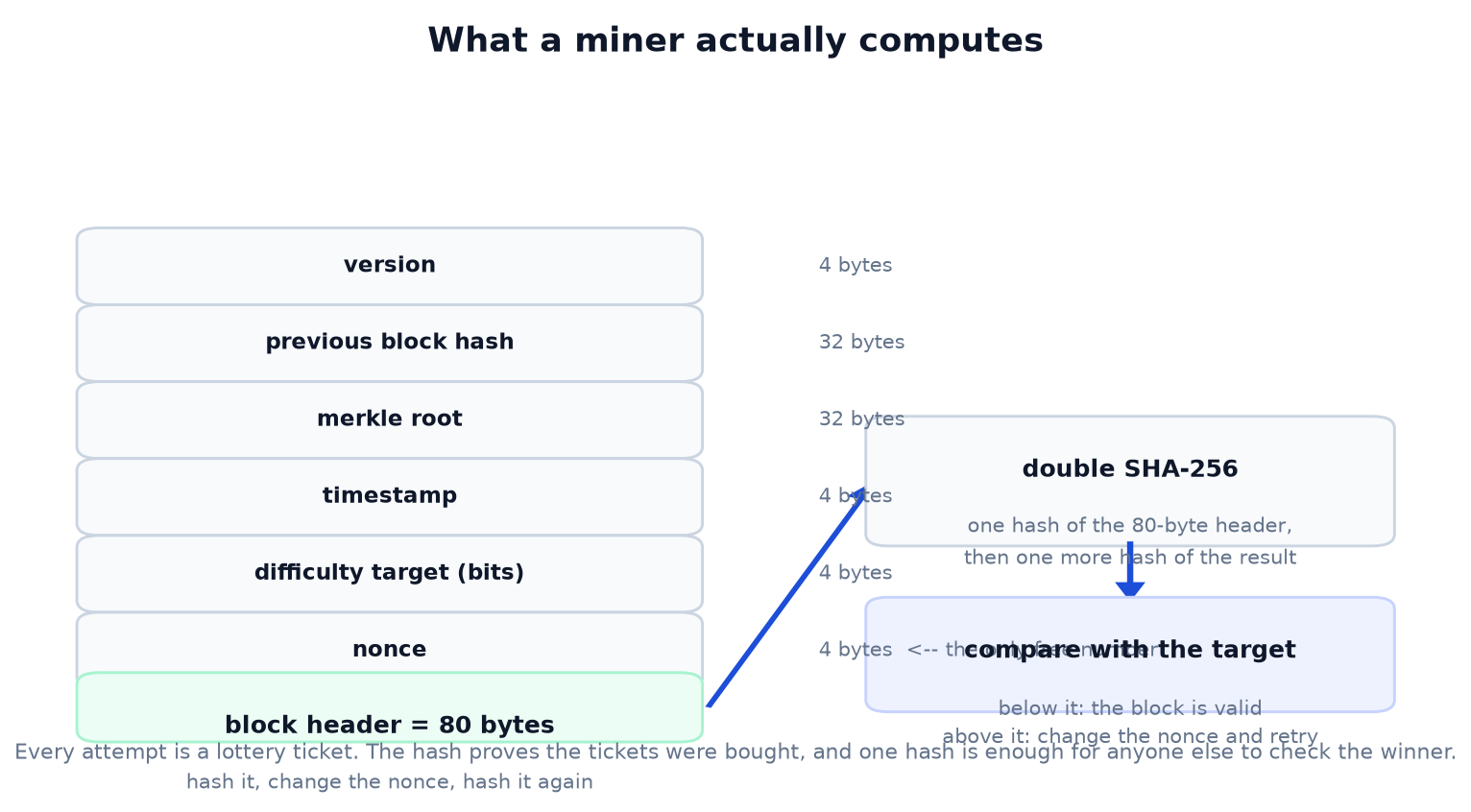
Two properties of the hash function turn that into a business. The output is unpredictable, so the only way to find a low one is to make many attempts; and it is deterministic, so any other participant can verify a solution with a single hash of the same 80 bytes. That asymmetry, expensive to produce and free to check, is what the operator is paying electricity for. At modern hash rates the entire 32-bit nonce space is exhausted in a fraction of a second, so machines also vary the coinbase transaction to change the merkle root and thereby change the header, which is how a search can continue indefinitely without ever altering the block’s actual payload of user transactions.
The accounting consequences are specific. First, the search is a lottery with a known jackpot and a known cost per ticket, so the expectation is calculable and the realisation is not: a facility with a small share of network hash rate can go weeks without finding a block, and pools exist to convert that variance into a monthly payment. Second, the difficulty is what holds the frequency constant. Every 2,016 blocks the protocol compares the elapsed time against the ten minutes per block it targets and moves the difficulty in proportion, which means the industry’s output is fixed in time and variable in cost: adding machines to the network does not produce more coins per day, it produces the same coins at a higher total power draw.
That single sentence is what separates mining from an ordinary commodity business. A copper mine that adds capacity adds supply. A mining facility that adds machines adds cost, while the issuance schedule stays where it was written in 2009. Every line in the ledger below is a consequence of operating in a business where the revenue per round is fixed by code and the price of participating is set by everyone else’s purchases.
Costs, in the order they matter
| Line | Unit | How it behaves | Who controls it |
|---|---|---|---|
| Electricity | Currency per kilowatt hour | The largest variable cost, and the deciding one in a margin squeeze | The site, through contracts and location |
| Hardware depreciation | Capital per joule per terahash | Accelerates when the difficulty rises and when a new generation ships | The operator, through purchase timing |
| Hosting and cooling | Capital and labour per megawatt | Fixed once built, and a reason not to shut down at a loss | The operator |
| Pool fee | Percent of gross reward | A few percent, and the price of variance smoothing | Chosen by the operator, set by the pool |
| Firmware and maintenance | Labour and failure rate | Rises with overclocking and with heat | The operator |
| Difficulty | Not a cost, an input to all of them | Adjusts every 2,016 blocks and re-prices the whole table | Nobody |
Electricity dominates the table in most operations, which is why the geography of mining follows power rather than regulation alone. A site pays for energy continuously and receives coins intermittently, so cash flow is a function of the interval between earning and selling, and every operator has some policy about when to convert the mined coins into currency. That policy is a financial decision that sits on top of the engineering ones, and it is the reason miners appear as sellers in the market with a rhythm set by their power bills rather than by price targets.
Hardware depreciation is the line operators most often underestimate, because it is not a function of time. A machine that cost a fixed amount per unit of hash rate earns less every time the difficulty rises, and its useful life ends when its power cost exceeds the value of what it can mine. The arrival of a more efficient generation accelerates that for everyone, including the operator who just bought the previous model, which makes the purchase decision a bet on the shipping schedule of competitors as much as on the machine in the crate.
The breakeven, and why it moves every two weeks
Because the difficulty adjusts every 2,016 blocks, the industry’s cost of production is re-priced roughly every fortnight by a rule that nobody controls. An operator’s breakeven is therefore not a number that can be calculated once: it is the power price at which the marginal machine in the fleet still earns, and it moves as the network adds or removes hash rate.
This is where the shutdown threshold does real work. When revenue per unit of hash rate falls below the cost of the energy required to produce it, a rational operator switches the machine off. That behaviour is what gives the difficulty adjustment something to react to: hash rate leaves, blocks slow down, difficulty falls, and the remaining machines become profitable again. The network has a negative feedback loop on cost, and it is enforced by businesses closing machines rather than by any policy.
The loop also explains a behaviour that looks irrational from outside. Operators keep running machines at a loss for short periods, because power contracts often have take-or-pay terms, because restarting a site has costs, and because a machine that is off earns nothing at all while a machine that is on earns something. The decision is not whether the machine is profitable in the abstract but whether running it is cheaper than the alternatives available that hour, which is why site-level power arrangements matter more than industry-wide averages.
Hardware is a depreciating bet on a moving target
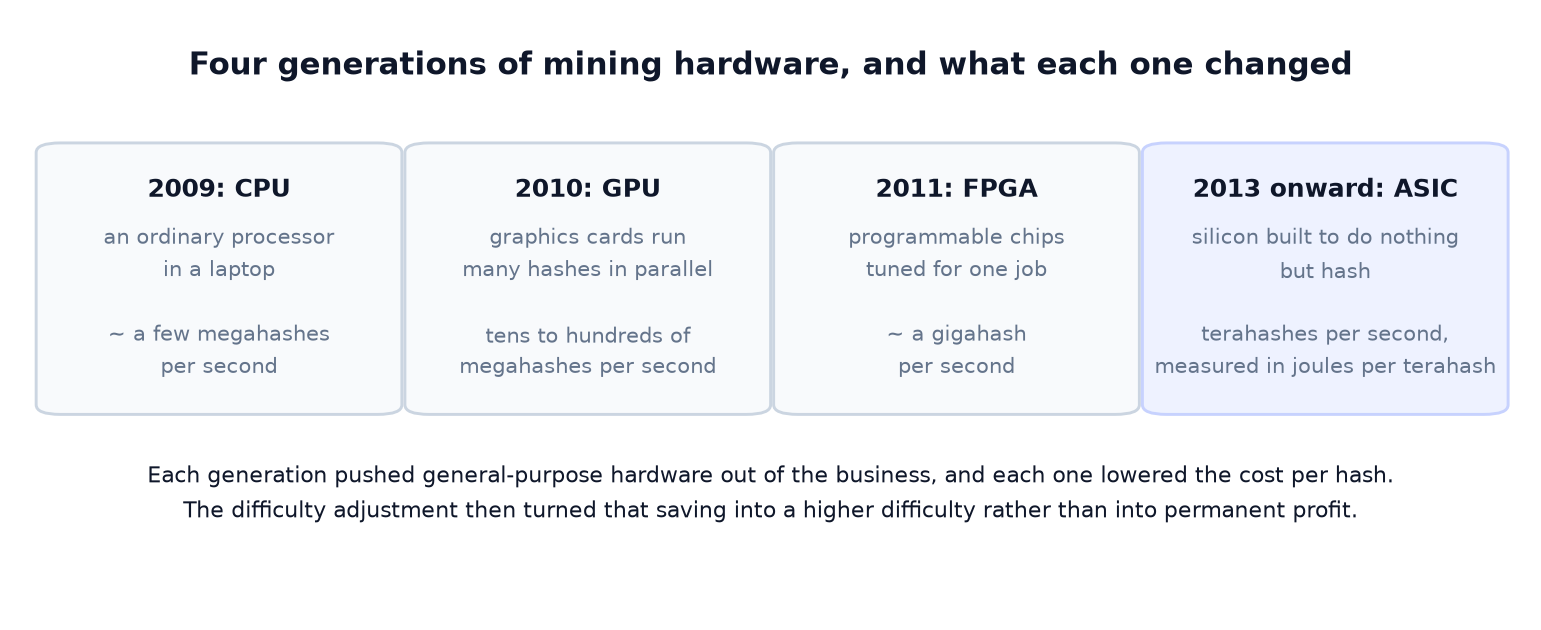
Application-specific silicon changed the industry twice. It made general-purpose hardware uneconomic, and it gave the equipment a lifecycle measured in difficulty rather than in years. A machine bought at the wrong point in a generation cycle can be worth a fraction of its purchase price within months, and the secondary market for mining equipment exists precisely because the valuation depends on where a buyer’s power price sits.
There is a second-order effect that shapes the market between generations. Improvements now arrive through smaller process nodes and better thermal design, which are expensive to develop and manufacture, so the pace of improvement is a capital allocation question for a handful of chip designers rather than a continuous curve. Operators plan around that cadence, which is why announcements from a small number of vendors move the economics of an entire industry.
Power contracts are the actual business
If the margin is decided by the price of a kilowatt hour, then the business is the negotiation of that price, and the rest is execution. Three structures dominate. A fixed price contract gives certainty and caps upside. A spot arrangement follows the market and exposes the site to volatility. An interruptible or demand-response arrangement takes the lowest price in exchange for the right of the grid operator to ask the site to stop consuming, and that arrangement is the reason a mining facility can be a useful participant in an electricity market rather than only a load on it.
The location decision follows from the same logic. Sites appear where generation is stranded, curtailed or cheap for structural reasons, which is why the map of mining moved decisively after China banned the activity in 2021 and the equipment migrated to North America, Central Asia and a set of smaller jurisdictions. That migration was fast because the machines are portable and the operators were already global, and it left the industry dependent on the energy policy of a small number of countries for its cost structure.
The honest version of the environmental argument lives here rather than in a slogan. Mining is location-flexible, it can consume energy that would otherwise be curtailed, and it also runs on grids where that is not true, because the only filter it applies is price. Both statements are measurable at the level of a specific site, and neither is a property of the protocol.
What the halving does to the ledger
Every 210,000 blocks the subsidy halves. For an operator, that is a 50 percent cut to the largest revenue line, applied on a date published years in advance, with no corresponding change to the cost lines. The industry’s response to each halving has followed the same three moves.
| Response | What it changes | How long it takes |
|---|---|---|
| Fleet upgrade | Joules per terahash, at a capital cost | One shipping cycle, and it is available to everyone |
| Power renegotiation or relocation | The other half of the metric | Months to years, and it is site-specific |
| Shutdown of the marginal machines | Network hash rate, then difficulty | Immediately, once the margin is gone |
The order in which those responses happen is predictable and uncomfortable. Efficiency improvements are available to every competitor, so they raise the difficulty and leave the industry where it started, richer only in capital equipment. Shutdowns reduce the network’s hash rate, which lowers the difficulty and restores some margin to whoever is still running. The durable advantage belongs to the operator whose power contract is cheaper than the alternatives, because that advantage cannot be copied by buying the same machines.
What the operator does not control
Three things in this business sit outside the operator’s decisions, and all three are easy to forget when a spreadsheet looks favourable. The first is the fee market, which decides the second revenue line and moves with demand from users who have nothing to do with mining. The second is the difficulty, which re-prices the fleet every two weeks and is a function of decisions made by every other operator in the world. The third is the rule set itself: what a valid block looks like, what the subsidy is, and how often it halves.
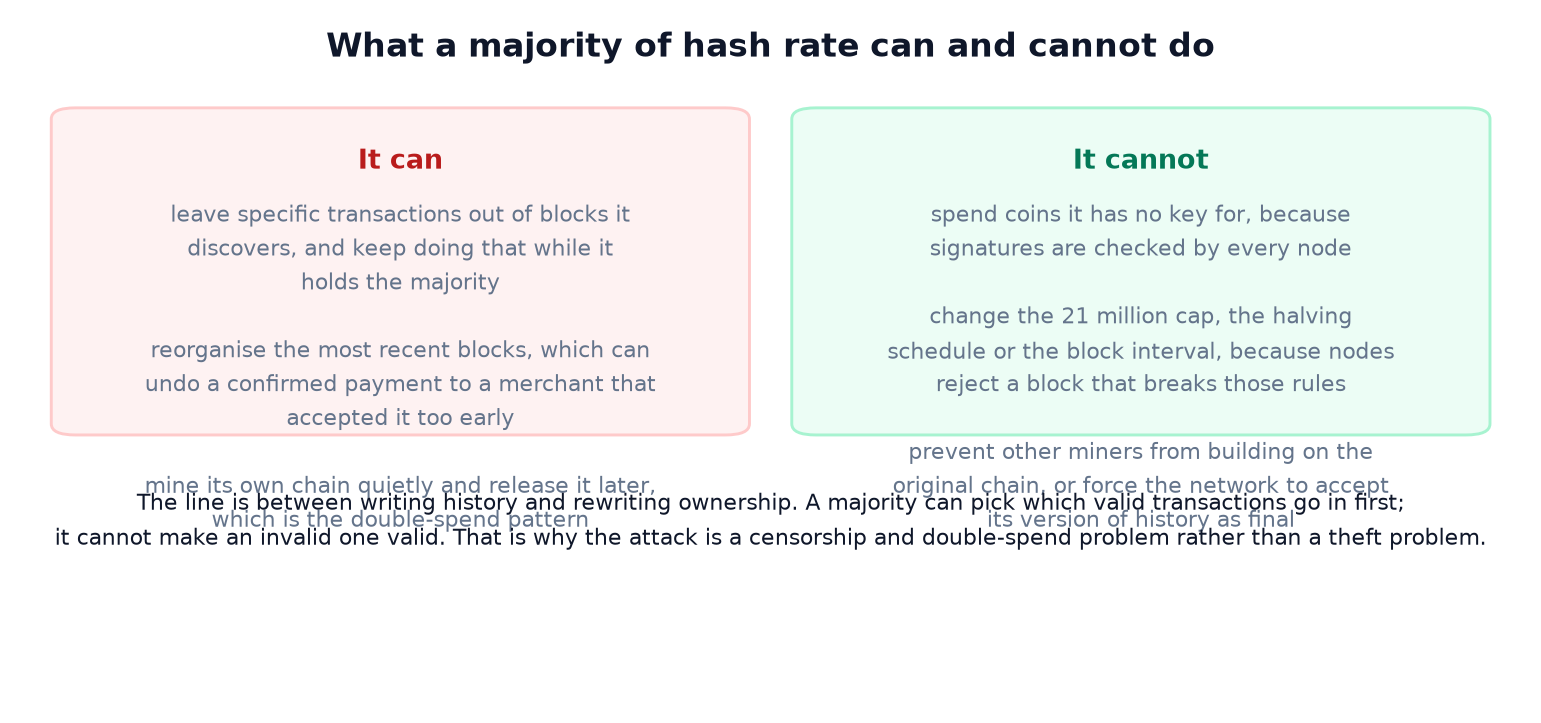
The third item is where mining’s industry and mining’s protocol are most often conflated. An operator with a large share of hash rate can influence which valid transactions are included, and can in the extreme reorganise recent blocks, but cannot make an invalid block valid, change the subsidy schedule or spend coins without keys, because those checks belong to every node rather than to the largest miner. The rule set is enforced by the machines that validate, and the machines that produce blocks are one input to it among several.
For the operator this matters financially as well as philosophically. The value of a mining business depends on the rules staying where they are, and the rules are the one line of the ledger that no amount of capital can move.
The ledger in one column
Write the business as a single column and it reads like this. The network issues a fixed amount per block, halved on a published schedule. An operator earns that reward in proportion to its share of hash rate, which everyone else’s expansion dilutes. Electricity is the dominant variable cost, depreciation is the second and it is driven by other people’s purchases, and the pool fee is the price of smoothing variance. The difficulty adjustment resets the whole column every two weeks, and the halving resets the revenue line every four years. What an operator controls is the price of a kilowatt hour, the timing of a purchase and the efficiency of its site; what it does not control is the reward, the competition, or the rules.
Read that way, the industry stops looking like a gold rush and starts looking like a commodity business with a steadily falling price per unit of output and a fixed prize per round. The machines are the visible part, the marketing is about the machines, and the business is decided by an electricity contract that never appears in a photograph. The supply cap and the ten-minute interval are what make the prize fixed; everything else on the page is a negotiation with the power grid, and that negotiation is the only part of the column that is not the same for everyone.


