



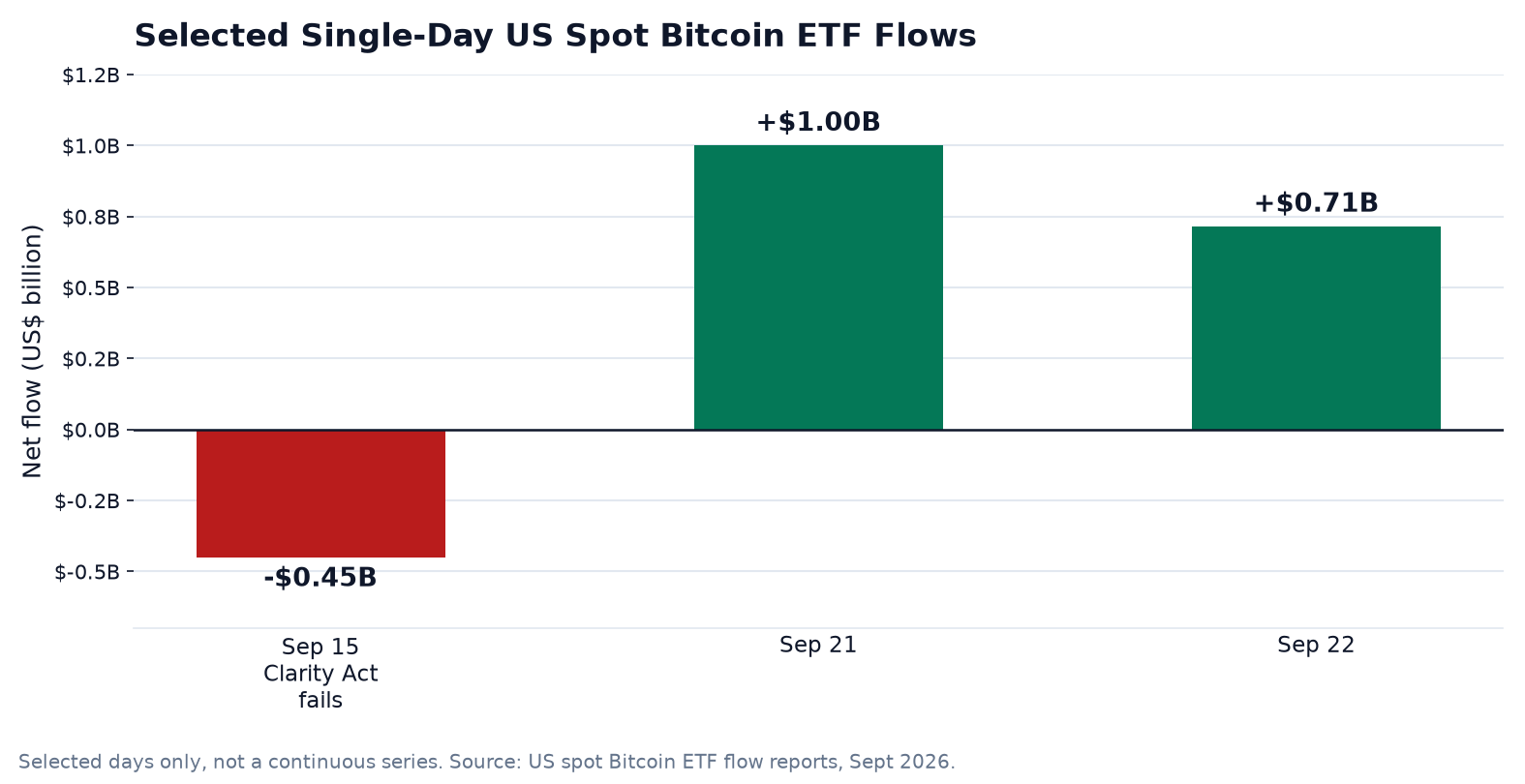
On September 15, 2026, the U.S. Senate failed to advance the CLARITY Act, the most ambitious attempt yet to write a single federal framework for digital assets. The procedural vote failed 49–50 — ten short of the 60 needed to open debate. U.S. spot Bitcoin ETFs recorded a net outflow of about $450.4 million that day, the largest single-day redemption since June 24.
Thirty days later, the same funds had taken in roughly $2.95 billion on net, according to flow data reported at the end of September: eight consecutive days of net inflows, a peak day near $1.0 billion, and a weekly total around $2.4 billion, the highest since October. Bitcoin ended the period near $83,429 — above the estimated average cost basis of spot ETF holders at about $81,722, which put the average ETF investor back in profit for the first time since January.
The gap between a headline that read bearish and a flow that stayed bullish is the part worth understanding. Price reacts to sentiment in seconds. ETF flows reflect slower, structural allocation decisions. This article explains what the CLARITY Act would have done, why it failed, what the SEC did instead, how spot Bitcoin ETFs actually move money, and which three variables are worth watching next.
Key takeaways
- The CLARITY Act failed a Senate cloture vote on September 15, 2026, by 49–50 — ten votes short of the 60 required.
- U.S. spot Bitcoin ETFs lost about $450 million on the day of the vote but took in roughly $2.95 billion over the following 30 days.
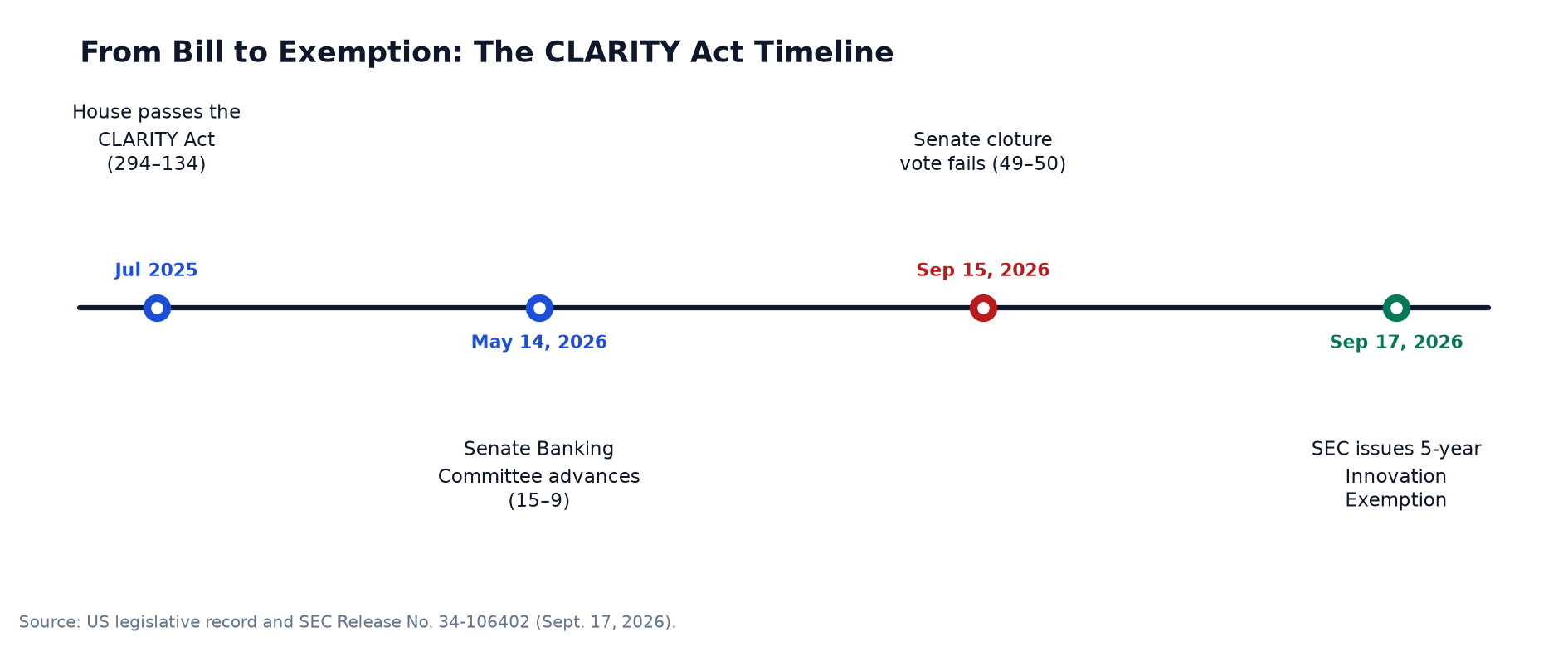
- Two days after the vote, the SEC issued a five-year “Innovation Exemption” for on-chain trading of tokenized U.S. stocks — a rule, not a law.
- ETF flows measure structural allocation; price measures sentiment. The two rarely move on the same clock.
- The single most useful number is Bitcoin’s position relative to the roughly $81,722 average cost basis of spot ETF holders.
What the CLARITY Act would have done
The bill’s formal name was the Digital Asset Market Clarity Act (H.R. 3633). It was designed to resolve the question that has hung over U.S. crypto policy for a decade: which digital assets are securities, which are commodities, and who regulates each. Its main provisions:
- A split of oversight between the SEC and the CFTC. Primary jurisdiction over “digital asset commodities” — that is, the spot market — would go to the CFTC. The SEC would keep authority over “restricted digital assets” that qualify as securities. Stablecoins would fall under joint oversight, ending a years-long jurisdictional dispute.
- A three-tier asset taxonomy and a statutory capital-formation pathway for crypto projects, plus a disclosure framework for non-security crypto assets tied to distributed ledgers such as layer-1 blockchains and decentralized applications.
- Registration and anti-money-laundering requirements for exchanges, brokers, and platforms, along with customer-fund segregation and conflict-of-interest disclosure.
- A stablecoin-yield compromise that would ban yield paid solely for holding a payment stablecoin while permitting activity-based rewards tied to balance, duration, or use.
- Developer protections, shielding software developers from liability for bad actors’ misuse of their code.
- Token-specific treatment, including a framework that would classify XRP as a digital commodity in secondary-market transactions regardless of the issuer’s holdings.
- A legislative vehicle for a Strategic Bitcoin Reserve and for agency pathways to tokenized securities and on-chain futures.
Read plainly, the bill was less about Bitcoin’s price than about giving institutions a stable legal map: a defined regulator, a defined asset category, and a defined disclosure standard. That is precisely why its failure mattered for sentiment — and why the market’s eventual shrug was notable.
The vote that failed — and why
The CLARITY Act had a long path before it stalled. The House passed its version 294–134 in July 2025. The Senate Banking Committee advanced it 15–9 on May 14, 2026, with two Democrats joining all 13 Republicans. Then momentum stopped at the procedural step.
On September 15, 2026, the Senate failed a cloture motion 49–50. Every Democrat voted against advancing the bill, joined by Republican Senators Susan Collins of Maine, Josh Hawley of Missouri, and Jerry Moran of Kansas. Senator Thom Tillis of North Carolina initially voted yes and then switched to no — a maneuver that preserved the option to bring the bill back later.
Two disputes were decisive:
- Ethics provisions. Democrats wanted rules preventing senior government officials — including the president and his family — from profiting from crypto. Republicans offered divestiture or blind-trust language with enforcement by state attorneys general, but critics argued the mechanisms were not sufficiently independent.
- Stablecoin yield. Community banks warned that allowing yield on stablecoins could pull deposits out of the traditional banking system. The compromise language did not satisfy them.
Coinbase’s policy chief, Faryar Shirzad, blamed a late electoral calendar and roughly $200 million in bank campaign spending. Whatever the mix, the immediate market reaction was sharp: Bitcoin fell about 3.7% and XRP about 7.3%, with roughly $669 million in liquidations. Coinbase and Circle shares fell harder than Bitcoin itself — a reminder that equity in crypto-adjacent businesses carries policy beta that the asset does not.

The numbers: a 30-day net inflow after a bearish headline
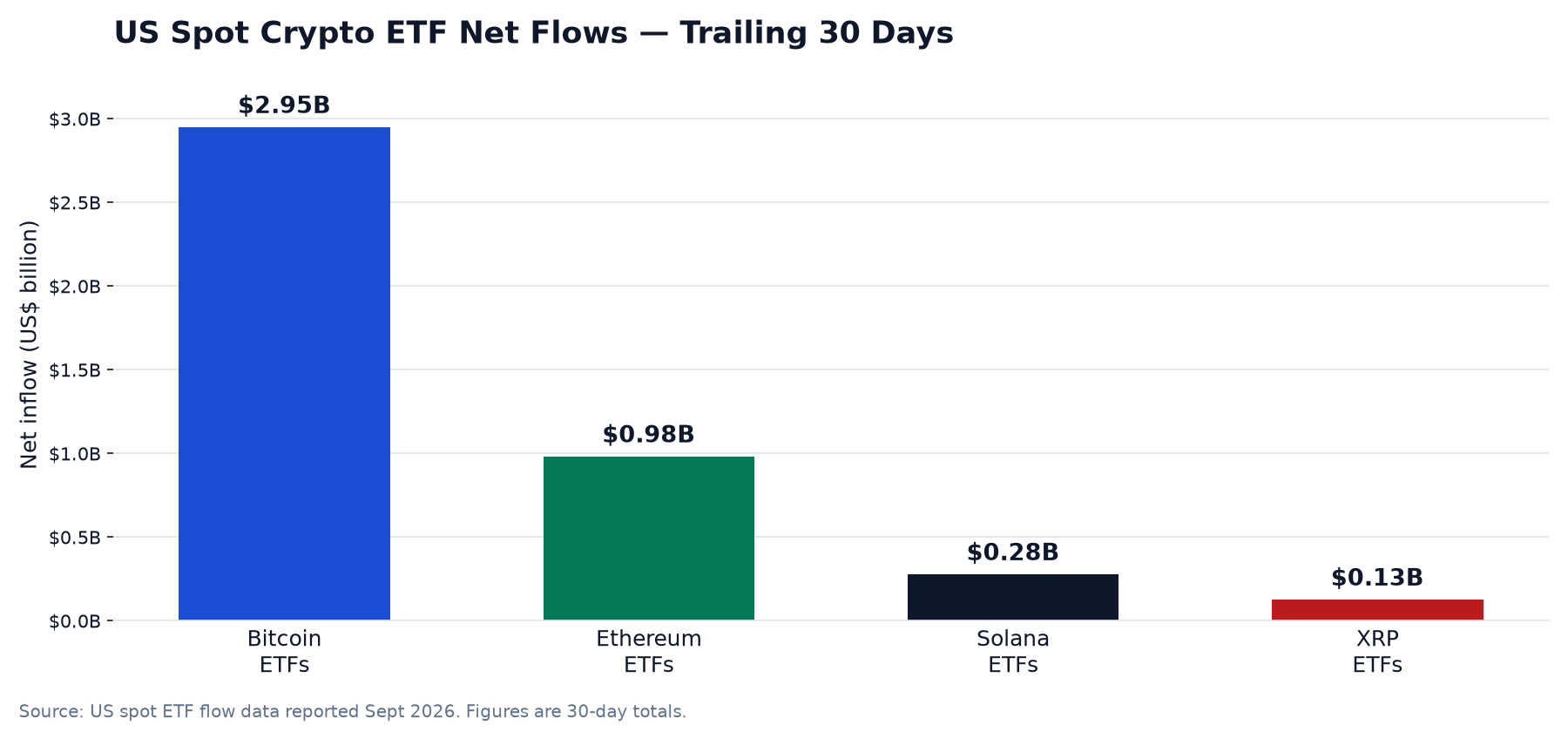
Over the trailing 30 days, inflows were not confined to Bitcoin. Every major U.S. spot crypto ETF group took in money:
| Fund group | 30-day net flow |
|---|---|
| Bitcoin ETFs | +$2.95B |
| Ethereum ETFs | +$982.5M |
| Solana ETFs | +$278.2M |
| XRP ETFs | +$127.05M |
Three details in the Bitcoin flow series matter more than the headline total:
- Eight consecutive trading days of net inflows, from September 17 through September 28. A streak that long signals scheduled buying rather than a single opportunistic trade.
- A peak single day of about $1.0 billion on September 21 — the largest since October — followed by $715 million on September 22.
- A weekly total of roughly $2.4 billion, also the highest since October. The Bitcoin flows were not narrowing to a single fund; the demand was broad.
For context, this inflow followed a much weaker stretch. U.S. spot Bitcoin ETFs saw four consecutive months of net outflows from November 2025 through February 2026, with total category assets falling from a peak near $170 billion to roughly $84 billion before recovering. The September print is best read against that backdrop: a market that had been bleeding assets for months turned around while the legislative news was at its worst.
How spot Bitcoin ETFs actually move money
To read flows correctly, it helps to know the plumbing. A spot Bitcoin ETF does not trade Bitcoin itself; it holds the asset in a trust and issues shares that trade on an exchange like a stock. Only authorized participants (APs) — large broker-dealers — can create or redeem those shares directly with the fund. Everyone else buys and sells on the secondary market.
There are two creation routes, and the difference matters for how flows behave:
- Cash creation. The AP wires dollars, and the fund buys Bitcoin through institutional counterparties or a custodian. This was the only permitted route until July 2025.
- In-kind creation. The AP delivers actual Bitcoin and receives newly created shares. The SEC approved in-kind creations and redemptions for spot crypto exchange-traded products in July 2025, bringing Bitcoin ETFs structurally closer to gold ETFs.
In-kind settlement is growing quickly. BlackRock cut its in-kind creation minimum for IBIT by 96%, from $25 million to $1 million, in mid-2026. Bitwise lowered its floor from $100 million to $3 million. Grayscale reported that in-kind settlement reached 62% of gross Bitcoin creations in June, up from 28% in March. By late August 2026, IBIT had processed more than $5 billion in tax-deferred Bitcoin-to-ETF swaps.
Two structural facts are easy to miss. First, retail investors cannot redeem ETF shares for Bitcoin or withdraw the underlying coins — only APs can. Second, because creation and redemption run through a small set of institutions, flows respond to portfolio-level allocation decisions, not to the mood of a single trading day. That is why a failed vote tends to produce one day of outflows, or a short run of them, rather than a month.
The SEC’s Innovation Exemption, explained
Two days after the Senate vote, on September 17, 2026, the SEC issued a five-year exemptive order — the “Innovation Exemption” — to allow on-chain trading of tokenized National Market System (NMS) stocks. It expires September 17, 2031, and was issued under Section 36(a)(1) of the Securities Exchange Act as part of Chairman Paul Atkins’ “Project Crypto” initiative.
The order grants two coordinated forms of relief:
- A “Tokenized Securities Venue” (TSV) exemption, freeing qualifying venues from the definition of “exchange.” They would not have to register as a national securities exchange or operate as an alternative trading system, and would not have to comply with Regulation NMS.
- A “Covered Firm” exemption, freeing certain liquidity providers from the definition of “dealer” so they can supply tokenized stock to permissioned automated-market-maker liquidity pools using proprietary capital.
The relief covers only secondary trading — no primary issuance or initial offerings. The conditions are extensive: U.S.-person and OFAC compliance, permissioned access with screened participants, equal economic, dividend, voting, and liquidation rights for token holders, a 30-calendar-day issuer objection window before a venue lists third-party tokenized stock, auditable smart contracts on a public permissionless ledger, trading halts that track the primary listing exchange, no leverage or credit extension, and machine-readable trade data published within ten minutes.
Volume is capped in two tiers. Tier 1 — S&P 500, Russell 1000, and eligible exchange-traded products — allows up to 75 symbols at 0.25% of prior-month average daily volume. Tier 2 allows up to 250 symbols at 2.5%. A first breach requires only prospective compliance; a repeat breach triggers an immediate three-month trading pause in that security.
The significance is structural, not cryptographic. The exemption does not legalize Bitcoin or settle whether any given token is a security. It shows the SEC is willing to build frameworks by rulemaking while legislation stalls. That has a durability cost: an agency rule can be rewritten by the next administration, while a statute cannot. For anyone modeling crypto policy risk, legislation and rulemaking are not substitutes — they are different half-lives.
Who holds the Bitcoin — and what they pay
Flows are easier to interpret when you know where the assets sit. The U.S. spot Bitcoin ETF market is concentrated: the top five issuers control well over $100 billion, and BlackRock’s iShares Bitcoin Trust (IBIT) alone holds roughly 60% of the category, with more than 800,000 BTC at points during 2026 — close to 4% of Bitcoin’s total supply. Fidelity’s Wise Origin Bitcoin Fund (FBTC) is a distant second and differentiates by custodying its Bitcoin in-house rather than through a third-party custodian.
Fees are where competition is sharpest. A “fee war” has pushed expense ratios down toward 0.15%:
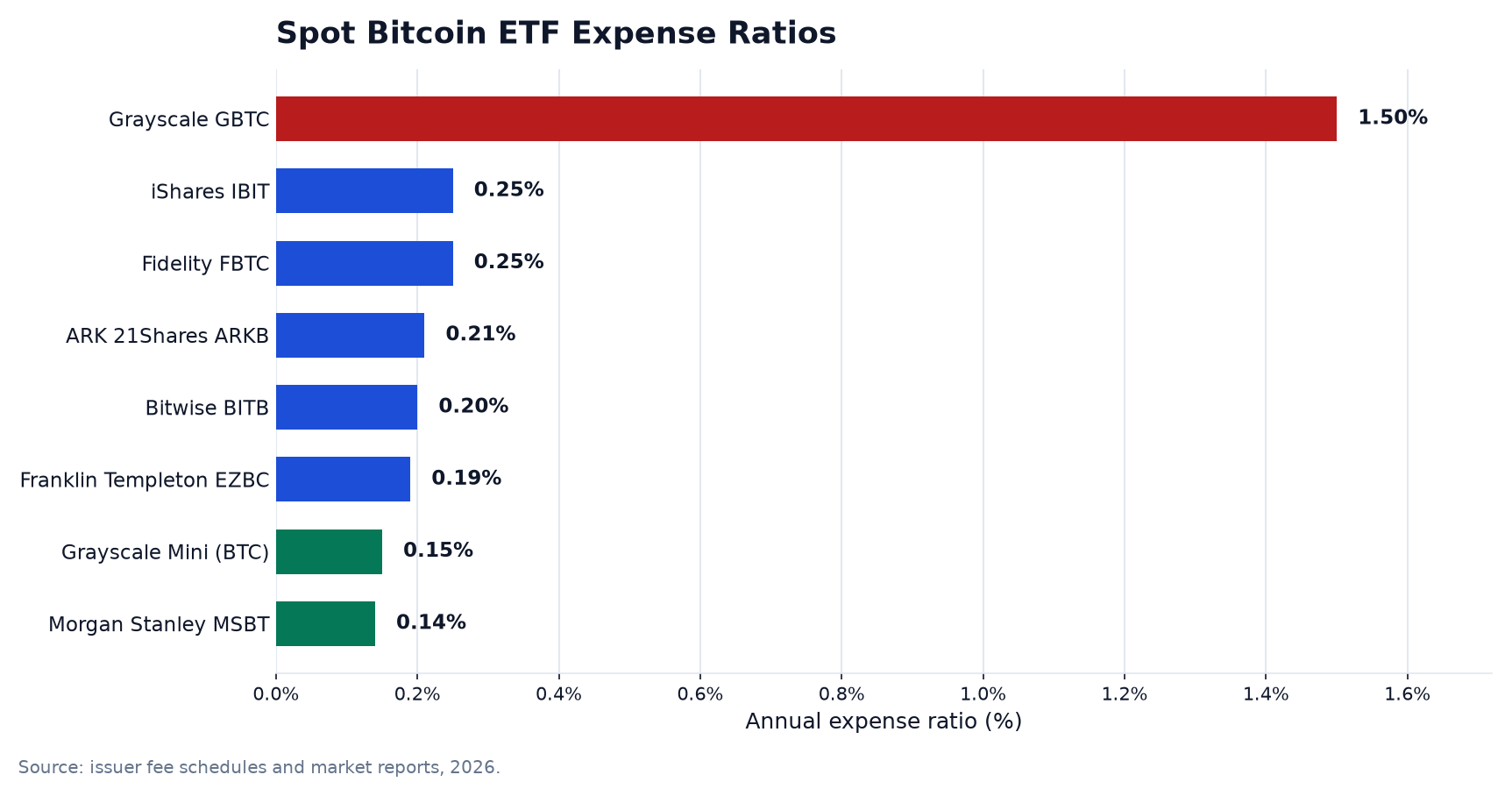
Grayscale’s legacy GBTC still charges 1.50% and continues to shed assets to cheaper products, including its own 0.15% Mini Trust. Morgan Stanley’s entry at 0.14% reset the floor and invited rivals to cut. But fee competition does not automatically change flows at the category level: because creations run through a limited set of APs and liquidity concentrates in the largest funds, the money that entered during September went disproportionately to the most liquid products rather than the cheapest ones. Liquidity, not price, is what large allocators optimize for first.
Price versus cost basis: the number that governs redemptions
Most coverage of a vote like the CLARITY Act failure focuses on price. For this question, price is the wrong instrument. Price is a sentiment gauge — it moves on a headline and can fully retrace within days. ETF flows are an allocation gauge, driven by scheduled, rules-based decisions: rebalancing, dollar-cost averaging, or fitting crypto into a portfolio through a wrapper that a compliance team will approve.
The more useful number is not the day’s price move but the position of price relative to cost basis. At the end of the period Bitcoin traded around $83,429, above the estimated average cost basis of spot ETF holders at about $81,722. For the first time since January, the average spot ETF holder was back in profit.
Cost basis governs redemption behavior. When holders sit above their average cost, redemptions tend to be orderly — people trim winners rather than panic-sell losses. When price falls below it, the same holder base becomes a source of supply. A cushion of roughly $1,700 is not large, but it is the difference between a base that absorbs selling and one that adds to it.
What would change the story
Strip the headlines away and this episode reduces to three measurable variables. Treat them as a dashboard rather than a narrative:
- Flow persistence. Is the eight-day inflow streak extending, or was it a two-week bounce? Consecutive net-inflow days are the cleanest real-time signal of demand, because they are hard to fake through a single large trade.
- Position versus cost basis. Bitcoin’s distance from the roughly $81,722 average ETF cost basis. Above it, the holder base is a stabilizer; below it, a source of supply. A sustained move under that line would change the flow math faster than any headline.
- The policy path. Whether the CLARITY Act is reintroduced in a form that can clear 60 votes, and how broadly the SEC’s Innovation Exemption is implemented. Legislation moves slowly; exemptions can change the rules faster, but with less durability.
FAQ
Did the CLARITY Act fail permanently?
No. The September 15 vote was a procedural cloture motion, not a final vote on the bill itself. Senator Tillis’ switch from yes to no preserved the option to bring it back, and senators on both sides described the result as a setback rather than an end. With midterm elections in November, near-term passage is unlikely, but the bill can return in a later session.
Why did Bitcoin fall less than XRP after the vote?
Bitcoin’s demand base is broader, deeper, and increasingly institutional, with a large spot ETF complex and derivatives market absorbing selling. XRP had a specific provision riding on the bill — classification as a digital commodity in secondary markets — so its price reflected both the general market-structure setback and the loss of that specific treatment. Assets with the most to gain from the bill fell the most when it failed.
Do ETF outflows directly cause Bitcoin’s price to fall?
Partly, and with a lag. Flows are a demand signal, not a price. Under cash creations, large redemptions force the fund to sell Bitcoin, which can pressure the market; under in-kind redemptions, Bitcoin changes hands without a sale. But Bitcoin’s price is set across many venues, including offshore spot markets and derivatives, so ETF flows are one input among several rather than the sole driver.
What does the SEC Innovation Exemption actually cover?
Only on-chain secondary trading of tokenized National Market System stocks, by permissioned venues and qualifying liquidity providers, with no leverage and with capped symbols and volume. It does not cover Bitcoin, primary issuances, or synthetic products such as tokenized linked securities and security-based swaps.
Are spot Bitcoin ETFs “custodied” Bitcoin?
Yes, in effect. The fund holds Bitcoin in a trust through a custodian, and shareholders own a claim on that trust rather than the coins themselves. That is why retail investors cannot redeem ETF shares for Bitcoin or withdraw the underlying asset — only authorized participants can.
Is buying a spot Bitcoin ETF the same as buying Bitcoin?
No. An ETF is a regulated wrapper that tracks Bitcoin’s price, with its own expense ratio, market-hours trading, and tax treatment. It offers custody, reporting, and access through a standard brokerage account, but it is not the bearer asset and does not let you hold the coins directly.
Bottom line
A failed bill that costs one day of outflows and one month of net inflows is telling you something. The short-term driver was always going to be sentiment, and sentiment was always going to be noisy. The structural bid — institutional allocation through regulated wrappers — has been the quieter and more durable of the two. Watch the flows, the cost basis, and the rulemaking calendar rather than the floor vote.
Sources
- Gate News — Bitcoin ETFs see $2.95B inflow in 30 days despite Clarity Act failure
- Jones Day — U.S. Senate falls short on procedural vote to advance the Digital Asset Market Clarity Act
- SEC Press Release 2026-90 — SEC issues Innovation Exemption to facilitate trading in tokenized NMS stock
- Gibson Dunn — SEC opens up five-year sandbox for tokenized trading of NMS stocks
- Yahoo Finance — Five asset managers control Wall Street’s Bitcoin ETF market
- Tiger Brokers — Trump urges Congress to pass the Clarity Act; Bitcoin rebounds


