


A staking rate is one of the few numbers in this market that looks like a banking product and is not one. It is quoted as a percentage, paid on a schedule, and compared across venues the way a deposit rate is compared across banks, and every part of that comparison misleads. The rate is a bundle of three unrelated income streams with different payers, different stability and different consequences for everyone who is not being paid, and it is priced against a dilution that the headline figure usually ignores.
The way to read it is to decompose it. What is being paid, who is paying it, what does the payer give up, and what does the recipient risk? Answer those four questions for each component and the number resolves into something comparable. This article does that decomposition, then follows the same position through the two layers of wrapping that most holders now encounter before they ever run a validator.
What staking is, mechanically
On a network that orders its blocks by requiring a bond rather than by requiring computation, participation means locking capital behind a validator, operating software that proposes and attests to blocks, and accepting a set of penalties for misbehaviour. The protocol defines a minimum unit — on the largest such network, thirty-two coins per validator — and the network selects proposers and attesters from the set of active validators in proportion to their weight.
In exchange for performing those duties, a validator receives whatever the protocol pays for a block and whatever users pay to have their transactions included. Against those rewards sit two penalties: a loss of rewards if the validator goes offline, which is not a fine but an absence of income, and a slashing penalty if the software signs conflicting messages, which is a fine, a forced exit, and a permanent mark.
The important framing from this description is that staking is employment rather than investment. A validator is paid for doing a job that the protocol needs done, and the capital is collateral for doing it correctly. Almost every misunderstanding about yields follows from treating the payment as a return on capital rather than as compensation for a task, because a return on capital has no obligations and this one does.
Source one: issuance, which is dilution wearing a yield
The first component is new coins created by the protocol and paid to the validators who produce blocks. From the recipient’s side this looks like income. From the network’s side it is issuance, and issuance dilutes every holder proportionally, which means the coins arriving in a validator’s account are partly a transfer from holders who did not stake.
That is not a criticism of the design; it is how a network pays for its own security without a treasury or a tax authority. It does mean that a yield dominated by issuance tells a reader something specific: the ratio between the rewards earned by stakers and the dilution suffered by everyone else. A chain with a high issuance rate and a low staking participation rate produces a high headline yield and a correspondingly high cost for passive holders, and the two numbers are the same event observed from two sides.
The distinction has a practical use. A validator whose rewards are mostly issuance is being paid in a currency diluted at a known rate, so the “real” return to a holder who would otherwise hold the asset passively is smaller than the quoted number by the amount of dilution. That gap is invisible in a rate quoted as a percentage of the staked amount and obvious once the source of the payment is named.
Source two: transaction fees, which are payments from users
The second component is the fee that users pay to be included in a block. This is ordinary revenue: a service is provided, a price is charged, and the money arrives from outside the validator set. Nothing about it dilutes anyone, and its level is a function of demand for block space.
The behaviour of that demand is what makes the component unstable. On a quiet day, fees contribute a small fraction of what validators earn. During a congestion event, they can exceed the issuance component by a multiple, and the same is true in reverse during long stretches of low activity. A yield quoted as a single number therefore embeds an assumption about future activity, and the assumption is usually the average of the recent past.
Fees have one further property that issuance does not. They are paid by somebody who chose to transact, at a price that reflects the congestion they are competing with, which means the component grows when the network is useful and shrinks when it is not. That is a healthier connection between income and activity than a protocol-defined issuance schedule, and it is also the reason the component cannot be forecast from inside the protocol.
Source three: ordering revenue, which is a payment for position
The third component is the newest and the most misunderstood. On a network where the order of transactions inside a block determines whether some of them are profitable, the right to choose that order has value, and the mechanism that allocates it directs part of that value to the validator who produces the block. The revenue arrives from traders who want to be first rather than from users who want to be included, which makes it a different kind of payment entirely.
Two features of this source matter for anyone comparing yields. The first is its concentration: it is largest exactly when markets are moving fast, which is when normal fees are also high, so a busy hour can pay a validator far more than a busy day. The second is that it is a cost to the traders paying it, not to the network as a whole, which means the revenue does not represent value created but value captured from a set of participants who are willing to pay for speed.
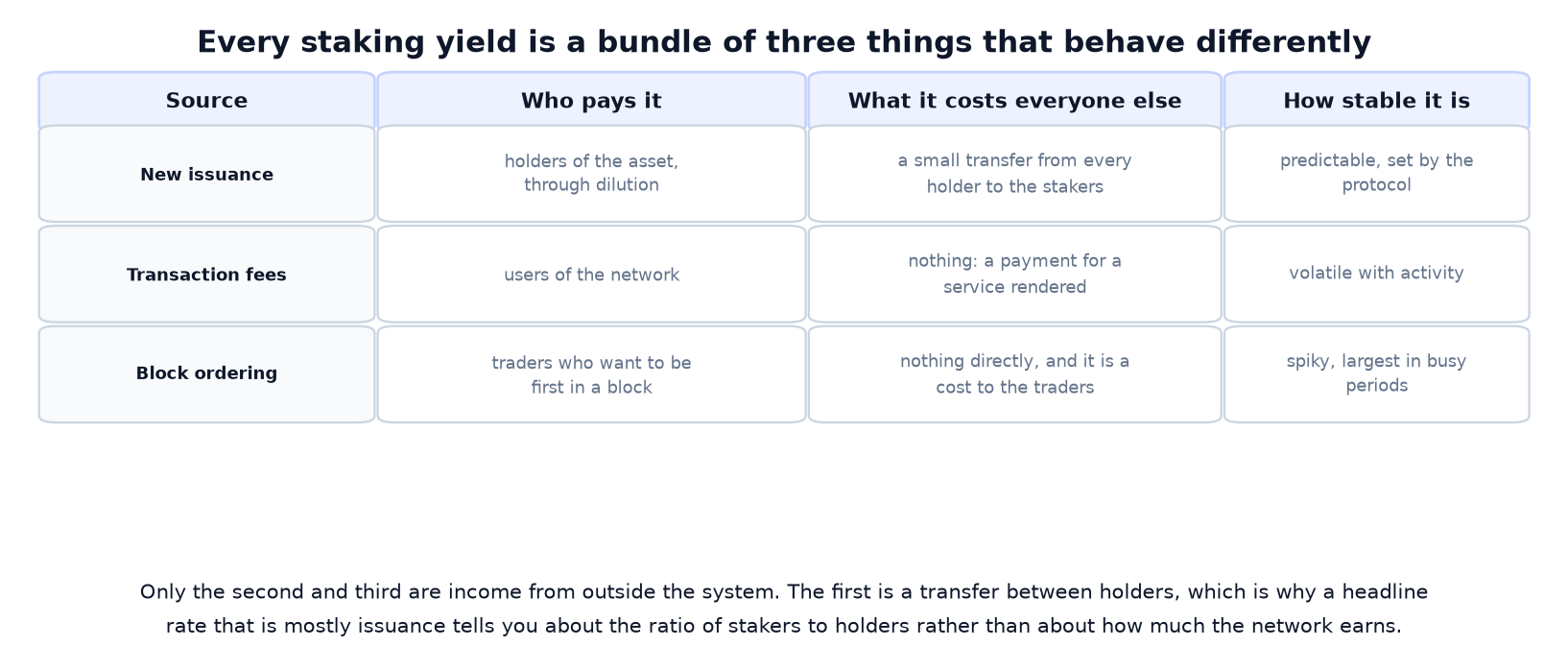
The three sources compared
| Source | Payer | Effect on a passive holder | Stability |
|---|---|---|---|
| New issuance | Every holder, through dilution | Loses a share of supply to the stakers | Defined by the protocol, and it shrinks as more capital stakes |
| Transaction fees | Users buying block space | No direct effect | Tracks network activity |
| Ordering revenue | Traders buying priority | No direct effect, and it raises their costs | Concentrated in volatile periods |
A worked example with invented figures and a real mechanism
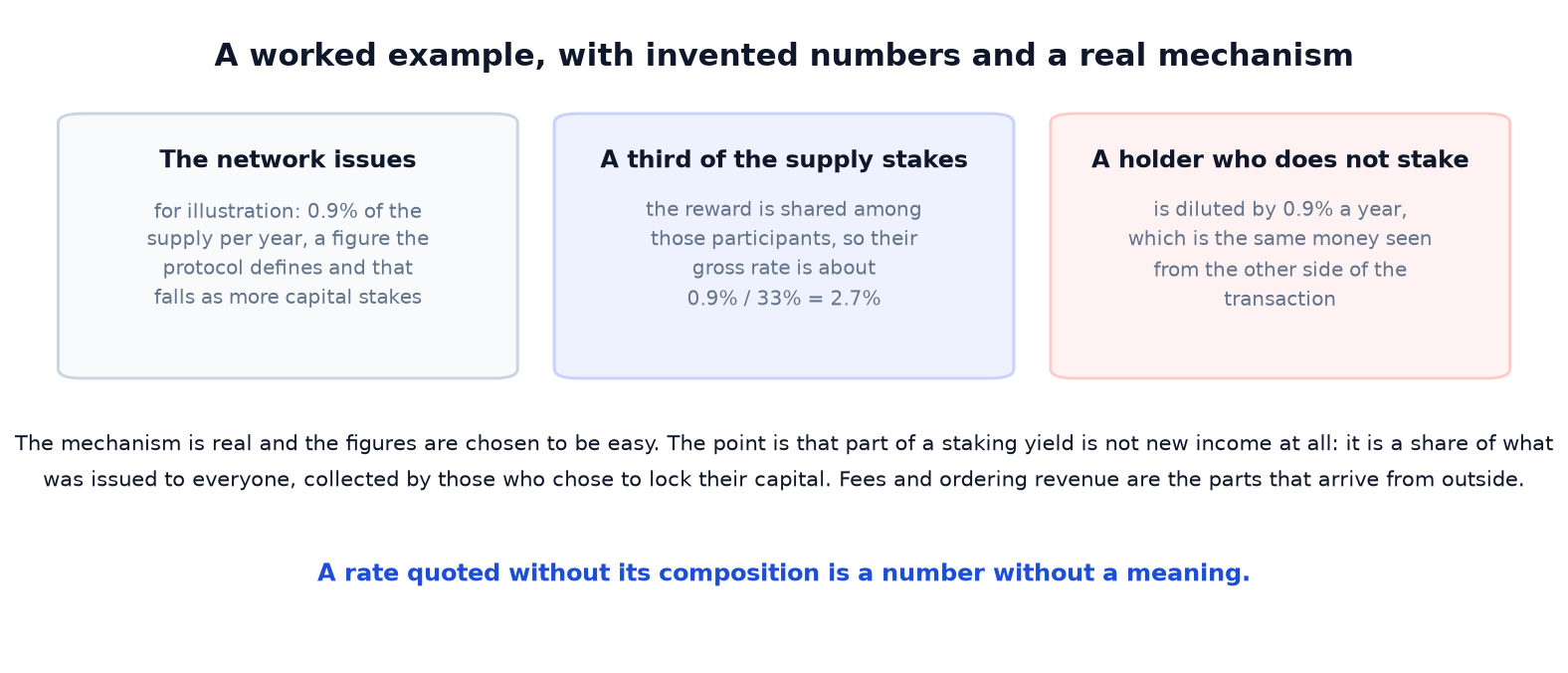
Suppose a network issues nine tenths of one percent of its supply over a year and that a third of the supply is staked. The stakers share the issuance, so their gross rate on staked capital is roughly the issuance divided by the staked share — about two point seven percent in this example. The holder who did not stake has had their share of the network reduced by nine tenths of one percent, which is the second half of the same transaction.
The figures are chosen for arithmetic rather than for accuracy, and the mechanism they illustrate is what matters. Part of a staking yield is not new income at all; it is a share of what was issued to everyone, collected by those who accepted the obligation of validating. Fees and ordering revenue are the parts that arrive from outside, and they are the parts that can be described as earnings rather than as redistribution.
A reader who internalises that will approach every quoted rate with the same question: how much of this is dilution? The answer is rarely published alongside the rate, and it is derivable from two public numbers, which is the reason it is worth deriving rather than taking on trust.
Why the rate falls as more capital stakes
On the largest proof-of-stake network the issuance schedule is set so that the total amount issued rises with participation but not proportionally: the reward per unit of staked capital falls as the amount staked rises, following a square-root relationship rather than a linear one. The design intent is to make participation less profitable as it becomes more common, which keeps the security budget bounded and discourages a stampede.
The consequence inverts the usual reading of a yield. A high rate on such a network is a signal that relatively little capital is staked, which on its own is a statement about security rather than an opportunity. A low rate means participation is heavy, the bond securing the network is large, and the marginal validator is being paid less because the job is already well covered.
That inversion is worth keeping in mind when two networks or two venues are compared. A rate is a price for a service under conditions the protocol sets, and a high price for the same service usually indicates scarcity of the suppliers rather than generosity of the buyer.
The costs that never appear in the headline rate
Four costs sit behind a quoted rate, and each is quantifiable. The first is the validator’s commission where somebody else operates the node, which is normally a single-digit percentage of rewards and is deducted before the holder sees anything. The second is the opportunity cost of lock-up: capital committed to a bond is not available for other uses, and on a network where the exit takes time, the commitment is longer than the holder may assume.
The third is the tax and accounting treatment, which varies by jurisdiction and can be considerably more involved than holding the asset, because rewards are typically taxable when received regardless of whether the holder sold anything. The fourth is the risk of penalties, which is small in normal operation and is the reason the bond exists.
None of those four is hidden by the protocols; all four are omitted from the rates that get compared. The practical effect is that a quoted rate minus commission is the number to start from, and everything else has to be estimated from the holder’s own circumstances.
Losses: the two ways a validator can lose
A validator that goes offline stops earning. That is the whole penalty in ordinary circumstances: no rewards for the period, and if a large share of the network is offline simultaneously, an inactivity mechanism that slowly penalises the remaining participants to restore consensus. For a single node with a maintenance window, the cost is the missed rewards and nothing else.
A validator that signs conflicting messages is slashed. The offence is specific — voting for two different blocks at the same height, or building a vote that surrounds another one — and the penalty is a fine proportional to the stake, a forced exit from the validator set, and a permanent record. The failure mode that produces it in practice is not malice but duplication: the same key running on two machines, which happens during migrations, restores from backup and misconfigured failover.
Both penalties are worth understanding because they define the difference between a staking service and a deposit account. A deposit has a credit risk and no operational obligations. A bond has an operational obligation, and the loss that matters is the one caused by an operational mistake rather than by an economic event.
The exit queue, and why it is a real cost
Leaving a bond is not instantaneous. A network with a large validator set limits how quickly validators can enter and leave, which means an exit request enters a queue and waits. During the wait the stake earns nothing, and if the queue is long the effective cost of leaving is measured in weeks of forgone rewards as well as in the price the holder eventually receives.
The queue also carries information for the rest of the market. A large queue means a large number of participants have decided to stop validating, which is a statement about intended supply rather than realised selling, since the tokens are still bonded while they wait. A queue of around one and a half million coins appeared in the account kept of the third quarter, and the correct reading of it was as a statement about positioning rather than as a sale.
For anyone modelling a position, the practical point is that the exit condition is part of the return. A rate that is two tenths of a percent higher in exchange for a queue that is four weeks longer may be the worse trade, and no rate sheet expresses it in those terms.
Layer two: the liquid token that replaces the position
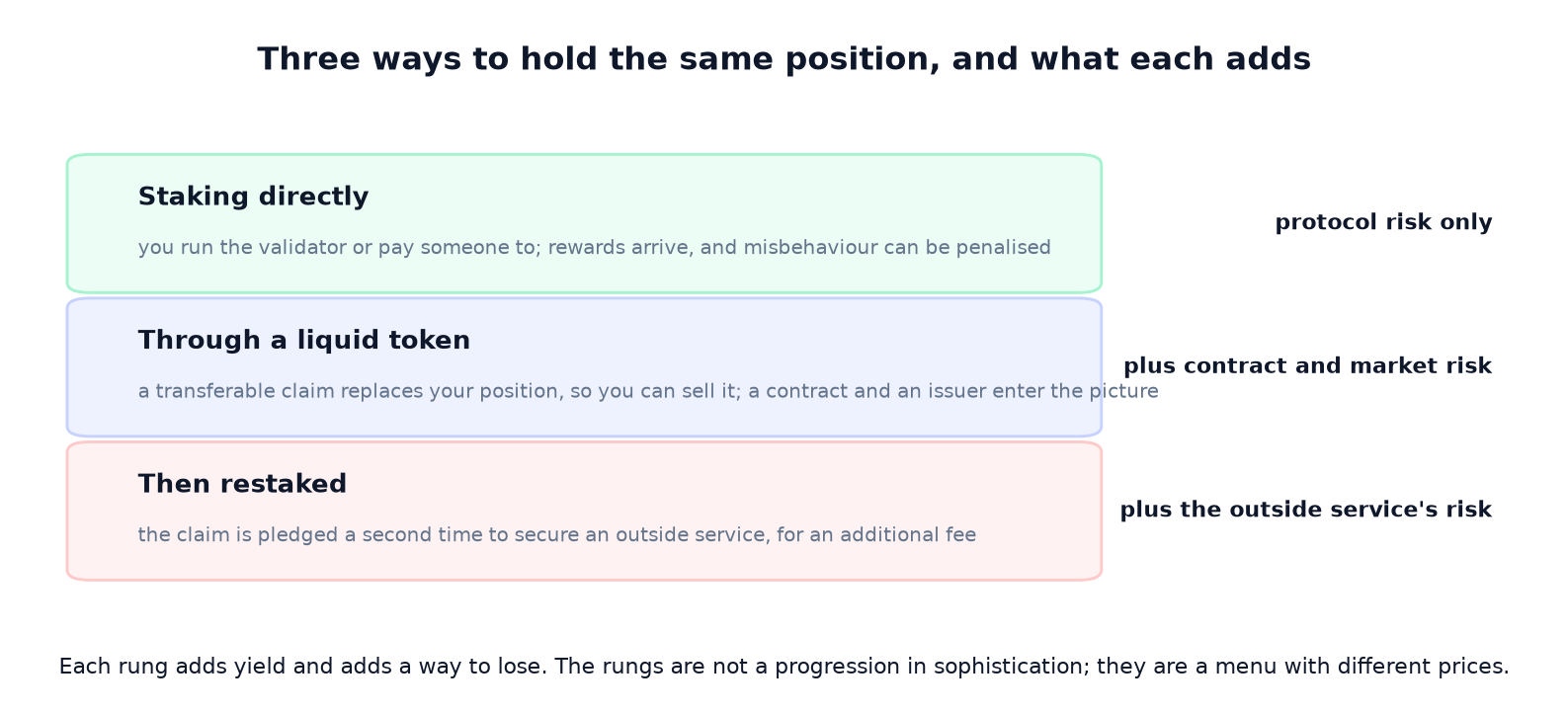
The most widely used wrapper solves the liquidity problem by issuing a transferable token that represents the staked position. The holder keeps earning, and can sell or use the token in the meantime, which is a genuine improvement for anyone who wants the yield without the lock-up.
Three additional risks arrive with it. The first is contract risk: the wrapper is a program, and the position now depends on that program being correct. The second is market risk: the token can trade away from the value of the position it represents, which happened on a large scale during a stress event when the wrapper’s perceived quality fell faster than the underlying. The third is concentration: because the wrapper delegates to a set of node operators, the choice of operators determines how much of the network’s security sits with a handful of organisations, which is a systemic consideration rather than a personal one.
None of that makes the wrapper a bad instrument. It makes it a different instrument with a different risk inventory, and the standard comparison is wrong in both directions: the wrapper’s rate is not a free upgrade to the underlying rate, and the underlying rate is not automatically safer for someone who needs to move.
Layer three: pledging the same capital twice
The newest layer takes the wrapper one step further by allowing the staked position, or its tokenised form, to be pledged a second time to secure an external service. The holder earns an additional fee from that service, and the service gets access to a large pool of economic security without building one.
The price of the extra yield is that the conditions under which the capital can be penalised expand. A position that was exposed to one protocol’s slashing rules is now exposed to those rules plus a second set belonging to the external service, and the second set is defined by a contract that the holder has usually not read. When several such services share the same collateral, the same capital counts as backing for multiple commitments, which is efficient until one of them triggers a penalty.
That is not a warning about a specific project; it is a description of what adding a layer means. Each rung on the ladder adds income and adds a way to lose, and the two are not independent: the additional income exists because somebody is paying for the additional exposure.
What a staking yield is not
It is not a risk-free rate. The bond is subject to operational penalties, the position is illiquid for a period, and the return is denominated in a volatile asset. A comparison with a government bill is a category error in every dimension except the schedule of payments.
It is not interest, because nothing has been lent. It is payment for performing validation, plus a share of issuance, plus a share of ordering fees, and no borrower exists who owes the principal back at a date.
It is not a dividend, because no earnings are being distributed and no claim on the network’s cash flows is created. And it is not a free lunch: every component traces to a payer, and the payer is either every holder through dilution, a user buying space, or a trader buying position.
How to compare two offers
Four questions reduce a set of offers to a comparable set. What is the composition of the rate — how much is issuance and how much is fees and ordering revenue? What is the denomination, meaning how much of the rate simply offsets dilution the holder would suffer anyway? How many layers of wrapping sit between the holder and the bond, and what does each layer add to the slashing conditions?
And what is the exit — whether the position can be sold immediately, and if so at what discount, or whether it must wait in a queue for a period that the network sets. Those four answers turn a rate sheet into a risk inventory, and the risk inventory is what a holder is actually choosing between.
What the network receives for the payment
The purpose of all of this is a security budget, and the yield is the price at which that budget is rented. A network secured by a bond is protected in proportion to the value that would be destroyed if a large share of the bond were penalised, which means the cost of an attack is roughly the size of the stake that an attacker would have to acquire, multiplied by the probability of losing it.
Read that way, a rate carries information that inverts the way it is usually read. A low rate on a large bond means the job is well paid but heavily subscribed: the network’s security is expensive to attack and cheap to maintain. A high rate on a small bond means the opposite: the protocol is paying generously because too little capital is willing to take the position, and the network’s protection is thin.
The practical consequence for anyone comparing rates across networks is that a higher number is not a better product. It is a price signal from a market where suppliers are scarce, and scarcity of validators is a description of the chain rather than an opportunity for the holder.
The issuance component deserves one more sentence in that light. Paying validators with new units is a transfer from every holder to the stakers, which is how a network funds its own defence without a treasury. Adoption of a design with low issuance and heavier reliance on fees is therefore a decision about who pays for security — passive holders or active users — and it is argued about in exactly those terms inside every network that has made the choice.
The decomposition, in one paragraph
A staking yield is a payment for doing a job, made up of new issuance that dilutes every holder, transaction fees paid by users, and ordering revenue paid by traders who want to be first. The first component is redistribution and the other two are income, which is why a rate quoted without its composition cannot be compared with anything. The protocol sets the issuance schedule so that the reward per unit of staked capital falls as more capital stakes, which makes a high rate a statement about low participation rather than an opportunity. And every wrapper added on top — a liquid token, or a second pledge of the same capital — buys additional yield with additional ways to lose, in an exchange that is explicit in the protocol’s parameters and quiet in the marketing.


