


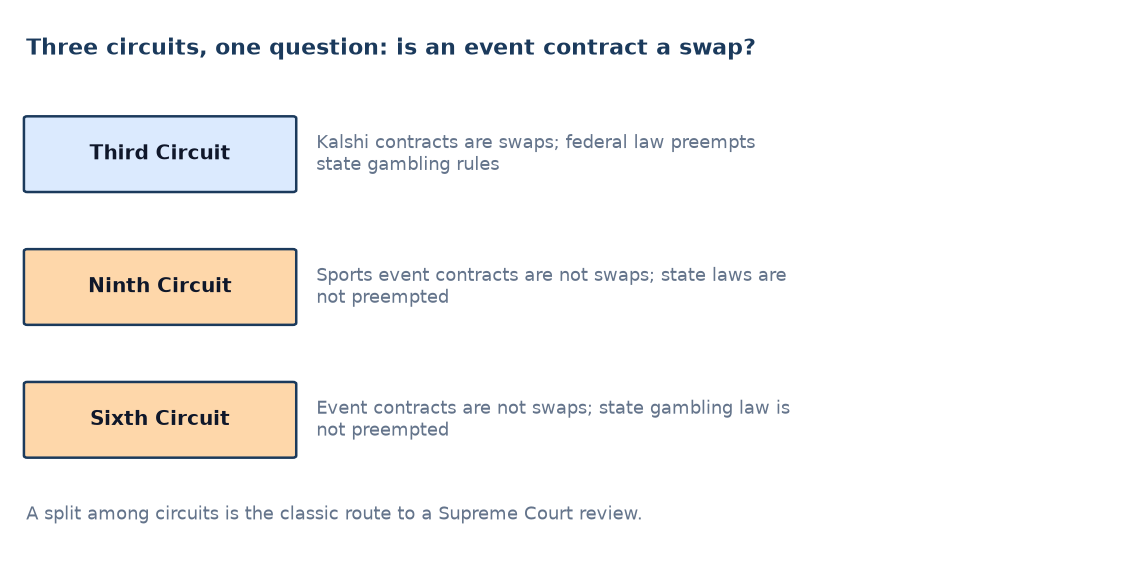
A United States appeals court ruled in late September that event contracts offered by a prediction market are not swaps, and that the federal commodities law does not preempt a state’s gambling rules. The holding is narrow and the consequence is large, because it put the Sixth Circuit alongside the Ninth and against the Third, and a disagreement among circuits on a question of federal law is the standard route to the Supreme Court.
The temptation is to read the ruling as a win or a loss for the industry. It is neither, at least not yet. It is an answer to a jurisdiction question, and the jurisdiction question is the one that has been holding the structure of the market in place for years. This article sets out what the Sixth Circuit decided, what the Third Circuit decided, why the two cannot both be right for long, and what a split actually means for the people who trade on these venues.

What the Sixth Circuit decided
Two holdings did the work. The first was that the sports event contracts at issue are not swaps, which removes them from the definition the federal commodities regulator uses to claim authority over them. The second was that the state’s gambling laws are not preempted by federal commodities law, which leaves the state free to regulate the contracts as gambling.
Together those two holdings produce a result that is the opposite of what the venues had argued for. The venues want to be federal instruments, regulated by the federal commodities authority under one national rulebook, because that is the only structure in which a market can operate across fifty states without fifty sets of rules. A holding that the contracts are not swaps and that state law applies is a holding that the national rulebook does not reach them, which is the outcome the venues have been litigating to avoid.
The legal question, in plain terms
Strip the citations and the dispute is about one word. Federal commodities law gives a national regulator authority over swaps, and a swap is defined by a set of characteristics that an event contract either has or does not. If an event contract is a swap, then federal law governs it and, under the argument the venues make, a state’s gambling law is preempted. If it is not a swap, federal commodities law has nothing to say about it, and the state is free to call it gambling and regulate it as such.
The venues’ argument is structurally attractive, because a market needs one rulebook to scale. The states’ argument is that a contract whose payoff depends on the outcome of a sporting event is a wager in substance regardless of its legal wrapper, and that the federal commodities statute was not written to turn gambling into a federally supervised financial instrument. Both arguments are coherent, and the circuits have now come down on both sides of them, which is why the question is headed upward.
Why the Third Circuit went the other way
The Third Circuit had earlier held that the contracts are swaps and that federal law preempts state gambling rules, which is the outcome most favourable to the venues and the one that would have given the industry its national rulebook. That holding is now in direct conflict with the Sixth Circuit’s, and the conflict is not a matter of emphasis; the two courts answered the same question with opposite conclusions.

It is worth being precise about what a split does to the parties that are not in either circuit. A holding binds the litigants and the courts within that circuit. It does not bind anyone else. So for a period that can be measured in years, the same contract offered by the same company can be a federally regulated instrument in one part of the country and a prohibited wager in another, and the venue has to decide whether to operate a patchwork or to withdraw from the states that disagree with it. That is the practical state of affairs the split creates, and it is expensive in a way that a clear loss would not be.
Why a circuit split matters
A split among circuits is the mechanism by which a legal question becomes national. When two circuits disagree on federal law, the Supreme Court is far more likely to grant review, because the alternative is a country in which the same statute means one thing in one region and the opposite in another. The process is slow, and it produces two outcomes that are both worse for the industry than a single clear rule: several years of uncertainty, and the possibility of a decision that goes the other way entirely.
That is why the sensible reading of the Sixth Circuit ruling is not that the industry lost but that the clock started. The question has been removed from the realm of agency guidance and into the courts, and the courts move on a timetable that no exchange can trade around. The industry’s preference for a legislative fix, which is the only instrument that settles the question permanently and quickly, makes more sense in that light, and it is the same reason the collapse of the market-structure bill mattered. Our earlier analysis of the Clarity Act’s failure and the rulemaking calendar that replaced it covers the legislative side of the same problem.
What it means for a trader
For an individual using a prediction market, the split has three practical consequences, and all three are about risk rather than about returns.
The first is geographic inconsistency. Whether a given contract is legally offerable can depend on where the user is, and a venue that compiles in one state may be restricted in another. A trader who moves, or who uses a platform that serves several states, may find the terms of access change for reasons that have nothing to do with the market. The second is venue risk. A platform that loses a licensing argument in a state may have to stop serving that state or wind down operations there, and positions held on it are exposed to whatever the venue does to resolve the situation. The third is timing risk. A contract that pays out in a year may be resolved under a legal regime that did not exist when it was bought, because the appellate process outlasts most positions.
None of that argues against using the venues. It argues for reading the jurisdictional question as part of the credit risk of the platform, in the same way a depositor reads a bank’s regulator as part of the risk of a deposit. The mechanics of what happens when a venue is forced to wind down are the same as those in our explainer on exchange failure and the order of claims, and the market’s growth is the subject of the twenty-billion-dollar week that made the question urgent.
The bigger picture: a market outgrows its legal wrapper
The reason the jurisdiction fight is escalating is that the market has grown into something the law was not written for. A prediction market is, in substance, a price for a probability, and a price for a probability is useful far beyond sports: it is a forecast, a hedge, and an information aggregation mechanism, and each of those uses has a plausible claim to be finance rather than gambling. But the same contract can be offered as a wager on a football game, which is the version the states have been regulating for a century.
That dual nature is why the litigation has been so persistent and why the outcome matters beyond the venues. If the courts hold these contracts to be financial instruments, they become a new asset class with a national regulator and a place in the derivatives architecture. If they are held to be wagers, they remain a state-by-state business subject to gambling law. The two outcomes are not just different in regulation; they are different in the kind of institution that can offer them, the kind of capital that can hold them, and the kind of customer who can use them. Our piece on why the real problem with prediction markets is not the courts argued that the harder questions are about integrity and settlement, and the split does not change that.
The distinction worth keeping
The Sixth Circuit held that event contracts are not swaps and that state gambling law is not preempted, putting it in direct conflict with the Third, and a conflict like that is how a question reaches the Supreme Court. The ruling is not a verdict on prediction markets; it is a verdict on which court will decide them, and the honest answer is that no one can decide them until the conflict is resolved. In the meantime the market operates under a patchwork, which is worse for the venues than either a clear win or a clear loss and is the reason the industry keeps asking for legislation rather than litigation.
For anyone using the venues, the practical instruction is to treat jurisdiction as a variable rather than a constant. Read the terms for your state, watch the pending cases, and size positions with the understanding that the legal regime under which a contract resolves may not be the one in force when it was bought. That is not a reason to avoid the market; it is the same discipline any participant applies to any platform whose rules can change.
The statutory definition of a swap, and why it is the whole argument
The entire dispute turns on a definition, and the definition is not an accident of drafting. The federal commodities statute was expanded decades ago to cover a class of over-the-counter derivatives that had grown up outside the exchanges, and the expansion was drafted to capture contracts whose value derives from an underlying and which are used to manage or take on risk. A swap, in that sense, is a financial instrument, and financial instruments are supervised by a financial regulator.
An event contract fits part of that description and not all of it. It has an underlying, in the sense that a payoff depends on an outcome. It can be used to take on risk, and it can also be used to hedge, as anyone who has hedged a weather outcome knows. But the underlying is not a price; it is a result, and the payoff is binary rather than continuous. That is why reasonable judges can read the same definition and reach different conclusions, and it is why the circuits have split rather than one being plainly wrong. The question is whether the definition stretches to cover a contract whose underlying is a fact rather than a price, and the answer is not in the text.
One consequence follows that is worth stating. Because the dispute is definitional, it is not resolvable by regulators agreeing to be reasonable; only a court or a legislature can settle what the words mean. The agencies have tried to bridge the gap with guidance and no-action letters, and those instruments are exactly the ones that a later court, or a later administration, can withdraw. That is why every party in this dispute has been asking for a statute, and why the litigation continues even while the agencies fill the space.
What the states have been doing while the courts argue
The split did not emerge in a vacuum, and the states have not been waiting for the appellate process. The pattern across recent months is one of state-level enforcement and legislation running in parallel with the federal litigation, and each strand reinforces the others.
Several states have brought actions arguing that event contracts are unlicensed gambling, and the effect of those actions is felt immediately, because a state can force a platform to stop serving its residents long before any federal question is finally answered. Alongside the enforcement, state legislatures have been passing laws that touch adjacent areas, from restrictions on public officials issuing tokens to new money-laundering and asset-seizure provisions, and each new statute adds a rule that a platform must satisfy. The practical result is a market that is being regulated from the state level upward while the federal question is decided from the top down, and the two processes do not wait for each other.
That dynamic explains why the venues care so much about being classified as federal instruments. A federal rulebook is one rulebook. A state-by-state regime is fifty rulebooks, several of which will be written with the explicit intention of making the product unworkable, and no operator can build a national market on top of that. The industry’s position is not that it fears regulation; it is that it fears fifty inconsistent regulations, which is a legitimate commercial objection rather than a philosophical one.
The integrity question the courts will not answer
Even a decisive ruling will not resolve the questions that matter most to the people who trade on these markets, because those questions are about integrity rather than jurisdiction. A prediction market is only as good as its resolution, and resolution depends on a source of truth, a rule for ambiguity and a procedure for dispute.
Three questions follow. Who decides what happened when the event is ambiguous, and what happens if a source of truth is itself disputed or manipulated? What stops a participant with knowledge of the outcome, or the ability to influence it, from trading against the rest of the market? And what stops the operator, which sets the rules, from resolving a contested market in a way that favours a large position? A court can decide whether a contract is a swap; it cannot decide whether the contract was resolved fairly, and the market’s credibility rests on the second question rather than the first.
This is the point our earlier piece on the real problem with prediction markets made, and the split does not weaken it. A market that receives a national rulebook and resolves its contracts badly is not safer for the participants than one that resolves them well under fifty rulebooks. The regulatory fight is necessary and it is not sufficient.
How to read the next ruling
The next decision in this line will produce another round of headlines, and a short list keeps the signal clear.
First, identify which circuit issued the ruling and which circuits are now in conflict, because the effect on a particular user depends on where the user and the venue sit. Second, separate the two holdings, since whether a contract is a swap and whether state law is preempted are distinct questions and a court can answer them differently. Third, look for a dissent, because a strong dissent is often the roadmap a higher court follows. Fourth, check whether the losing party signals an appeal, since the relevant timeline is the appellate one and not the news cycle. Fifth, ask whether the ruling changes what a platform may offer in any particular state, because that is the only part of the decision that reaches a user immediately.
Applied to the current split, the list gives a clear reading. Two circuits have now held that event contracts are not swaps and that state law is not preempted, one has held the opposite, and the disagreement is fundamental rather than technical. The practical effect on a user is a patchwork that will persist until a higher court or a legislature resolves it, and the practical instruction is the one any regulated product deserves: know which regime applies to you, and treat the operator’s regulatory standing as part of the risk you are taking.
Frequently asked questions
What did the Sixth Circuit rule on prediction markets?
That event contracts are not swaps and that federal commodities law does not preempt a state’s gambling rules. That leaves the state free to regulate the contracts as gambling and removes them from the federal definition the venues had relied on.
What is a circuit split?
A situation in which two or more federal appeals courts reach opposite conclusions about the same question of federal law. Because one circuit’s ruling does not bind the others, the same contract can be treated differently in different parts of the country, which is the condition under which the Supreme Court usually agrees to hear a case.
Why does the industry prefer legislation to litigation?
Because a statute settles the question everywhere at once, while litigation produces a patchwork for years and leaves open the possibility that the final ruling goes against the industry. The failure of the market-structure bill is why the litigation route is now the one running.
Do I need to worry about this as a user?
As much as you would worry about any platform’s regulatory risk. Your access can depend on where you are, a venue can be forced to stop serving a state, and a long-dated contract can resolve under a legal regime that did not exist when you bought it.
Does the ruling mean prediction markets are illegal?
No. It means the question of whether they are federal instruments or state-regulated gambling is now the subject of a conflict among circuits, and that the answer is likely to come from a higher court rather than from the current one.
Is the outcome the same in every circuit?
No, and that is the point. Two circuits have now held the contracts are not swaps while another has held they are, so the effect of the ruling depends on which circuit applies to you and to the venue.
Sources and further reading
The rulings described here are as reported in legal and industry newsletters covering developments in late September and early October 2026, and appellate holdings of this kind are subject to further review, so treat the description as of that reporting date.
For related reading, see why the real problem with prediction markets is not the courts, the twenty-billion-dollar week, and the legislative context in the Clarity Act’s failure and the rulemaking calendar. The mechanics of a forced wind-down appear in what happens to your crypto when an exchange fails.


