


A leveraged exchange-traded product is sold with a number in its name, and almost every misunderstanding about it comes from reading that number as a description of what it will return. The number describes an exposure that is reset at the end of every trading day, and the reset is not a footnote; it is the product. Understanding three daily-exposure products therefore means understanding one piece of arithmetic, and the arithmetic is simple enough to do by hand.
The reason this matters now is that a regulator approved a set of three-times-leveraged products on major assets in early October, alongside a proposed custody framework and a pause in reviewing new fund applications. The three decisions are usually reported as a single story about permission. Read separately they describe something more interesting: a market where the wrapper is easy, the arithmetic is unforgiving, and the administrative machinery behind both has become the binding constraint. This article takes the arithmetic first, because everything else is downstream of it.
The promise is daily, and the word daily does all the work
The objective written into the documents of such a product is a return equal to some multiple of the underlying’s return for a single day, before costs. That qualifier is the whole instrument. Nobody promises three times the return of the asset over a month, a quarter or a year, and no fund could deliver such a promise without taking a position that is different from the one it actually holds.
What the product actually does is maintain a fixed ratio between its exposure and its own net assets, and it restores that ratio when the day ends. If the exposure is meant to be three times assets, and the underlying rose ten percent, the exposure is now worth more than three times assets, so the fund must either add to the position or restrain it. In practice, it adds: the instrument is mechanically a buyer after a rise and a seller after a fall, at the daily frequency.
Stated that way, the design is defensible and specific. It offers a constant sensitivity for one day at a time. What it does not offer, and cannot offer, is a constant sensitivity over a period, because a constant ratio has to be restored by trading, and trading against a moving price produces a result that depends on the path rather than on the endpoints.
Three paths, and the arithmetic in full
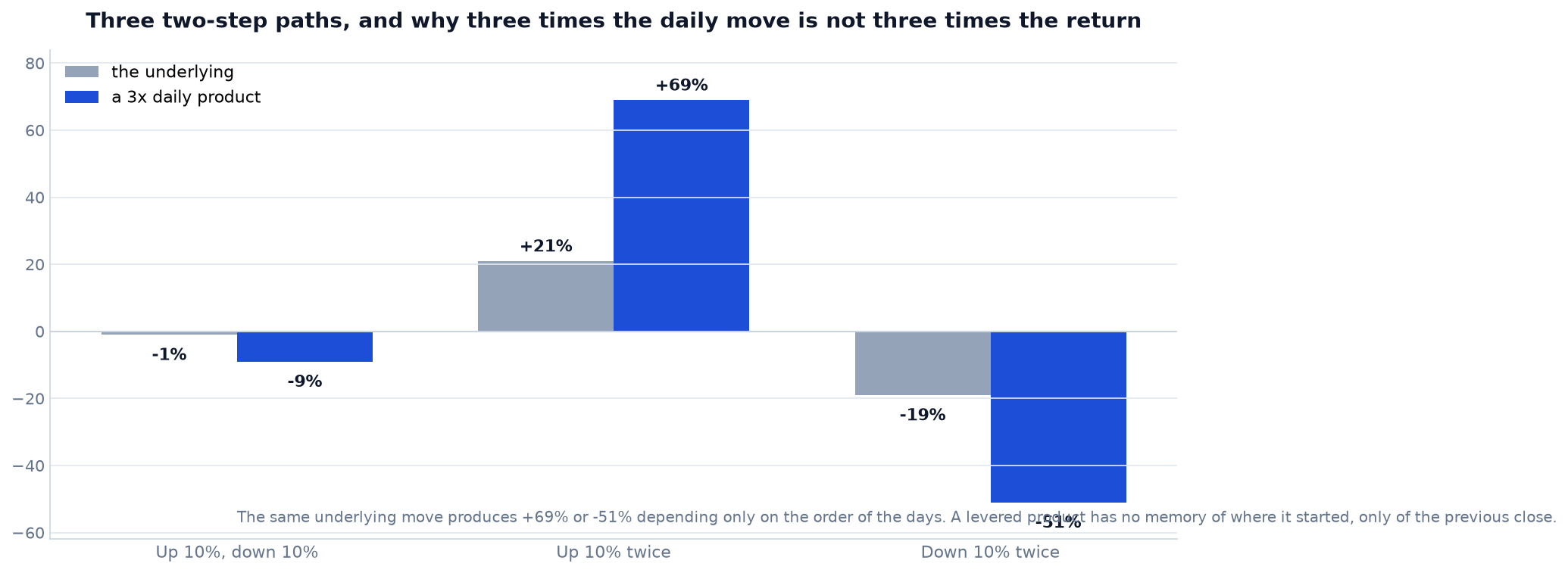
Take a product whose target is three times the daily move, and a two-day sequence. On the first path the asset rises ten percent and then falls ten percent. The asset ends at ninety-nine percent of where it started, a loss of one percent. The product multiplies by one and three tenths on day one and by seven tenths on day two, ending at ninety-one percent, a loss of nine percent. The product lost nine times as much as the asset on a round trip that went nowhere, and nothing unusual happened.
The second path is two consecutive ten percent gains. The asset ends up twenty-one percent; the product multiplies one and three tenths by itself and ends up sixty-nine percent, which is more than three times the asset’s gain. The third path is two consecutive ten percent declines. The asset is down nineteen percent and the product is down fifty-one percent, which is less than three times the loss but still ruinous in a way that the asset is not.
Those three rows are the entire education. A daily-reset product gives you more than the multiple when the underlying trends, less than the multiple when it chops, and a much worse outcome than the multiple on a round trip. None of this is malfunction or bad faith; it is what compounding a scaled daily return produces, and it follows from the multiplication rather than from anyone’s intentions.
Why the sequence matters more than the destination
The mechanism behind all three rows is the difference between an arithmetic average and a geometric one. An asset’s cumulative return is the product of its daily returns, and that product is always smaller than the sum, by an amount that grows with volatility. Multiplying each daily return by three multiplies that drag by roughly three as well, which is why a leveraged product’s return decays relative to its multiple as the number of days and the size of the daily moves increase.
Two implications follow. The first is that the decay is a function of volatility rather than of direction, so it happens in a market that simply moves a lot, regardless of whether it ends higher or lower. The second is that the effect is compounding rather than arithmetic: a year of four percent daily moves costs a great deal more than a year of one percent daily moves, even if the annual return of the asset is identical.
There is a symmetry worth stating because it is the half that gets ignored. The same mechanism that produces decay in a choppy market produces acceleration in a trending one, and in a strong and persistent uptrend a daily-reset product can beat its multiple over a month. Investors who have made money in these instruments have usually been in that regime, and the experience generalises exactly as well as a winning streak does.
What the fund does every evening
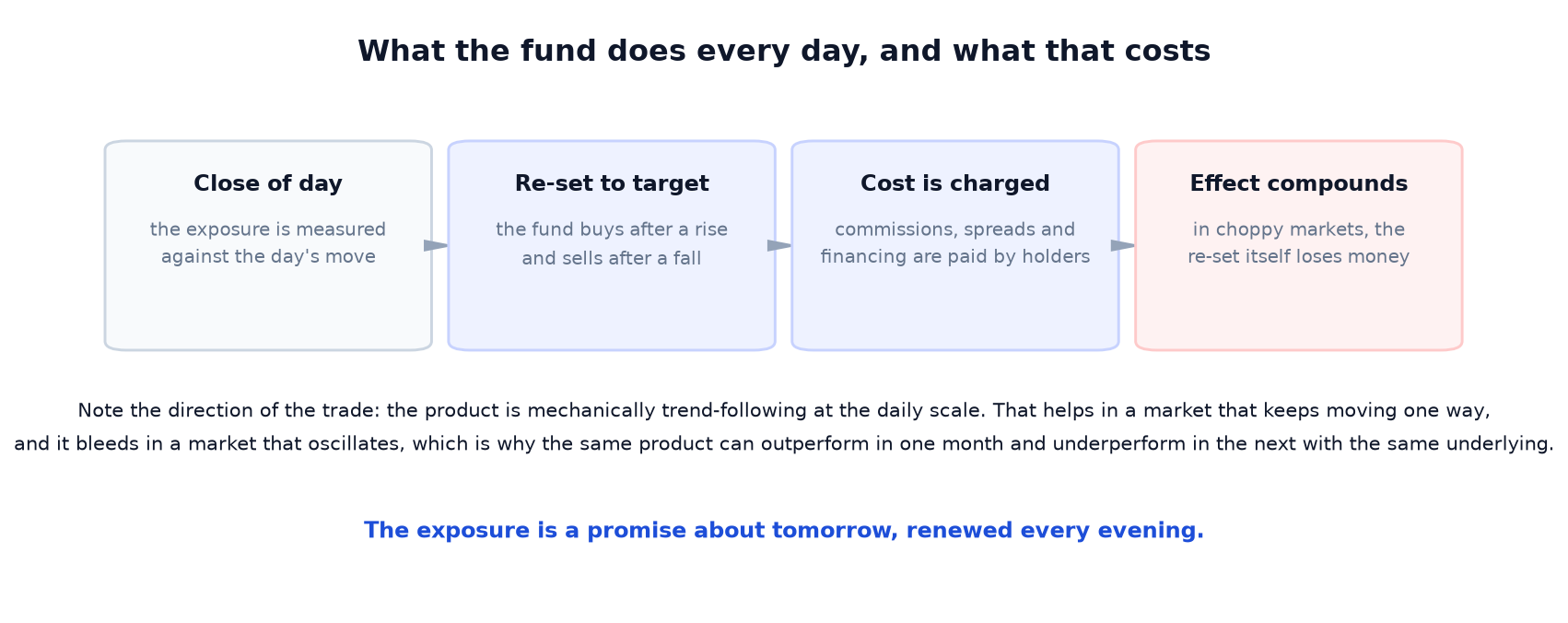
The mechanics of the re-set are worth following once. At the close, the fund measures the value of its exposure against its net assets. If the ratio has drifted above the target, it sells part of the position; if it has fallen below, it buys. The trades happen at whatever the closing market offers, and the associated costs — commissions, spreads, financing where the position is built with borrowed money, and the fee — are charged to the fund and therefore to holders.
Two consequences of that cycle are easy to miss. The first is that the costs are not a risk but a certainty: every day brings a re-set and every re-set costs something, so a holder pays for the machinery whether or not the market cooperates. The second is that the re-set makes the product a participant in its own tracking, and in a market that gaps overnight the fund’s trades at the open can be priced away from the level its documents assume.
Where the exposure is created through derivatives rather than by borrowing, a further layer appears: the fund holds positions with counterparties, and the terms of those positions determine both the financing cost and the fund’s exposure to a counterparty failure. None of that is hidden, and it is not what the buyer of a ticker symbol is thinking about.
The two regimes, stated as plainly as possible
In a trending market, the daily reset is a feature. Exposure grows as the trend continues, so a sustained rise is compounded at an increasing base, and the product can deliver more than the multiple over a period. The annual returns quoted in these products’ marketing material come from that regime, and the mechanism that produced them is the same one that produces losses in the other regime.
In an oscillating market, the reset is a cost. Each round trip leaves the product poorer than the multiple implies, and the loss is proportional to how much the price moved back and forth rather than where it ended. A year of the asset going nowhere with large daily swings is the worst case for the product, and it is also a market state that nobody can predict from the asset’s price alone.
The honest summary is that the instrument is a bet on persistence rather than on direction, at a frequency of one day. A holder who is right about the destination and wrong about the persistence will lose money on a product that is described as offering exposure to exactly that destination, and the description is not false; it is just about a period of one day.
Daily reset versus a margin loan
Both arrangements use borrowed money to increase exposure, and they fail differently. A margin account lets the borrower choose the duration and the size of the position, and it can take the position away when the value falls below a threshold, which is a sudden and total ending. It also lets a patient borrower wait through a drawdown as long as the maintenance requirement is met, which is discretion that no product provides.
A daily-reset product has no liquidation event to fear, because the point of the reset is precisely to prevent the exposure from outrunning the collateral. What it substitutes is the certain drag described above, which arrives in small daily amounts rather than in one dramatic event. For a holder, the trade is discrete and catastrophic risk against continuous and quiet cost, and both choices are legible — which one is worse depends entirely on the horizon over which the position is held.
That comparison is the reason the same instrument can be appropriate for a view lasting hours and inappropriate for a view lasting years, without any change to the instrument or to the holder’s conviction. Duration is the variable that decides which of the two mechanisms dominates, and duration is the thing the product’s name does not mention.
What the regulator approved, and what that changes
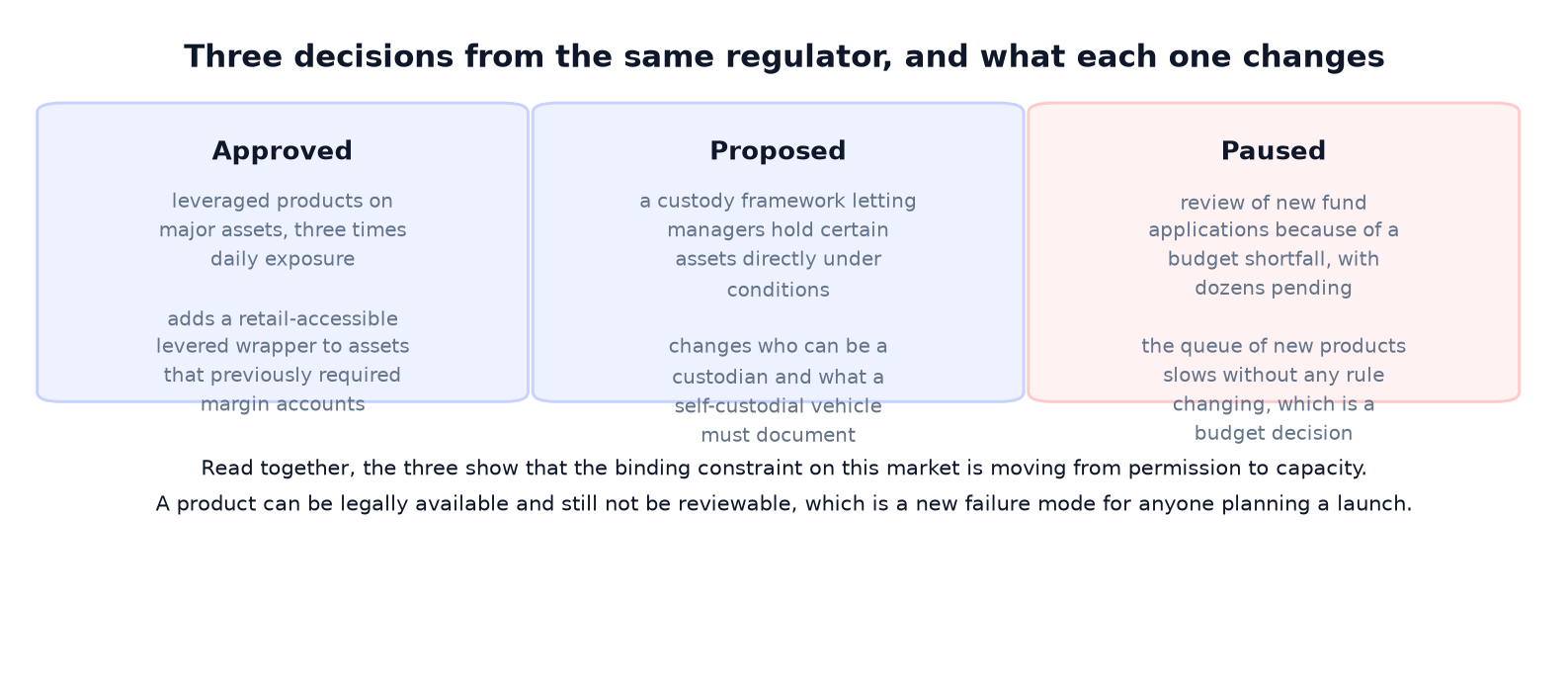
The approval that produced the arithmetic above covers three-times-leveraged exchange-traded products on a list of major assets, including the two largest digital assets and several commodities. The immediate effect is access: a piece of leveraged exposure that used to require a margin account with a broker, and the collateral and paperwork that goes with it, becomes a ticker that can be bought in a normal account subject to platform rules and suitability checks.
The second-order effect is educational in a way that benefits the market’s critics and its participants at once. A product that decays in a range-bound market, available to people who have only seen it quoted in a trend, is a product whose costs become visible in a way that the same exposure on a margin desk never was. Whether that is described as democratisation or as a trap depends on the holder’s horizon, and the arithmetic above applies identically in both descriptions.
One clarification belongs here for anyone reading the filings. Products of this type are described collectively as exchange-traded products, and their legal structures vary: some are registered funds, some are commodity pools, and the registration determines what the vehicle may hold and how it must report. The number in the name is a statement about daily exposure, and the structure is a statement about everything else, and the two should be read from the document rather than from the marketing page.
The custody proposal, which is the more consequential one
The second decision received less attention and reaches further. A proposed framework would allow investment advisers and funds to hold certain assets directly, under conditions, rather than requiring a qualified custodian to hold everything. For digital assets that removes a structural problem which has shaped the industry since the first funds were approved: the requirement for a third party to hold the assets pushed every product toward a small number of specialists, and concentration in custody became the category’s shared risk.
Allowing managers to hold assets directly changes three things at once. It changes who can be a custodian, which changes the fee structure of the industry. It changes what a self-custodial vehicle must document, which is where the conditions in the proposal do their work. And it changes the concentration problem, possibly for the better and possibly not: an adviser holding keys is a smaller target than a specialist custodian, and it is also an adviser holding keys.
The proposal is a consultation rather than a rule, and the comment period is where its shape will be decided. The group that has the most to lose from it is the custodian industry, and the group with the most to gain is the long tail of managers who never launched a product because the custody requirement made the economics impossible. The role of the custodian in the current architecture is worth revisiting before assuming that removing the requirement is straightforward.
The pause, and why a budget line is a market event
The third decision is the one with the least regulatory content and the most practical effect. The agency suspended its review of new applications in this category because of a funding shortfall, leaving a queue of dozens of filings — by some accounts around ninety — awaiting attention, including several whose schedules fall within weeks.
Nothing in that decision changes any rule. A product that was legally permissible on the day before remains legally permissible, and a filing that was pending remains pending. What changes is throughput: the queue stops moving, and the only publicly visible effect is that products which would have listed in the fourth quarter list later, or not at all, without any announcement about which ones or why.
The pause is the clearest illustration of a shift described elsewhere in this market. For a decade the binding constraint on digital-asset products was permission: something was either allowed or not. With frameworks written and exemptions in place, the constraint has become capacity — the number of filings an agency with a fixed budget can process, and the number of opinions its staff can form. A market whose growth depends on a queue is a market whose growth depends on appropriations, which is a sentence that would have read as absurd five years ago.
Three decisions, one pattern
Read together, the week’s three decisions separate the parts of this market that are settled from the parts that are not. The product question is settled: leverage on major assets is available in a retail wrapper, and the arithmetic that governs it is now something an ordinary investor can be shown rather than a hidden property of a broker’s margin desk.
The custody question is open and consequential, because it decides whether the concentration of assets in a handful of specialist holders continues or reverses. And the capacity question is neither open nor closed: it is a function of budgets and staffing, which means it can change without anyone in this industry doing anything.
The common thread is that each of the three is about infrastructure rather than about assets. None of them changes what bitcoin is; all of them change who can hold it, in what wrapper, and how quickly a new wrapper can be approved. Markets are more sensitive to those three things than to any narrative about adoption, which is why a filing queue and a custody consultation deserve the same attention as a price.
Three judgements worth carrying
If a reader takes nothing else from the arithmetic, three short rules cover most of the situations that go wrong. Look for the word daily in any description of a leveraged product, and if it is absent from the marketing, find it in the document; the entire difference between expectation and outcome lives in that one word. Judge the instrument by the path rather than by the endpoint, because a rally with a lot of noise in it will produce a different result from an equally sized rally in a straight line. And treat the re-set cost as a certainty rather than as a risk, since it is charged every day whether or not the market moves.
Those three judgements are not opinions about crypto, and they do not depend on any view about the underlying. They are the operating manual for a specific financial object, and the object is now available to anybody with a brokerage account.
Where this account is uncertain
Two limits belong in the record. The first is that the exact structure and timing of the re-set varies by product: some settle at a particular hour, some use derivatives rather than borrowed cash, and the financing terms differ, which means two products with the same number in the name can have measurably different tracking. The illustrations above describe the mechanism, not any specific fund’s results.
The second is that the capacity situation is reported rather than documented. The size of the queue and the reason for the pause are stated in coverage of the agency rather than in a filing, and it is not disclosed which applications are affected or in what order they will resume. That is a normal consequence of an administrative bottleneck, and it means that anyone modelling a launch date should treat the queue as a variable rather than as a schedule.
What the fee and the financing add up to
The daily re-set is the visible cost, and two more costs sit underneath it that a buyer should be able to estimate before buying.
The first is the management fee, charged on the fund’s assets and therefore also on the borrowed portion, which means it is effectively charged on the exposure rather than on the equity. The second is financing. Where the exposure is built with borrowed money or synthetic positions, the holder pays a rate tied to short-term funding, plus a spread the counterparty keeps. In an environment where short-term rates are at the levels described earlier in this market, that financing is a material annual number rather than a rounding error, and it accumulates every day the position is held.
Add the three together — the fee, the financing, and the trading cost of the re-set itself — and the picture is one of a product with a cost structure that is continuous and a return that is path-dependent. Both of those properties point in the same direction for a holder with a long horizon, and both are visible in a document rather than hidden in a footnote.
The practical test is short. If the expected holding period is measured in days, the financing and the re-set costs are small relative to the exposure being sought, and the instrument does what it says. If the expected holding period is measured in quarters, the same costs are certain while the return is not, and the comparison is no longer between the product and the asset but between the product and a leveraged position the holder could structure differently.
The lesson of the arithmetic
Leverage in a wrapper is not a new idea, and it has always had the same property: it multiplies outcomes and it also multiplies the cost of staying in place. What changed in October is access and disclosure, and both changed in the direction of making the property visible to people who previously encountered it only through a margin call.
The arithmetic is the part that stays true regardless of the wrapper, the regulator or the asset. Three times a daily return is not three times a return, and the difference between those two phrases is the distance between a product that does what it says and a product that does what a holder thought it said.


