


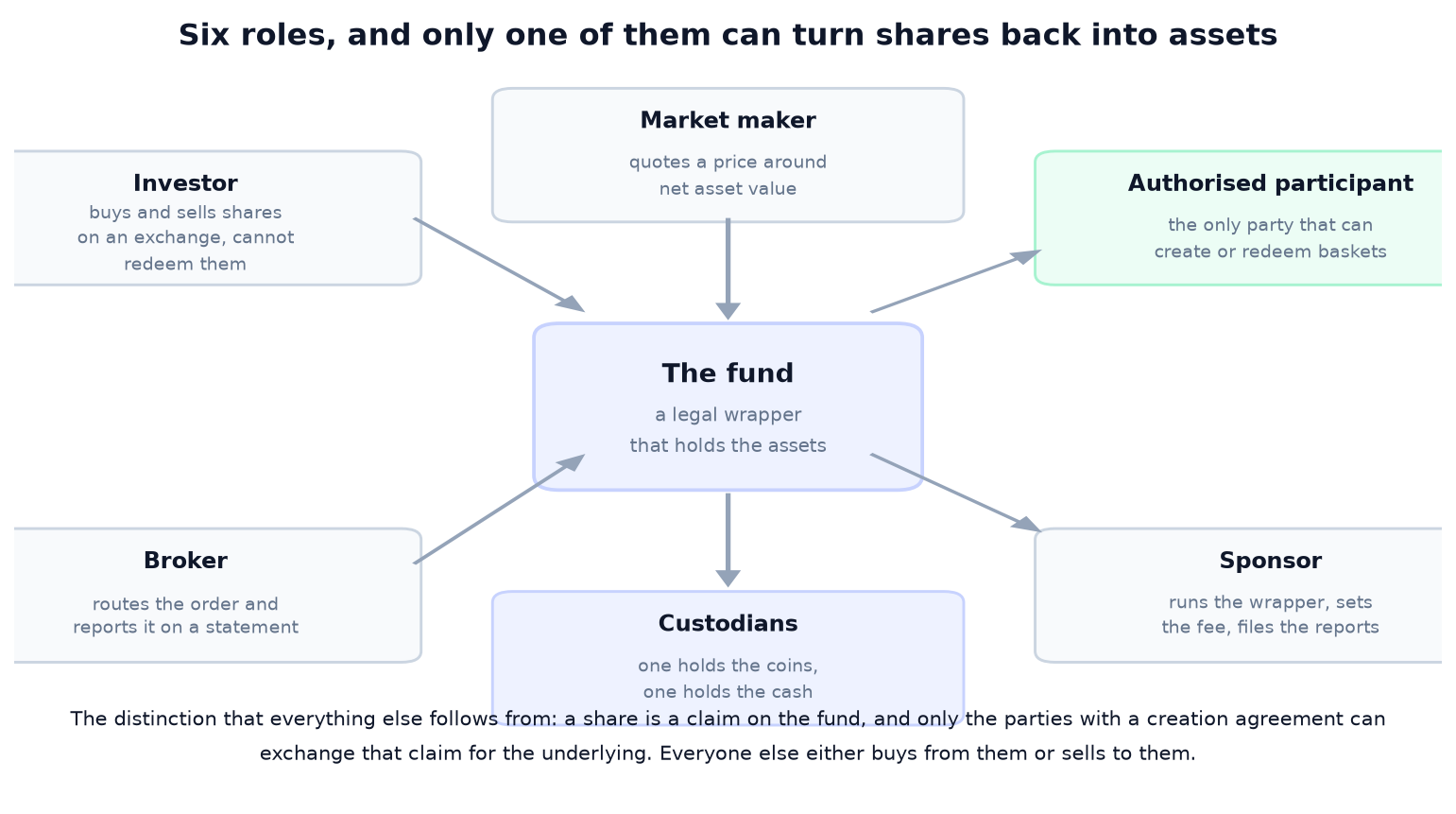
A spot crypto exchange-traded fund is not a coin in a wrapper, and the wrapper is not the interesting part. It is a legal entity that holds assets, a set of shares that trade on an exchange, and a single narrow channel through which shares can be exchanged for the assets behind them. Six roles sit around that channel, and only one of them is allowed to use it. Everything a holder experiences — the price on the screen, the statement from a broker, the fee deducted inside the fund, the difference between the share price and the value of the holdings — comes from the interaction between those six roles and the two markets they connect.
The frame is worth adopting because the alternative framings mislead in predictable ways. Describing the fund as “bitcoin in a brokerage account” hides the fact that a share is a claim on a fund rather than a balance of coins, and that redemption belongs to somebody else. Describing it as “just another ETF” hides the peculiarities of a commodity trust: no dividends, no yield, no lending, and a custodian whose failure mode is a key rather than a vault. This article walks the six roles and then the loop that connects them, because the loop is where the price is actually made.

Role one: the investor, who buys a claim rather than a coin
An investor buys a share through an ordinary brokerage account, and what they own is a proportionate interest in a trust. The trust holds coins with a custodian and cash with a bank, and the share is a claim on that pool rather than on a specific quantity of anything. The taxonomy matters for two practical reasons: the position appears on a securities statement rather than a crypto one, and it is sold by whoever makes a market in it rather than by the fund.
The consequence that surprises people is the one about redemption. A shareholder cannot call the fund and ask for coins, at any size. The mechanism that converts shares into assets is available only to institutions with a creation agreement, which means a retail holder’s route out is to sell the share to somebody else on an exchange. That is not a limitation unique to crypto funds; it is how the structure works for every ETF, and it is invisible until the moment a market is dislocated and the difference between selling a claim and redeeming it becomes the whole story.
Two further properties follow from the wrapper. The first is that the share has no intrinsic yield, because the underlying has none, so the total return is the change in the value of the coins minus the fee. The second is that the position carries the tax treatment of a security, which in the United States means gains and losses are realised when the share is sold, in contrast to the treatment of the underlying asset for a holder who moves it between wallets.
Role two: the broker, who routes rather than executes
The broker is the visible edge of the system and the least powerful participant in it. It routes the order to a venue, reports the fill, holds the position on the customer’s behalf, and supplies the tax documents at year end. It does not hold the coins, does not control the fund, and cannot create or redeem shares, though one broker may also be a participant in the fund’s ecosystem in a different legal capacity.
What the broker does decide, quietly, is access. Whether a share can be bought at all, whether it can be bought in a retirement account, whether it can be used as collateral, and whether it can be lent out under a securities lending programme are broker and platform policies. Those decisions are commercial rather than technical, and they explain most of the variation in what retail holders in different countries and different platforms can actually do with the same fund.
Role three: the market maker, who quotes the price the investor sees
The price on the screen is not set by the fund. It is set by market makers who quote a bid and an offer continuously, and they do so around their estimate of the value of the underlying holdings. The width of the spread they charge compensates them for inventory risk, for the cost of hedging, and for the possibility that the assets move while they are holding the other side of a trade.
Two features of this role are worth knowing because they explain quiet behaviour. A market maker is not obliged to keep quoting. When volatility rises or when the connection between the two markets becomes unreliable, quotes widen or disappear, which is the mechanism by which liquidity evaporates exactly when the market wants it most. And a market maker’s pricing depends on the participant channel being open, because the ability to hedge a position against the underlying is what makes a tight quote possible. The two roles are commercially separate and technically inseparable.
Role four: the authorised participant, the only door in the wall
The creation and redemption channel is narrow by design. Only firms that have signed an agreement with the fund’s sponsor may deliver assets to the fund and receive newly issued shares, or deliver shares and receive assets. They do it in large blocks rather than in retail orders, they do it for their own account rather than on behalf of customers, and their profit comes from the difference between the value of the assets they deliver and the market price of the shares they receive.
For a spot crypto fund, the mechanics of that delivery have a wrinkle that matters. Where an equity fund can deliver the actual securities, a fund holding coins operates in a cash-creation mode: the participant delivers cash, and the fund — or its agent — buys the coins in the spot market. The result is that the fund’s execution happens after the order rather than with it, which introduces a small timing difference between the moment the share is created and the moment the assets are acquired. The rules around in-kind delivery for these funds have been revisited in the last two years, and the mode a particular fund operates in is stated in its prospectus rather than in its marketing.
The number of participants is the second feature that matters, and it is not known to the public with precision. A fund with many participants and a competitive relationship between them has a tight arbitrage margin; a fund with one participant has an arrangement that depends on a single firm’s willingness to bid. When a share price drifts away from the value of the holdings and stays there, the reason is almost always in this role rather than in the market maker’s quote.
Role five: the sponsor, who owns the wrapper
The sponsor runs the fund: it files the documents, engages the custodians, sets and collects the fee, and determines what the fund is permitted to do with the assets. For a spot crypto fund the legal form is usually a trust holding a single commodity rather than a fund registered under the investment company framework, and that choice has consequences that are easy to miss.
A trust of that kind is generally restricted from the activities a typical fund would use to offset its costs: it cannot lend the assets for a return, it cannot pledge them, and it cannot stake proof-of-stake assets to earn the network’s reward. The restriction is structural rather than custodial, which is why the debate about whether a staking yield can be passed through to holders is really a debate about the wrapper rather than about the coins. Any change in that area is specific to each fund and each filing, and the operating document is the only reliable source.
The fee is the sponsor’s revenue, and it is the most competitive number in the industry. The market currently spans from fourteen basis points for a bank-branded fund launched undercutting the field to twenty-five for the largest one, with several products clustered in between and some funds relying on temporary waivers. A fee difference of eleven basis points is a marketing decision rather than a cost advantage, because a sponsor with a distribution network large enough to move assets can treat the fee as an acquisition cost.
Role six: the custodians, where the failure mode is a key
Two custodians usually sit behind one fund, and they hold different things. One holds the coins, in a segregated account, and its operational security is the whole substance of the arrangement. The other holds the cash used for subscriptions and redemptions, and it is an ordinary banking relationship. Some funds use the same parent for both roles, and some split them, which is a governance choice worth noticing.
The peculiarity of the first role is that custody of a bearer asset is a different kind of promise from custody of a security held in the depository system. There is no register to correct, no transfer agent to intervene, and no court order that moves a coin by itself: whoever holds the keys can move the assets, and every other protection is procedural. That fact is why these funds disclose the custodian prominently, why audits of such a custodian’s controls matter more than the size of its balance sheet, and why the arrival of bank-branded funds using the same crypto-native custodian was such a revealing detail about where the industry’s expertise sits.
The loop that keeps the share price near the assets
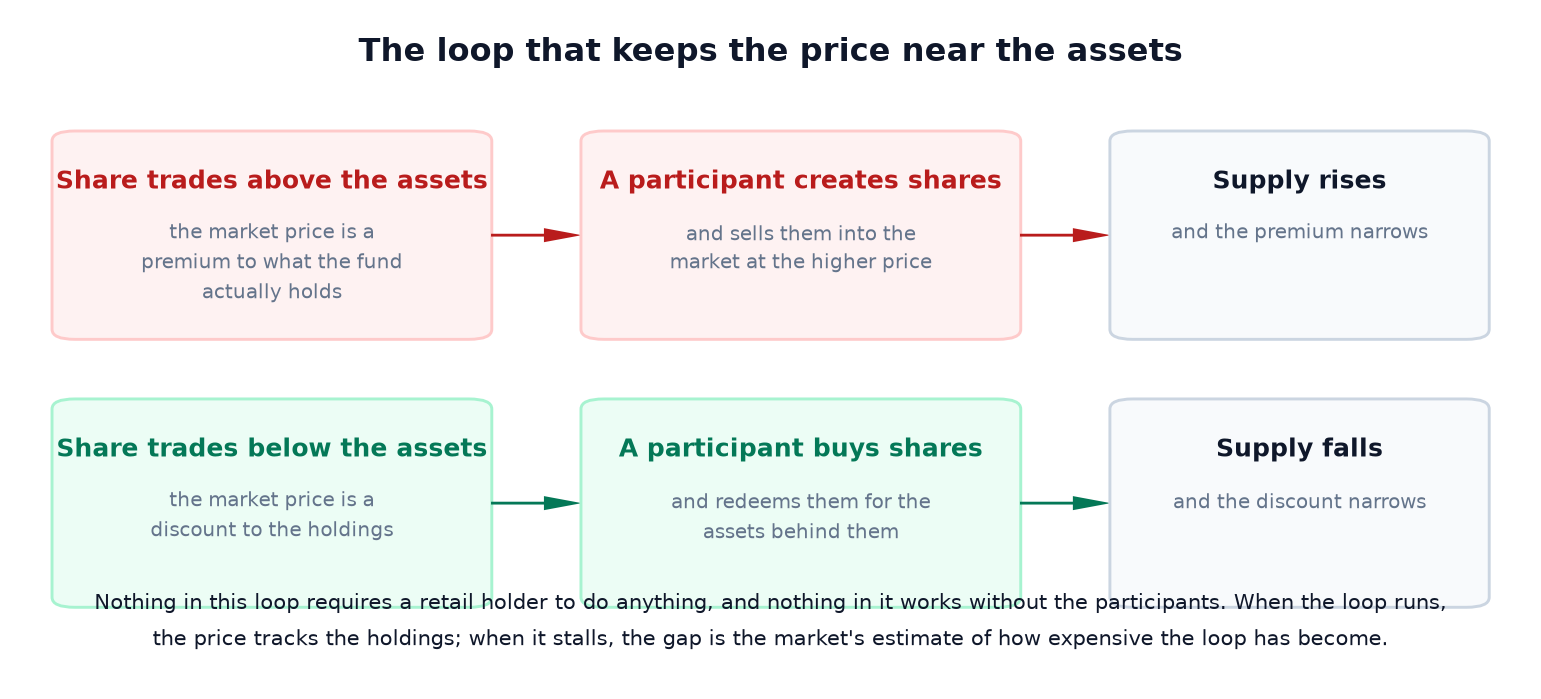
The mechanism that ties the two markets together is a pair of trades available to one role. If shares trade above the value of the assets they represent, a participant buys the assets, delivers them to the fund, receives newly created shares, and sells those shares at the higher market price. If shares trade below that value, the same participant buys shares in the market, redeems them for assets, and sells the assets. In both directions the profit is the gap, and the side effect is that the gap closes because the trade itself moves both prices.
Three implications follow, and each one is a common source of confusion. The first is that the anchor for the share price is not the marketing claim that the fund is backed by coins; it is the profitability of the arbitrage. The second is that a persistent premium or discount is a statement about that profitability rather than about the fund’s honesty, and the usual causes are a closed channel, an expensive hedge, or a participant that has run out of balance-sheet capacity. The third is that the loop is entirely institutional: no retail action is part of it, and no retail action can substitute for it.
The loop also explains why the flows that get reported every day are a poor guide to what the fund is doing. A creation happens when a participant finds the arbitrage attractive or when a large client wants exposure, not when a retail order arrives. The daily flow numbers describe decisions made upstream, which is why they track sentiment and follow price rather than the other way around.
Where the money goes, and what it costs to hold
A holder pays three costs, and they are not equally visible. The management fee is deducted inside the fund and reported as an expense ratio. The trading spread is paid once, on entry and again on exit, and its size depends on the market maker’s view of risk at that moment. The tracking difference is what remains after the fee: the gap between the return of the share and the return of the assets it holds, caused by the fund’s own execution, cash drag and operational timing. The first is published, the second is quoted, and the third has to be computed from two return series.
Scale changes the significance of each. In a market where one fund alone holds tens of thousands of coins and the category has taken in more than fifty-seven billion dollars since launch, with assets under management above a hundred billion, the fee is a steady institutional revenue line and the spread is a fraction of a percent on a retail order. Both are dwarfed, for most holders, by the volatility of the underlying, which is precisely why comparing funds on fee alone is a mistake and why the useful comparison is between tracking differences measured over the same period.
What each role can do to a holder
| Role | What it can change | What a holder can do about it |
|---|---|---|
| Investor | Nothing; this is the holder’s own position | Sell the share, or hold it |
| Broker | Whether the share can be bought, held in a retirement account, or lent out | Change platform |
| Market maker | The spread, and whether a quote exists at all | Trade in liquid hours, or accept a wider price |
| Authorised participant | Whether the creation channel is open and how tightly it arbitrages the gap | Nothing directly; watch the premium |
| Sponsor | The fee, the custodian, and whether the fund continues | Sell, or choose a different fund |
| Coin custodian | Whether the coins are where the fund says they are | Read the disclosures and the control reports |
Read down the third column and the asymmetry is clear. A holder has two choices that work immediately, which are to sell and to switch, and both operate on the position rather than on the fund. Every other row is a fact to be assessed before buying rather than a lever to be pulled afterwards, which is the same conclusion that applies to any pooled vehicle: the difference between holding a claim and holding an asset is decided at the moment of purchase rather than at the moment of trouble.
Five things a share is not
The wrapper is easiest to understand by listing what it excludes, because each exclusion removes a risk the holder might otherwise assume is covered.
| A share is not | What that means in practice |
|---|---|
| A coin | There is no private key and no address. The position cannot be moved to a self-custody wallet or spent directly. |
| Redeemable by its holder | Only authorised participants can exchange shares for assets, so a retail exit is a sale to somebody else. |
| Direct ownership of the underlying | The coins belong to the trust, and the holder owns a proportionate interest in the trust. |
| On a blockchain | The shares are recorded in the conventional settlement system, which is why they appear on a brokerage statement. |
| Free of the fund’s limits | The wrapper restricts activities such as lending or staking the underlying, and it does so structurally rather than as a temporary policy. |
The exclusions are not defects; they are the reason the product was approved at all. A fund that let holders redeem coins directly would be a different instrument with different custody, tax and securities implications, and the entire architectural point of an exchange-traded wrapper is to concentrate those complications into a small number of participants who are equipped to handle them.
What the first two years showed
The category launched in January 2024 and has spent its short life demonstrating which parts of the design matter. Cumulative net inflows have passed fifty-seven billion dollars, assets under management have exceeded a hundred billion, and the holdings represent a little under six and a half percent of the asset’s total market value — a substantial institutional position assembled without any holder being able to redeem a coin.
Three other observations come from the same record. The first is that fees compressed faster than anyone projected, from a field clustered near twenty-five basis points to a bank-branded product at fourteen, and the compression came from distribution economics rather than from cost. The second is that flows behave like sentiment rather than like a leading indicator: months of steady accumulation interrupted by a single day of outflows and resumed the next day, with the arrival and departure of orders following the price rather than preceding it. The third is that custody has not diversified as much as the number of funds suggests, with several large products relying on the same crypto-native custodian, which makes one operational risk shared across a category.
The pattern across all three is the same. The technology question was settled in 2024 and the remaining competition is about distribution, fees and custody arrangements, which is the ordinary shape of a mature asset-management product rather than the shape of a technology transition.
The two sentences worth keeping
A spot crypto ETF is a trust that holds coins and issues shares, a channel that only authorised participants may use, and a market that prices the shares. The price tracks the holdings because the channel makes ignoring the gap expensive, and the channel is institutional by design, so the retail holder’s relationship with the fund is a securities position and not a redemption right.
That structure is neither a flaw nor a trick; it is the standard architecture, and it is why the product succeeded where a decade of alternatives did not. What it changes for a holder is the list of things worth checking before purchase rather than after: the fee and the trading spread, the identity of the custodians, the legal form of the wrapper and what it forbids, and the number of participants who can act when the market misprices the fund. None of those appear in a price chart, and all of them are the reason two funds holding the same coins can produce different outcomes for the same person.


[…] who never launched a product because the custody requirement made the economics impossible. The role of the custodian in the current architecture is worth revisiting before assuming that removing the requirement is […]