


Every dollar token is accompanied by at least four documents, and almost nobody reads them. There is the set of terms that says what the holder actually owns, the reserve disclosure that says what is on the other side, the redemption schedule that says how a holder converts one into the other, and the contract-level controls that say who can stop a balance. The price is a dollar and the interface is identical in every case, so the documents are the only place where the differences between two tokens live, and they are the first thing to read when a price stops being a dollar.
This is a review in the order a reviewer would work through it, from the terms of service outward. It is not a ranking of issuers, and it makes no claim about which design is safest, because that judgement depends on a portfolio and a time horizon rather than on a document. What it does is name the specific sentences that decide what a holder can and cannot do, and separate them from the sentences written for the marketing page.
Document one: what the terms say the holder owns
The first sentence to look for is about ownership, and it almost never says what a holder assumes. A dollar token is not the holder’s property in the way a banknote is. It is a claim on the issuer, recorded in a contract, and the terms typically describe the token as a prepaid or contractual right rather than as a deposit. That single classification decides which queue a holder stands in if the issuer fails, and it is settled in a paragraph rather than in a price chart.
The second sentence to look for concerns redemption rights, and its structure is consistent across the largest issuers: redemption at one to one is available to the issuer’s own customers, on the issuer’s own terms, subject to identity checks and minimum sizes. A holder on a secondary venue is not that customer. They hold the token, they can sell it in a market, and the one-to-one exchange that anchors the market price is performed by parties who have an account with the issuer.
The third is about discretion. Terms of this kind normally preserve the issuer’s right to refuse service, to require additional information, and to suspend conversions during circumstances it defines. Those clauses are not exotic, and they are the reason a depeg is better described as the market repricing the redemption path than as the market repricing the reserves. The assets can be exactly where the disclosure says they are while the path narrows.
Document two: the reserve disclosure, read as a document
The reserve disclosure is the most quoted and least read document in the category. Its standard form is an attestation, which is an outside firm stating that specified assets existed at a specified time. The words to check are the date, the custodian, the categories of asset, and the scope of the engagement, because those four items are what the statement actually covers.
| Line in the disclosure | What it establishes | What it does not |
|---|---|---|
| The date | Reserves existed then | Anything about any other day |
| Asset categories | What kind of instruments are held | Their duration, liquidity or counterparty risk in detail |
| The custodian | Where the assets sit | Whether they are segregated from the issuer’s own estate |
| The scope statement | That this is an attestation rather than an audit | Any test of the controls behind the balance |
| The absence of a liability column | Nothing, because it is absent | Whether tokens issued exceed assets held |
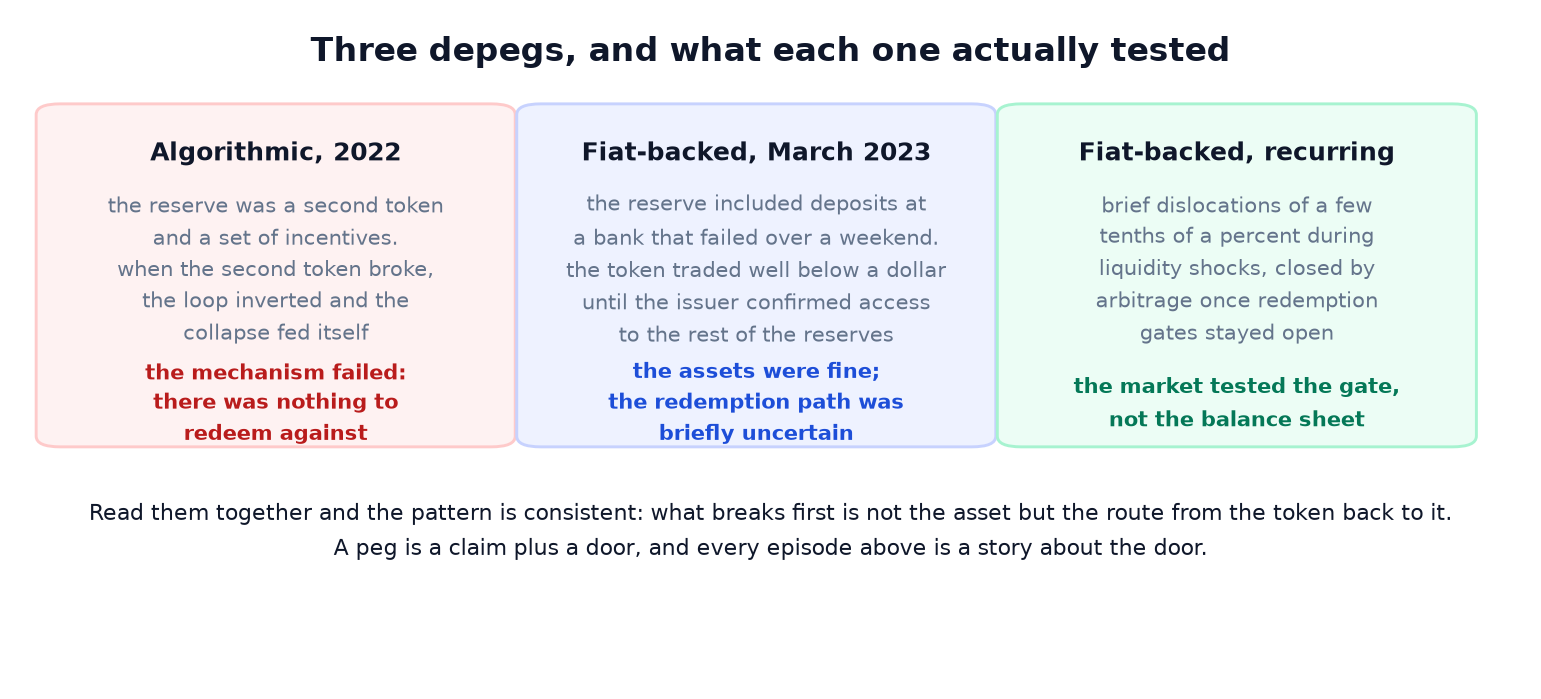
The composition question has become more consequential than the total, and the reason is a specific episode. In March 2023 a fully reserved token traded several percent below a dollar because part of its reserve sat as deposits at a bank that failed over a weekend. The assets were eventually whole and the price still moved, because for a period nobody could establish how much of the reserve was reachable that week. Since then the composition of reserves and the identity of the custodians have been treated as part of the credit assessment rather than as a footnote to it.
Regulation has partly standardised this. The framework signed in the United States in July 2025 requires payment stablecoin issuers to hold reserves in high-quality liquid assets, to segregate custody, and to disclose periodically. That narrows the range of what a disclosure can contain, and it does not change the fact that the document describes a date rather than an ongoing condition.
Document three: the redemption schedule
If reserves are the asset side, redemption is the plumbing, and the plumbing has parameters that decide how the peg behaves under stress.
| Parameter | Why it matters | What a narrow setting produces |
|---|---|---|
| Who is eligible | The arbitrage that holds the peg needs accounts at the issuer | A retail market that can sell but not redeem |
| Minimum size | Determines how many participants can arbitrage a small gap | Wider spreads on small dislocations |
| Settlement time | Sets how long a redemption is exposed to price movement | Capital that demands a discount for waiting |
| Fees | A cost floor for the arbitrage trade | Persistent small deviations in one direction |
| Supported venues | Whether the token can be redeemed on the chain it sits on | Cross-chain balances that must travel before converting |
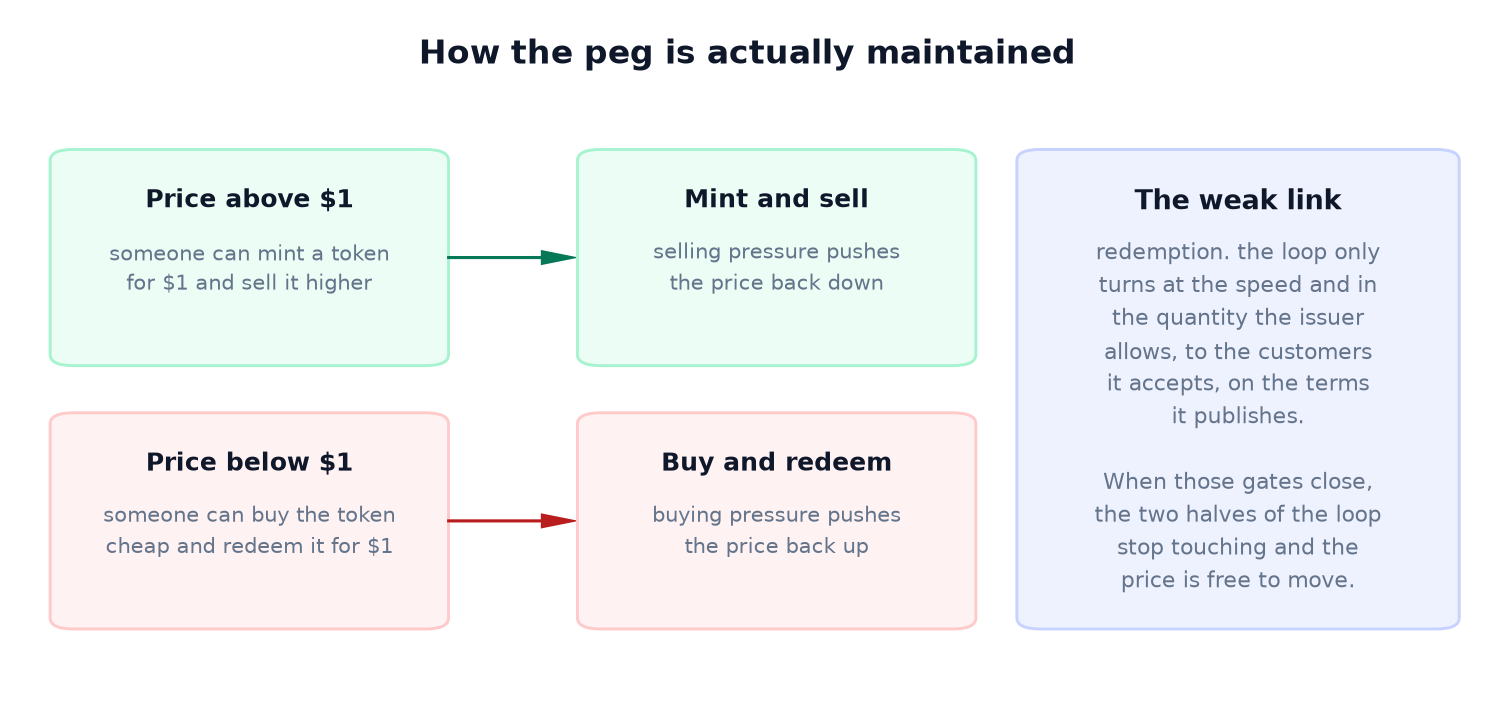
Read as a schedule rather than as a promise, redemption explains why stablecoin prices behave the way they do in normal conditions. Small gaps are closed quickly because the trade is nearly riskless for anyone with an account, and the size of the gap that persists is the size that is too small to be worth the settlement time and the fee. When the gap widens beyond that, the market is saying that the participants able to execute the trade have either run out of capital, run out of appetite, or stopped believing the settlement window.
Document four: the freeze clause
The controls at the contract level are the least discussed and the most immediately consequential part of the arrangement. A fiat-backed token issued as a contract on a public chain typically exposes a function that the issuer can call to place an address on a list that prevents it from transferring the token. The clause exists because the issuer is regulated as a money services business and is expected to be able to act on a lawful order, and it works because the contract is a program with an owner.
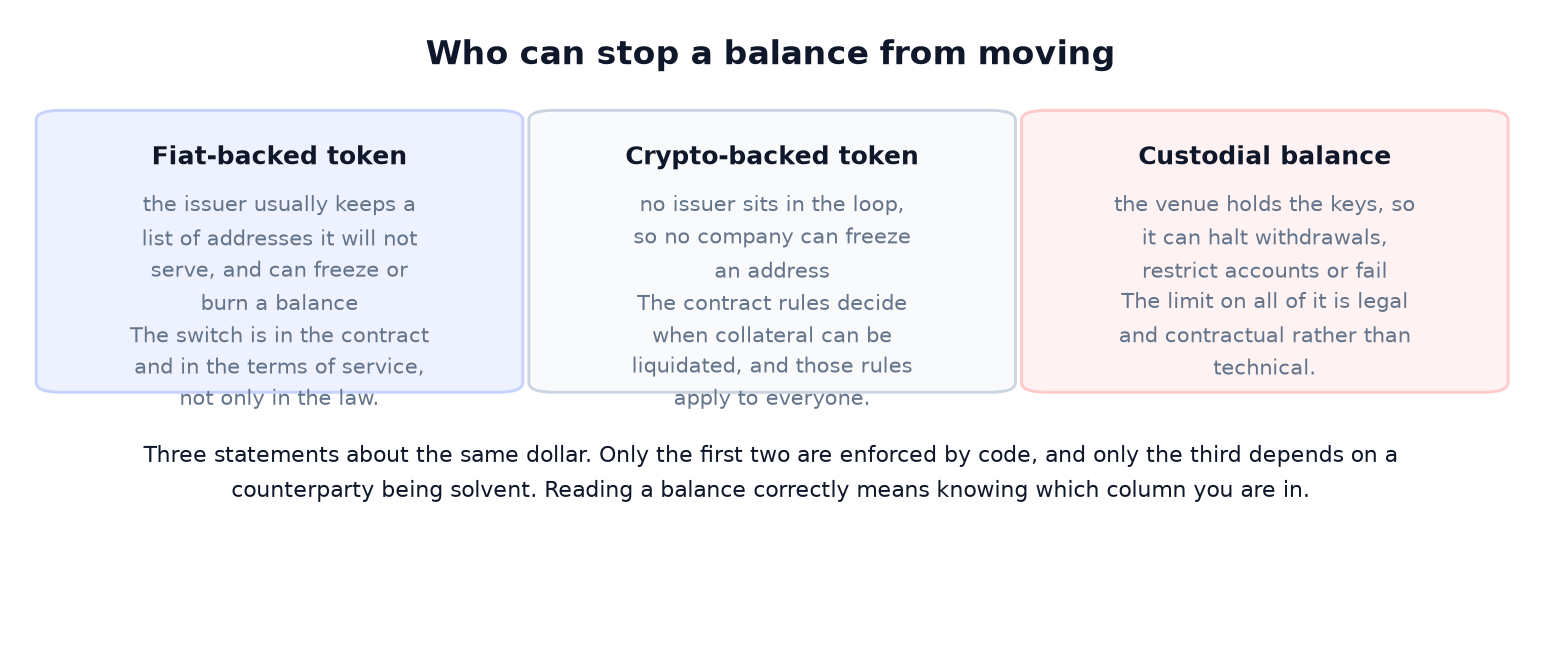
Two practical points follow. The first is that a freeze is not a legal fiction that a holder can argue with in the moment; it is an instruction that the contract executes on a balance regardless of consent, and the recourse, if any, is in a complaints process afterwards. The second is that the same capability appears in the report that has been published about tokens used to move illicit funds, which is why issuers describe it as a feature rather than an admission.
A crypto-backed stablecoin has no equivalent clause because there is no issuer inside the loop. The contract rules decide when collateral can be liquidated, and those rules apply identically to every holder, which is a different distribution of power rather than an absence of controls. A custodial account at a venue is the third case: the venue holds the keys, so it can halt withdrawals, restrict accounts or fail, and the only constraints are contractual and legal.
The clause that decides an insolvency
The most consequential sentences in the whole set are rarely in the token’s terms at all. They are in the structure around the reserves, and they answer two questions: are the assets held in a way that keeps them out of the issuer’s estate if the issuer fails, and what is the order of claims against them?
A segregated, bankruptcy-remote structure is a design in which the reserve is held by an entity separate from the operating company, so that the assets are not available to the operating company’s general creditors. Where that is absent, a holder’s claim competes with everyone else’s. The distinction is a matter of corporate and trust law rather than of cryptography, it is disclosed in different documents depending on the issuer, and it is the difference between losing time and losing principal.
Regulation has moved this question from contract drafting into statute in one important respect. The 2025 framework requires issuers to segregate custody and hold reserves in specified asset classes, which reduces one class of risk and leaves the claim-ranking question to whoever wrote the structure. A reviewer reads the operating agreement for that answer, and the marketing page will not contain it.
Three designs, three sets of documents
The document set differs by design, and the differences are visible enough to be diagnostic rather than theoretical.
| Question a reviewer asks | Fiat-backed | Crypto-backed | Algorithmic |
|---|---|---|---|
| What is the first document | Terms of service | The contract and its parameters | The mechanism’s specification |
| How is the asset verified | Periodic attestation by an outside firm | Continuously, from public state | Not applicable; there is no full reserve |
| Who can freeze a balance | The issuer, through a callable control | No counterparty exists | Usually a governance function |
| How does redemption work | Through the issuer, on the issuer’s terms | Through the contract, on fixed rules | Through the market at whatever price it offers |
| What breaks first | The path to the asset | The value of the collateral | Demand for the mechanism’s incentives |
The category’s history is largely a record of those answers being tested. An algorithmic token whose mechanism was the reserve collapsed in May 2022 when the mechanism required buyers of a falling asset to defend a peg. A fully reserved token with a concentrated banking relationship traded below par in March 2023 when the reachability of part of its reserve was unclear. Fiat-backed tokens have repeatedly drifted a few tenths of a percent during liquidity shocks and recovered within hours, which is the mechanism working exactly as designed.
What none of the documents say
A careful review ends with a list of absences, and the absences are consistent across the category. No token’s terms describe what the issuer will do about the peg during a crisis beyond the general right to suspend, and no disclosure describes how reserve management would behave if a large redemption arrived while the reserve’s assets were illiquid. Those are decisions rather than omissions, and they are made by people at the moment they become necessary.
Two further absences are worth naming. The first concerns the supply of the token, which is publicly verifiable on chain and says nothing about who holds it: a frozen address, a treasury wallet and an exchange’s omnibus account all look like ordinary balances. The second concerns the ecosystem around the token, which is where the practical risk often sits. A dollar token used as collateral in lending markets, or as the settlement asset on a venue, connects its reserve quality to positions that the issuer never agreed to and does not disclose.
The scale of the category makes those absences matter beyond any single holder. Supply sat at roughly $308 billion in August 2026, with one issuer accounting for about 59 percent of it and the second for about 23, and most aggregate statements about stablecoins are therefore statements about two balance sheets. A category of that size concentrated in two issuers is a system where the quality of two sets of documents decides how a large part of the market prices dollars.
Document five: the venue’s terms, which are longer
A dollar token held at a trading venue has one more document attached to it, and it is the most consequential of the set because it is not about the token at all. A venue’s terms describe an account relationship: what the balance represents, when withdrawals can be suspended, what happens to positions in the event of an insolvency, and what authority the venue has over the assets it holds for customers.
Three clauses in that document change the risk profile of a dollar balance more than any property of the token. A suspension clause allows withdrawals to be halted while trading continues, which means the balance can be visible and unusable at the same time. A set-off or lien clause allows the venue to apply a customer’s balance against obligations the customer is said to owe, including obligations arising from products the customer was sold by the same venue. And a claims-ranking clause determines where a customer sits if the venue fails, which in most jurisdictions depends on whether assets were held in segregated custody or treated as part of the venue’s own estate.
The pattern worth noticing is that these clauses are drafted by the party that benefits from them, they are agreed to by a click, and they apply to a balance that looks exactly like a self-custody balance in the interface. Reading a stablecoin’s four documents and skipping the venue’s terms describes an instrument while ignoring the arrangement the holder is actually relying on.
How a claim is tested rather than read
Documents are statements, and some of what they claim can be checked against data that nobody controls. Three of those checks are available to anyone with a browser, and each one tests a different sentence in the paperwork.
The first is supply. The number of tokens outstanding is written in the contract and readable from any node, so it can be compared with the figure the issuer publishes. A discrepancy here is not a matter of interpretation; it means one of the two numbers is wrong, and it is worth knowing which one is authoritative before doing anything else. The second is the address distribution, which shows how concentrated the supply is and whether particular addresses have been frozen or excluded from transferring. A frozen balance is an ordinary-looking number in a ledger, and the fact that it can be identified on chain is the strongest argument in favour of the transparency this category inherits from its underlying chain.
The third is the market itself. A secondary price that sits consistently a few tenths of a percent below par is a statement about the cost and speed of the redemption route, and a widening spread is a statement that the participants able to use that route have stepped back. Neither observation says anything about reserves. Both are measurable continuously, and they are the fastest available signal that something in the document set is being repriced.
What the rules changed, and what the newest structures are testing
The framework signed in the United States in July 2025 rewrote parts of the paperwork rather than the technology. Issuers of payment stablecoins are required to hold reserves in high-quality liquid assets, to segregate custody, and to disclose periodically, and they are prohibited from paying yield to token holders. The first three requirements standardise sentences that used to vary by issuer. The fourth creates a specific incentive to restructure.
That incentive explains the newest designs in the category. If reserve income cannot be paid to holders, it can be paid to the parties that distribute the token, and it can be paired with equity allocated on the same contribution basis. One launch in September 2026 did exactly that, routing nearly all reserve earnings to its distribution partners and giving them a claim on the company rather than a yield on the balance. It is a legal distinction with an economic purpose, and analysts have flagged it as a structure worth watching, because the boundary between a payment for distribution and a payment for holding is a boundary an issuer has a reason to test.
Read against the documents, the movement is easy to follow. Regulation standardised the reserve disclosure and the custody arrangement, which removed most of the room to compete on reserve quality. Competition moved to distribution, then to the terms of the distribution agreement, then to the cap table behind it. A reviewer who wants to know what changed in this category in a single year reads the operating agreement rather than the attestation, and the attestation is now the part where everyone is compliant and almost nobody is differentiated.
What a reviewer writes in the margin
Four questions survive contact with the documents. What exactly does the holder own, and in what queue do they stand? What is on the other side, verified by whom, on what date, and with what left unchecked? Through what door does the token become the asset, and who is allowed to walk through it? And who can stop a balance from moving, under whose authority, with what recourse?
Those answers do not identify a safe token, because safety is a comparison between an instrument and a use. They do something more useful: they separate the two things the word stablecoin conflates. The price is a target that a mechanism tries to hold, and the structure is a set of promises by identifiable parties. A balance a holder can see and not control is a claim on somebody, and the only place that claim is specified is in the documents nobody opens until the price moves. The offers that run the other way, returning the reserve income to whoever distributes the token, are read the same way and in the same four documents, which is the advantage of knowing where to look.


[…] Reading an announcement therefore requires one question beyond the technology: which of the three is this, and who is contractually obliged when something needs to happen. The same question arises in the tokenised-dollar market, where three designs sit under one word for the same reason: a shared name and a shared interface hide three different assets. […]
[…] the conventional system has engineered away: what happens if the issuer cannot or will not redeem? The three designs in that market answer it differently, and the answer determines whether a settlement asset is a liability of a regulated institution […]
[…] asset is the same question we set out in why a stablecoin is a receipt rather than a coin and in the three designs behind the word stablecoin, and the commercial race around it is the subject of one chain per issuer. A bank that adopts the […]
[…] and a growing set of businesses whose treasury operations run on tokens rather than on wires. The instrument doing the work is a liability of a private issuer, which means the layer’s most successful product also carries […]
[…] amount of dollars that somebody has promised to pay on demand, and it does not move with a price. Comparing a stablecoin’s supply with a volatile asset’s market capitalisation mixes a quantity of promises with a quantity of priced claims, and the resulting chart is a […]
[…] the holder owns a claim on them. The arrangement is described precisely elsewhere in this market: the token is a liability that pays nothing while it sits, and the interest on the dollars behind it is the issuer’s […]