


Two events in seven days moved U.S. stablecoin regulation from a promise to a rulebook. On September 24, 2026, the Federal Reserve proposed rules requiring payment stablecoin issuers to fully back their tokens with permitted reserve assets and to hold capital against operational risk. On September 30, the Treasury published its first binding regulation under the GENIUS Act — an interim final rule that draws a hard line through the market at $10 billion.
Taken together, the two moves end the era of “just issue a stablecoin.” They replace it with reserve management, capital charges, redemption deadlines, and a two-track system that decides which issuers answer to the states and which answer to Washington. For a sector that now holds roughly $307 billion, that is the most consequential regulatory shift since the GENIUS Act itself was signed.
The details matter more than the headlines, because the details are where the market splits. This article sets out what the Fed proposed, what Treasury’s rule actually does, why the $10 billion threshold matters, and which parts are still open.
Key takeaways
- The Fed proposed two rules on September 24, 2026: a 100% reserve and capital framework for the stablecoin issuers it supervises, and a tailored application process for banks that want to issue stablecoins.
- Permitted reserves are narrow: cash, Federal Reserve balances, insured demand deposits, Treasuries maturing in 93 days or less, and qualifying overnight Treasury repo.
- Issuers generally must redeem within two business days, and a proposed operational-risk capital charge starts at 2.0% of outstanding stablecoins.
- Treasury’s September 30 interim final rule sets up a Stablecoin Certification Review Committee and a $10 billion threshold that funnels large issuers to the federal track.
- The GENIUS Act takes effect on the earlier of January 18, 2027, or 120 days after final implementing rules are issued.
Where the rules came from
The GENIUS Act was signed on July 18, 2025, and set an effective date of January 18, 2027. It also directed federal agencies to write implementing rules — and set a statutory rulemaking deadline of July 18, 2026. Every agency missed it.
That created a staggered rollout. The OCC proposed its rules in February and March 2026, the FDIC in April, the NCUA in May, and Treasury in August. The Fed was the last major agency to move, and its September 24 proposals closed the federal supervisory gap. From that point, the clock on the GENIUS Act’s effective date began to run in earnest, because the law takes effect on the earlier of January 18, 2027, or 120 days after final rules are issued.
What the Fed proposed
The Fed put out two notices of proposed rulemaking, both approved unanimously, with a 60-day comment period once they are published in the Federal Register. The first is the substantive one.
Full backing at all times. Reserve assets must have a fair value equal to or greater than the par value of outstanding stablecoins, and must be held segregated from the issuer’s other assets. The list of permitted reserves is deliberately short: cash, balances at a Federal Reserve Bank, demand deposits at insured institutions, Treasuries maturing in 93 days or less, qualifying overnight Treasury repo and reverse repo, and funds invested solely in permitted assets. Some tokenized versions of these also qualify.
Redemption within two business days. An issuer generally must redeem stablecoins within two business days unless a safe harbor applies. If it falls below full backing, it must notify the Fed, liquidate reserves, and redeem — unless directed into a compliance plan. No discretion, no grace period of vague length.
The capital and risk charges
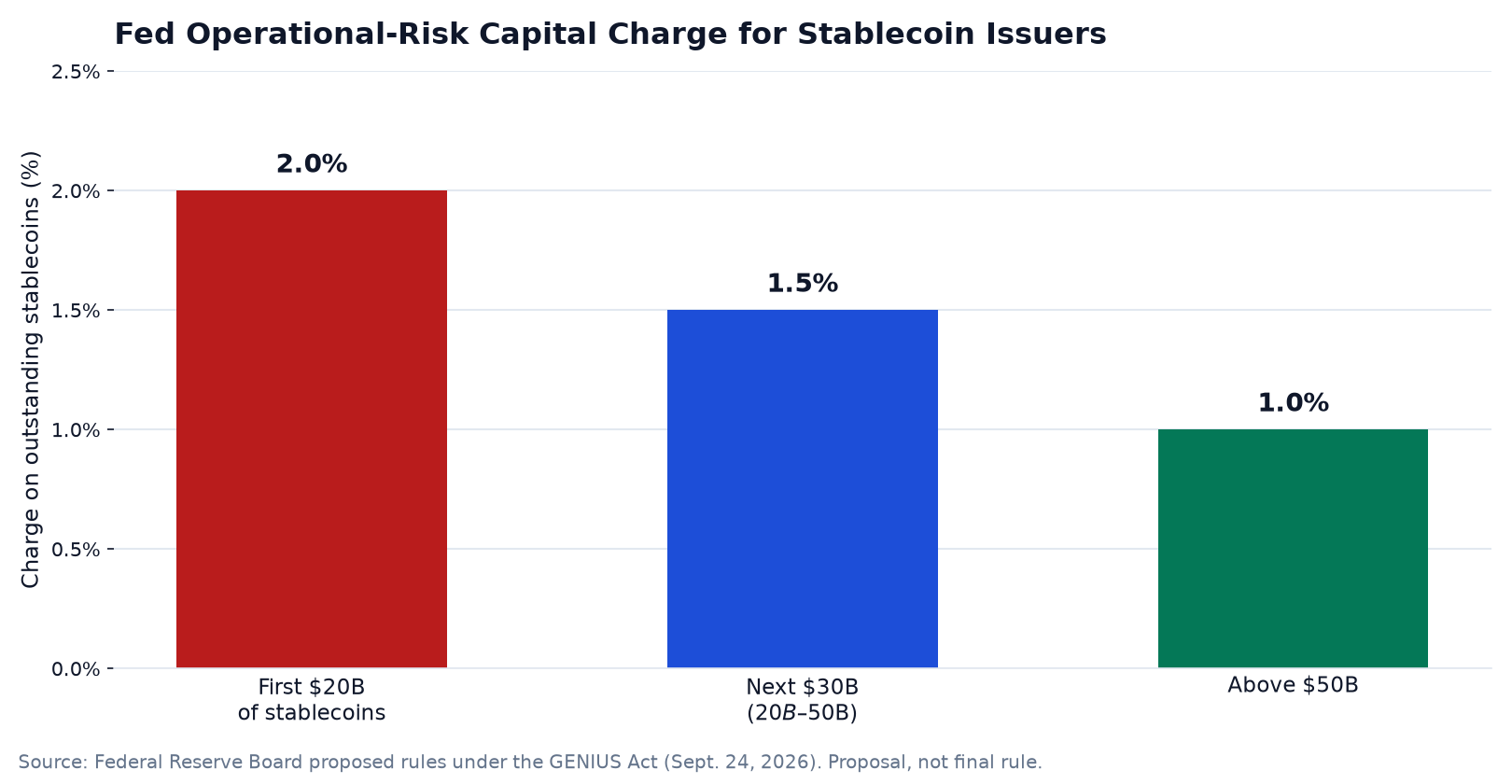
The second half of the first proposal is a capital regime. There is a 2% capital charge on reserve assets held as uninsured deposit claims and undercollateralized reverse repos. On top of that sits an operational-risk charge that scales down as an issuer grows:
- 2.0% on the first $20 billion of outstanding stablecoins,
- 1.5% on the next $30 billion ($20B–$50B), and
- 1.0% above $50 billion,
plus a charge equal to 25% of the three-year average of annual non-reserve revenue, adjusted for realized operational losses. An issuer that falls below minimum capital at two consecutive quarter-ends must liquidate reserves and redeem.
The proposal also implements the statutory yield ban — no interest or yield paid solely for holding a stablecoin — with a rebuttable presumption, following the OCC’s approach, that certain affiliate and third-party yield arrangements are prohibited. It adds rules for firms that safekeep reserve assets, clarifies permissible stablecoin activities for supervised banks, requires full-scope examination at least every 12 months with confidential weekly reporting, and states that a Bank Secrecy Act or AML deficiency must be “significant or systemic” before the Fed would take supervisory action.
The second proposal: how banks apply
The Fed’s second proposal creates the application process for Board-supervised banks that want to issue payment stablecoins. Insured state member banks file by letter with their Federal Reserve Bank, submitting a business plan, financial projections, and biographical reports. The Fed has 30 days to judge whether an application is substantially complete, then 120 days to decide — after which, notably, the application is deemed approved. The proposal also establishes procedures for appeals, hearings, and final determinations.
That deemed-approved mechanic is easy to miss and hard to overstate. It puts the burden on the regulator to act, rather than on the applicant to wait indefinitely — a design choice that mirrors the statute’s intent to keep the pipeline moving.
Treasury’s first binding rule: the $10 billion line
Six days after the Fed’s proposals, Treasury published an interim final rule (Federal Register 2026-19966) — the first GENIUS Act regulation that became effective upon publication. It does two things that shape the market’s structure.
First, it stands up the Stablecoin Certification Review Committee (SCRC), chaired by Treasury with the Fed and the FDIC, to judge whether a state’s regime is “substantially similar” to the federal standard. Second, it sets a hard $10 billion threshold: issuers with $10 billion or less in outstanding stablecoins may opt into state regulation; issuers above that line are barred from the state pathway and must move to the federal framework within 360 days.
The practical effect is a two-tier market. The largest issuers — Tether and Circle, which together dominate the roughly $307 billion market — are locked out of the state route and pulled onto the federal track. Smaller issuers keep a lighter, more local option. The American Bankers Association has already warned that the threshold invites regulatory arbitrage, since a state-supervised issuer just under the line faces a very different regime from a federal one above it.
Two procedural caveats keep this from being a finished story. The SCRC will not accept filings until the Office of Management and Budget grants Paperwork Reduction Act approval, and the comment period runs to November 30, 2026. The initial state certification deadline is January 18, 2028.
Barr’s objections — and why they matter
Governor Michael Barr supported the Fed’s proposal as “a step in that direction” but flagged three concerns worth tracking, because they preview where the final rule may move. He wants public input on whether the rule adequately addresses interest-rate and foreign-currency risk in reserves. He wants universal redemption rights made explicit in the final rule, arguing that “stablecoins will only be stable if they can be reliably and promptly redeemed at par” during stress. And he objected to the “significant or systemic” AML standard, saying it may have unknown effects on the Fed’s ability to substantiate that an institution maintains a compliant program.
Each objection points at a place where the proposal is, by design, permissive. The reserve list is narrow but silent on some second-order risks; the redemption rule has a safe harbor; the AML standard raises the bar for enforcement. If any of those tighten in the final rule, the cost of issuing a large stablecoin rises with them.
The global context
The U.S. is not writing these rules in isolation. Singapore has proposed its own 100% reserve requirement and a yield ban, aligning with the U.S. and EU frameworks. The Bank of Korea has published research linking dollar-stablecoin buying to local currency depreciation. European central banks have pushed to extend the yield ban to crypto lending and staking. And the U.S. is reported to be exploring a plan, across Treasury, State, and the Development Finance Corporation, to support the spread of dollar-pegged stablecoins abroad — a policy that treats the tokens as an instrument of dollar demand as much as a payments product.
That convergence is the real signal. Reserves, redemption, and the yield ban are becoming a global baseline, which means the competitive question for issuers is no longer whether to comply but where to be supervised — and how much capital the choice costs.
What “fully backed” actually costs
A 100% reserve rule sounds neutral. It is not. It decides how much revenue an issuer earns, because revenue is roughly the yield on reserves minus the cost of running the business. The permitted list — cash, Fed balances, and Treasuries of 93 days or less — is the shortest, safest, and lowest-yielding end of the curve. That is the design: reserves cannot be invested for yield in a way that reintroduces credit or duration risk.
Layer the capital charges on top and the economics tighten further. An operational-risk charge of 2.0% on the first $20 billion, 1.5% on the next $30 billion, and 1.0% above $50 billion, plus a charge of 25% of the three-year average of annual non-reserve revenue, is a direct tax on scale. For the largest issuers the marginal rate falls as they grow — which, ironically, favors the incumbents that the $10 billion threshold already pushes onto the federal track.
The second-order effect is on business models. If an issuer cannot pay yield to holders, it competes on distribution and trust rather than on interest, and the largest issuers already win that contest. A reserve-and-capital regime that suppresses yield therefore does not level the field — it reinforces whoever already has the user base.
How this compares with the EU — and with the CLARITY Act
The U.S. framework is converging with Europe rather than diverging. The EU’s MiCA rules already impose reserve and redemption standards on stablecoin issuers, and European central banks have pushed to extend the yield ban to crypto lending and staking. Where the U.S. differs is architecture: GENIUS is issuer-centric, with a federal-state split decided by a dollar threshold, while MiCA is a single passport across member states.
The comparison with the failed CLARITY Act is sharper, and it explains why stablecoins ended up a winner of that bill’s collapse. CLARITY would have banned platforms from paying yield on stablecoin balances, with fines up to $5 million per violation. The GENIUS Act bans yield paid by issuers, but not by exchanges. With CLARITY dead, exchange-level rewards survive — which is why Coinbase was widely named the biggest beneficiary of the Senate vote. The two laws regulate adjacent layers of the same product, and only one of them passed.
What to watch
- How the final Fed rule treats Barr’s objections. Interest-rate and FX risk, universal redemption, and the AML threshold are the three places the proposal could tighten before it is final.
- When the SCRC starts accepting filings. Nothing moves on state certification until OMB grants PRA approval — the gate for the entire two-tier structure.
- Whether the $10 billion line holds. If arbitrage behavior clusters just below the threshold, expect pressure to change it; if issuers migrate cleanly, the two-tier market becomes the baseline.
FAQ
Are these final rules?
No. The Fed’s two September 24 items are proposals, with a 60-day comment period once published. Treasury’s September 30 rule is an interim final rule — effective on publication, but with a comment period running to November 30, 2026.
When do the rules take effect?
The GENIUS Act takes effect on the earlier of January 18, 2027, or 120 days after primary federal regulators issue final implementing rules. The initial state certification deadline under Treasury’s rule is January 18, 2028.
What counts as a permitted reserve?
Cash, Federal Reserve Bank balances, demand deposits at insured institutions, Treasuries maturing in 93 days or less, qualifying overnight Treasury repo and reverse repo, and funds invested solely in permitted assets. Some tokenized versions of these qualify.
What is the $10 billion threshold?
Under Treasury’s interim final rule, issuers with $10 billion or less in outstanding stablecoins may opt into state regulation if the state regime is judged “substantially similar” to federal standards. Issuers above $10 billion must move to the federal framework within 360 days, which locks the largest issuers into the federal track.
Can stablecoins still pay yield?
The federal framework bans interest or yield paid solely for holding a stablecoin. The Fed’s proposal implements that ban with a rebuttable presumption that certain affiliate and third-party arrangements are also prohibited. Activity-based rewards tied to balance, duration, or use are a separate question the rulemaking is still working through.
Why is the Fed the last agency to act?
Agencies moved roughly in order of their direct jurisdiction: the OCC in February–March, the FDIC in April, the NCUA in May, and Treasury in August 2026. The Fed, which supervises the largest set of potential issuers, proposed last. Its September 24 action closed the federal supervisory gap and started the clock.
Does the GENIUS Act ban all stablecoin yield?
No. It bans interest or yield paid solely for holding a payment stablecoin, and the Fed’s proposal adds a rebuttable presumption that certain affiliate and third-party arrangements are also prohibited. It does not reach every exchange-level reward program — which is precisely why the collapse of the CLARITY Act mattered for the platforms that offer them.
Bottom line
The U.S. stablecoin market is moving from a light regime to a bank-equivalent one. Reserves must be narrow and segregated, redemption must be prompt, capital must be held, and the largest issuers must answer to Washington rather than to a state capital. The open questions are the ones Barr named: how the final rule treats rate and FX risk, how explicit it makes redemption rights, and how high it sets the AML bar. Read together, the Fed’s proposal and Treasury’s rule are less a set of constraints than a definition of what a stablecoin is allowed to be — and, by extension, who is allowed to issue one.
Sources
- Federal Reserve Board — Request for comment on two proposals under the GENIUS Act
- The Defiant — Fed proposes capital charges and bank approval rules for stablecoins
- Yahoo Finance — Treasury’s first GENIUS Act rule draws a $10 billion line
- Forkast — Treasury’s first GENIUS Act rule draws a $10 billion line through the stablecoin market
- Lukka — Two regulators, one week: what the Fed’s GENIUS Act proposals mean for institutions


