


On the morning of Monday, 5 October 2026, the United States government filed two documents that point in opposite directions. At 8:45 a.m., FinCEN — the Treasury bureau that fights financial crime — filed two withdrawal notices with the Federal Register, killing its six-year-old plan to track transactions to self-hosted wallets and its three-year-old plan to treat international crypto mixing as a money-laundering class of its own. On the same day, in the Southern District of New York, federal prosecutors filed a letter defending their right to keep trying the Tornado Cash developer Roman Storm in Manhattan.
Most of the coverage you will read this week takes the first filing and stops there. “US drops the wallet rule.” “Mixers win.” “Self-custody is safe now.” The second filing sits on a different docket, so it gets a different article, written by a different person, read by a different audience. That is how a non-event becomes a headline.
Here is the whole argument of this piece, in one sentence: the rule that died never lived — and the rules that live didn’t die. Everything below is the evidence, four documents at a time.
Same government. Same day. Two directions. If your mental model of “crypto regulation” is a single arrow, this is the week it breaks.
The rule that died was never born
Start with the 2020 document, because that is where the biggest misreading lives. On 23 December 2020 — in the last month of the first Trump administration, a window so notorious for it that the industry nicknamed it the “midnight rule” — FinCEN published a notice of proposed rulemaking at 85 FR 83840. Read the phrase carefully: a proposal. For six years it sat in the Federal Register as a threat. It never became a rule, never took effect, and never obligated anyone to do anything.
What it would have done is worth knowing, because that is what “died”:
- Above $3,000: banks and money services businesses would have kept records on any customer transaction with an unhosted wallet — including the counterparty’s name and physical address, alongside the value, timing and payment instructions.
- Above $10,000 — or several transactions aggregating past $10,000 in 24 hours: the institution would have filed a report with FinCEN and verified its customer’s identity, with 15 days to do it.
- The obligation sat on the institution, not on you — which is exactly what made it radical. Your exchange would have been conscripted as the KYC officer for your own cold wallet, collecting identifying information on a person who was not its customer at all.
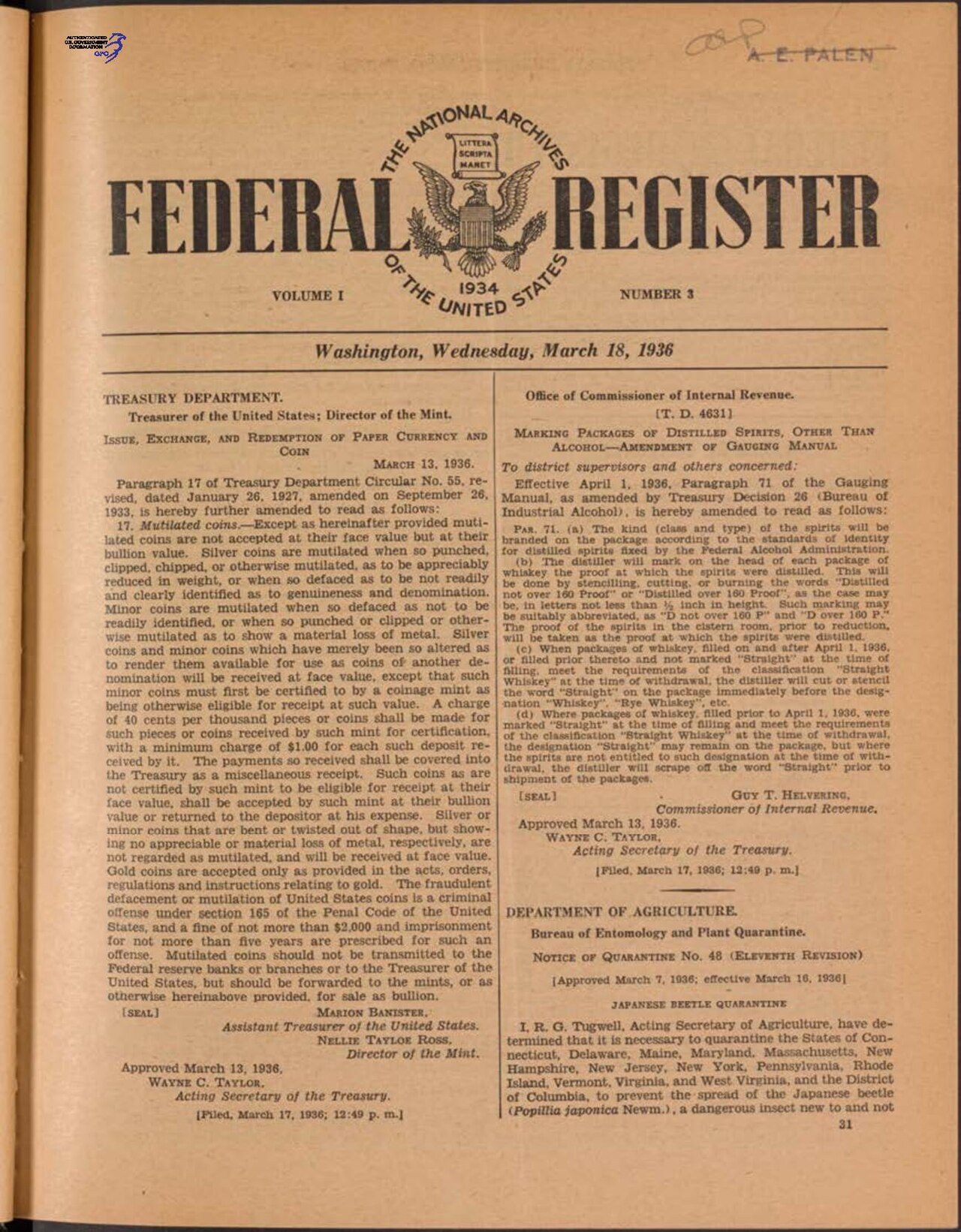
Now read what killed it. The withdrawal notice — 91 FR 63514, all of two pages — says, in full: “FinCEN will take no further action on this NPRM.” Signed by Deputy Director Jimmy L. Kirby, citing Executive Order 14178 and page 100 of the July 2025 report of the President’s Working Group on Digital Asset Markets. That is the entire mechanism.
So what changed on Tuesday morning? Not what any institution does today — none of them were doing it. What changed is what none of them can be forced to do tomorrow. The withdrawal removed a threat, not a rule. A proposal is a promise about the future; killing it changes the future, not the present. Call that deregulation if you like — just notice that nothing regulated got deregulated.
The $3,000 that is still alive
Now the trap, and it is a beautiful one, because it uses the same number twice. This week you will see “the $3,000 rule is dead” repeated until it hardens into fact. There are two $3,000 requirements in this story. One died. One didn’t.
| Requirement | Threshold | Where it lives | Status this week |
|---|---|---|---|
| Unhosted-wallet recordkeeping | $3,000 | 85 FR 83840 (Dec 2020) | DEAD — was a proposal |
| Unhosted-wallet reporting | $10,000 / 24h | 85 FR 83840 (Dec 2020) | DEAD — was a proposal |
| Mixer “primary money laundering concern” finding | Any amount, foreign nexus | Section 311 NPRM (Oct 2023) | DEAD — withdrawn, with a hedge |
| Funds Travel Rule for transmittals | $3,000 | 2013 + 2019 CVC guidance | ALIVE — untouched |
| BSA / AML duties on exchanges & MSBs | Framework | Bank Secrecy Act | ALIVE — untouched |
| OFAC sanctions & blocked property | List-based | Sanctions regime | ALIVE — separate docket |
| Criminal money-transmission law | 18 U.S.C. §1960 | Criminal code | ALIVE — actively litigated |
The live one hides in FinCEN’s 2019 convertible-virtual-currency guidance: a transmittal of $3,000 or more by a money transmitter triggers funds-travel-rule obligations — the institution must collect and pass along originator and beneficiary information, and the guidance adds, pointedly, that a blockchain’s inability to carry that data does not remove the obligation to provide it. Same number. Different requirement. Different legal life.
If you read “FinCEN drops $3,000 wallet rule” and conclude that the $3,000 obligation is gone, you have just confused a corpse with a living person who happens to share its name. Nothing on the right-hand column of that table moved this week. Everything on the left-hand column was never on your books. That is the whole story — and it is also, done properly, real relief, which brings us to the third document.
Read the withdrawal, not the headline
The mixer withdrawal is the more interesting of the two, because it is not worded like the wallet one. The wallet notice is flat — no further action, full stop. The mixer notice is hedged, and the hedges are where the information lives.
First, what was withdrawn. In October 2023 FinCEN invoked Section 311 of the USA PATRIOT Act — the heaviest tool in its kit, historically aimed at individual banks and entire countries — and pointed it, for the first time, at a whole class of transactions: international crypto mixing. The proposed definition was wide enough to swallow ordinary behaviour: pooling funds from several wallets, splitting transfers, single-use addresses, swapping one asset for another, adding delays. FinCEN’s own estimate said about 15,000 institutions would have filed the resulting reports, at roughly 1.47 million hours a year. That is not a reporting rule; that is an industry.
Now read the withdrawal’s own words. It concedes the commenters’ core argument — that the definition “could have a chilling effect on legitimate activity” and impose a heavy reporting burden — and it quotes the July 2025 Working Group report: “the Trump Administration supports the ability of lawful users of digital assets to privately transact on a public blockchain.” Then, in the same breath, it adds that “illicit actors continue to use mixers and other tools and methods to hinder law enforcement investigations,” that monitoring continues, and that FinCEN “may take appropriate steps in the future.”
Hold those two sentences together, because they are the actual policy. This is a ceasefire, not a treaty. The docket is closed; the doctrine is not. A narrower mixer designation — one that targets mixers rather than “mixing-like behaviour” — remains available the moment FinCEN wants it, and the notice says so in its own voice. Anyone selling you “mixers are legal now” has read the withdrawal as badly as the people who read the 2020 proposal as a ban.
The other hand: same Monday, same government
Which brings us to the filing nobody put in the same article. While FinCEN was closing its mixer docket, SDNY prosecutors were writing to Judge Katherine Polk Failla in United States v. Storm, asking her to reject a venue challenge to the money-laundering and money-transmission conspiracy counts. Their new ammunition: the D.C. Circuit’s 25 September 2026 decision in United States v. Sterlingov — the Bitcoin Fog case — cited as persuasive authority that serving a customer in the district is enough.
The customer they name is Shakeeb Ahmed, a Manhattan resident — and himself a convicted hacker — whose deposits, prosecutors argue, enlarged Tornado Cash’s anonymity pool even though the money sat there only briefly. Storm was convicted in August 2025 on one money-transmission conspiracy count carrying a five-year statutory maximum; an order dated 25 August 2026 schedules his retrial for 26 April 2027. The fight is no longer over whether mixing can be regulated. It is over whether a developer is criminally responsible for a service that strangers used to launder money.
And notice how much restraint was not withdrawn on the prosecution side. Deputy Attorney General Todd Blanche’s April 2025 memo told prosecutors to stop charging mixers for their users’ conduct or unwitting regulatory violations — but expressly carved out section 1960(b)(1)(C), funds known to be criminal. DOJ official Matthew Galeotti’s August 2025 remarks added a safe harbour for “qualifying software” — truly decentralized, purely peer-to-peer, no custody — as a promise about new charges. It did not set aside the conviction that already exists. Policy can pivot in a memo. A conviction can only move through a courtroom, and this courtroom date is in April 2027.
One more layer, because it completes the picture. After the Fifth Circuit’s Van Loon ruling, Treasury removed Tornado Cash’s addresses from the OFAC sanctions list in March 2025 — and the criminal case kept going anyway. That is the architecture you need to hold in your head: reporting rules (dropped this week), sanctions (moved last year), criminal statutes (untouched throughout). Three layers, three dockets, three clocks. Headlines flatten them into one; the documents never do.
The rule that died never lived. The rules that live didn’t die. Regulation is written in dockets, not headlines — read the docket.
What actually changed for you
Enough documents. Here is the translation into decisions, in the three columns that matter:
If this lens is useful, two of our earlier pieces were built with it: how one exchange logo resolves into five legal entities answerable to five different regulators, and why privacy chains like Zcash keep shipping protocol upgrades while the legal argument rages around them.
A withdrawal is not a repeal. A proposal is not a rule. And a policy memo is not a courtroom. The people who got this week right are the ones who read the dockets — the same people who read the 2020 proposal as a proposal when everyone else was screaming “wallet ban.” Be one of them next time too.
(The End)
Sources: 85 FR 83840 (23 Dec 2020); 91 FR 63514–63515 and the mixer withdrawal notice (FR Docs 2026-20430 / 2026-20429, 6 Oct 2026); FinCEN’s 5 October 2026 news release; the President’s Working Group report of July 2025; SDNY filings in United States v. Storm (docket 604938) and the D.C. Circuit’s Sterlingov opinion of 25 September 2026; DOJ statements of April and August 2025. Figures and dates checked 8 October 2026. This is a reading of public documents, not legal advice.


