
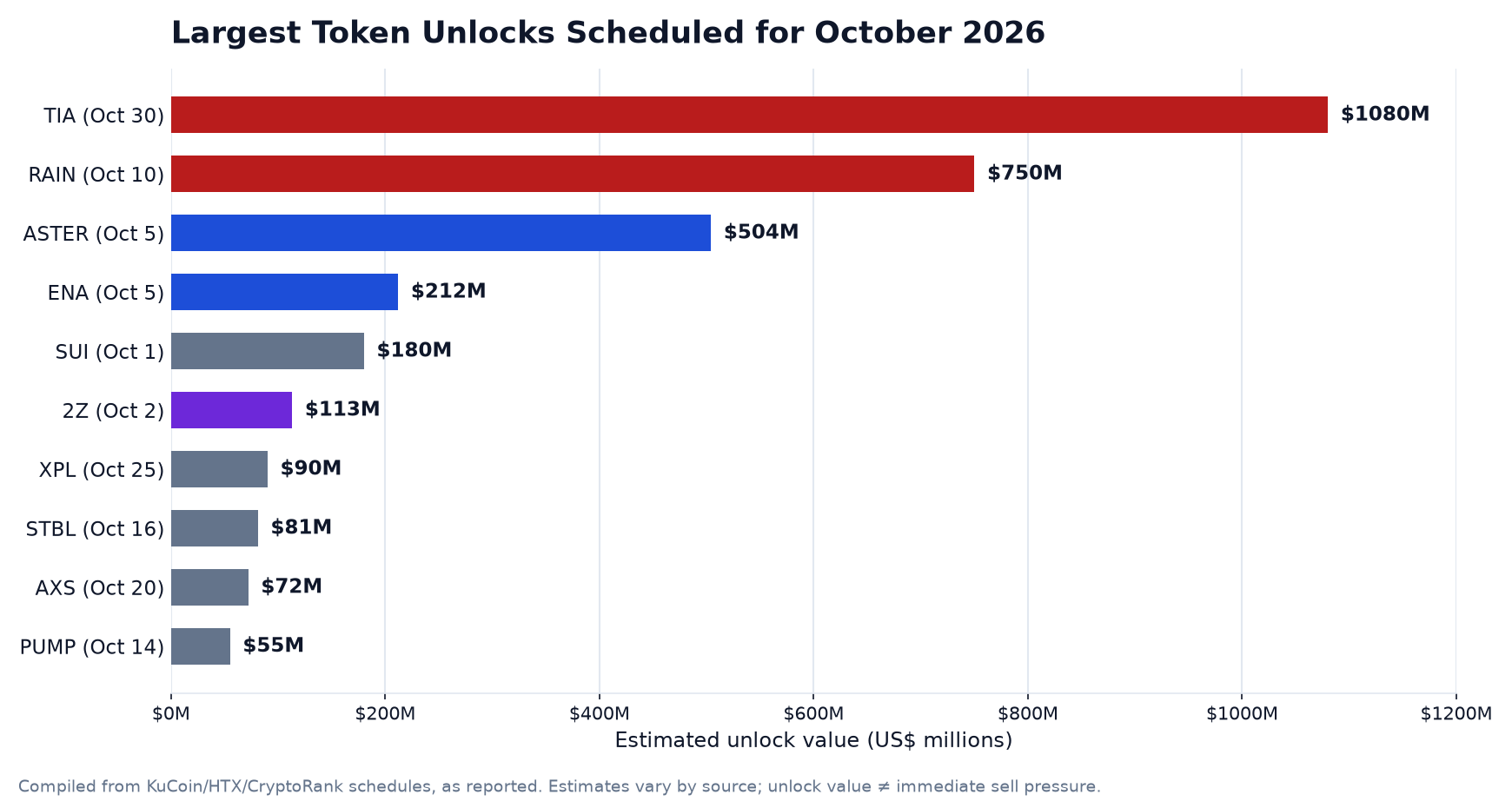
October 2026 is one of the heaviest token-unlock months of the year. More than $3 billion in vested tokens is scheduled to hit the market, concentrated in a handful of events that range from routine to market-moving. The largest is not the one with the biggest dollar figure — it is the one that releases almost half a token’s circulating supply in a single day.
For anyone holding tokens, the calendar matters because unlocks change the supply side of the equation. When a cliff expires, tokens that were locked by investors, teams, and contributors become tradeable, and the holder base shifts from people who could not sell to people who can. That does not guarantee selling, but it changes who is deciding.
This article lays out the October unlock calendar, explains why percentage of supply matters more than dollar value, and separates the events worth watching from the ones that are noise.
Key takeaways
- October 2026 brings over $3 billion in scheduled token unlocks.
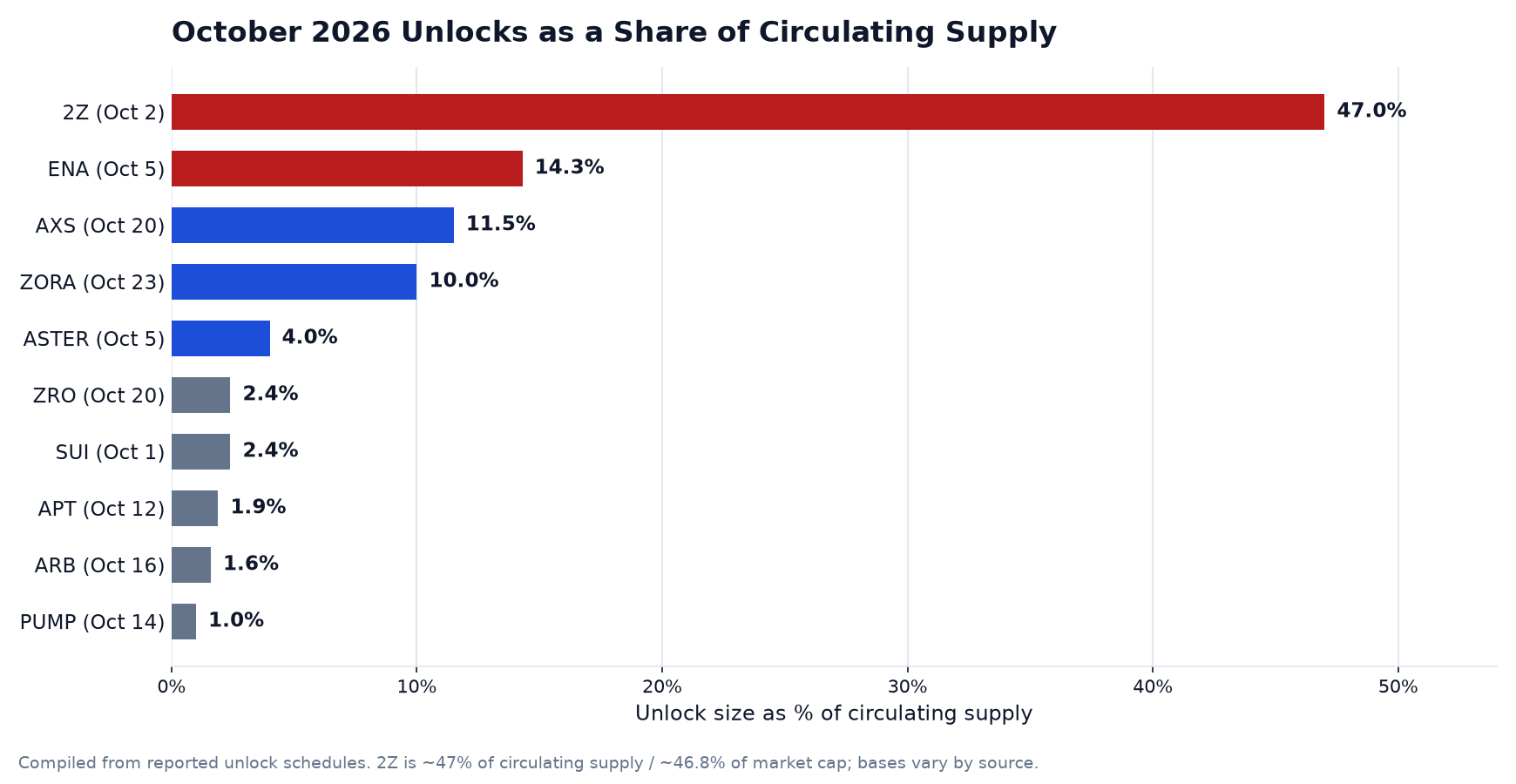
- The headline event is DoubleZero (2Z) on October 2 — roughly 1.6–1.8 billion tokens, about 46–48% of circulating supply, when a 12-month cliff expires.
- Celestia (TIA) is the largest event in dollar terms: ~175 million tokens (~$1.08 billion) on October 30.
- Ethena (ENA) accelerates its remaining investor allocation into a single October 5 release, ending its vesting schedule about 17 months early.
- Unlock size is not the same as sell pressure: the percentage of supply released is a better guide than the dollar value.
Why unlocks matter
Most crypto tokens launch with a vesting schedule. Early investors, team members, contributors, and sometimes foundations hold tokens that unlock over months or years, often with a “cliff”: a period during which nothing vests, followed by a large release. On the cliff date, a large block becomes liquid at once.
What that does to price depends on three things: how big the release is relative to circulating supply, who receives it, and whether those recipients need liquidity. A team that unlocks tokens it intends to hold behaves differently from a fund that needs to return capital. That is why the same dollar figure can be a non-event for one token and a shock for another.
The headline event: DoubleZero (2Z)
On October 2, 2026, DoubleZero (2Z) unlocks roughly 1.66–1.78 billion tokens — about 16.3–16.55% of total supply and, far more striking, roughly 46–48% of circulating supply (or ~46.8% of market cap). It is a cliff unlock tied to the expiry of a 12-month vesting cliff, exactly one year after 2Z began trading on October 2, 2025. The estimated value is about $113 million.
The allocation breakdown makes clear why it is the month’s defining event:
- Jump Crypto: ~575 million tokens
- Malbec Labs: ~350 million
- Institutions: ~300 million
- Team: ~250 million
- Contributors: ~100 million
- Builders: ~50 million
- Validators: ~30 million
One analysis noted that the single-day cliff of ~1.655 billion tokens is about 919 times everything the protocol has burned since launch — though the foundation frames the burn as an anti-spam safeguard, not supply management. Whatever the framing, half a token’s float becoming tradeable on one day is a structural event, not a routine vesting drip.
The rest of the calendar
| Date | Token | Approx. unlock | Supply impact |
|---|---|---|---|
| Oct 1 | SUI | ~$180.4M | ~0.57–2.4% circ. |
| Oct 2 | 2Z | ~$113M | ~46–48% circ. |
| Oct 5 | ENA | ~$212M | ~14.3% circ. |
| Oct 5 | ASTER | ~$503.6M | ~4.0% circ. |
| Oct 10 | RAIN | ~$683–785M | ~3.2% total |
| Oct 12 | APT | ~$47.96M | ~0.96–1.91% circ. |
| Oct 14 | PUMP | ~$54.82M | ~1.0% circ. |
| Oct 16 | STBL | ~$81.0M | ~2.31% circ. |
| Oct 16 | ARB | ~$37.7–52.3M | ~0.93–1.59% circ. |
| Oct 20 | ZRO | ~$49.23M | ~2.36–2.47% |
| Oct 20 | AXS | ~$71.8M | ~11.5% circ. |
| Oct 22 | SCR | ~$14M | ~43.6% of mcap |
| Oct 23 | ZORA | ~$41.94M | ~10.0% circ. |
| Oct 25 | XPL | ~$90.06M | ~0.89% circ. |
| Oct 30 | TIA | ~$1.08B (175M) | ~17.68% total |
| Oct 30 | OP | ~$35.3M | ~3.0% circ. |
Two entries deserve a note. Ethena (ENA) is not a routine unlock: the project moved its remaining original-investor allocation into a single October 5 release, ending its monthly vesting schedule about 17 months early (it had been scheduled to run to March 2028). Separately, StablecoinX holds about 3.03 billion ENA (~20% of total supply), whose contractual lockup also expires on October 5 — but sales still require prior written Ethena Foundation consent, with notice and right-of-first-refusal protections.
Celestia (TIA) is the largest event by dollar value: ~175 million tokens, about 17.68% of total supply, estimated near $1.08 billion. It is the first major unlock one year after launch, marks the start of subsequent monthly unlocks, and sends roughly 67% to seed and Series A/B investors sitting on large paper profits. Some reports put the near-term sell-pressure figure lower (~$460 million) because of a 21-day unlock queue.
The two dates that move everything
Beyond individual tokens, market observers tend to circle a smaller number of “cluster” dates, when several significant unlocks land together and the market reacts at once. For the fourth quarter, the two most-cited are October 28 and December 9, both described as days “on which the whole market reacts at once.” The reasoning is mechanical: when multiple large unlocks coincide, the aggregate supply increase is more likely to overwhelm demand in the same window.
There is also an event overlay: TOKEN2049 Singapore on October 7–8, which often coincides with announcements and liquidity shifts rather than unlocks themselves. The practical point is that the unlock calendar is not uniform — it clusters, and the clusters matter more than the daily average.
Percentage versus dollars
The most useful habit when reading an unlock table is to ignore the dollar column first and look at the percentage of supply. A $1 billion unlock of a token with a $50 billion float is a 2% event; a $113 million unlock of a token releasing half its float is a 47% event. The second is far more consequential, even though the first has a bigger number next to it.
Analysts make a related point about mechanics: an unlock is a change in who can sell, not a sale. Whether it becomes sell pressure depends on recipient behavior, and recipients — especially long-term funds and teams — often stagger their exits. The exception is a large cliff with a concentrated recipient list, which is exactly 2Z’s profile.
Cliffs versus linear unlocks
Not all unlocks are built the same. A linear unlock releases tokens gradually — a small slice each day or month — so the supply curve is smooth and largely anticipated. A cliff releases nothing for a period, then a large block at once. The cliff is the more dangerous shape because it changes tradeable supply in a single step, and because the recipients at a cliff are often the groups — investors, teams — with the largest positions.
An unlock also does not mean a sale. It means tokens move from a “cannot sell” state to a “can sell” state. Whether selling follows depends on the recipient’s intent, cost basis, and obligations. That is why two unlocks of equal size can have very different effects: one recipient base holds, another exits. Reading a calendar well means reading the recipient list, not just the total.
Why October is unusually heavy
This month is heavy for a simple reason: many projects that launched or began trading in October 2025 are reaching their 12-month cliff at the same time. DoubleZero is the clearest example — its unlock lands exactly one year after trading began — and several others share the same anniversary logic. When token-generation events cluster, their cliffs cluster too, which is why October carries a disproportionate share of the year’s scheduled supply.
The corollary is that the market has had months to see this coming. Widely broadcast unlocks are usually at least partly reflected in price before they arrive, which is one reason “unlock day” often produces a smaller move than the calendar’s size would suggest. The surprise, when it comes, tends to be in the tokens whose recipient behavior was misjudged, not in the ones everyone was watching.
The Ethena angle: acceleration and a controlled holder
Two details in the ENA schedule deserve a closer look, because they show how an unlock’s structure can matter as much as its size. First, Ethena did not simply follow its vesting plan — it moved the remaining original-investor allocation into a single October 5 release, ending a monthly schedule about 17 months early. Pulling vesting forward concentrates supply now, even though the total released over time is unchanged.
Second, the ~3.03 billion ENA held by StablecoinX (~20% of total supply) has a lockup that also expires on October 5 — but sales still require prior written Ethena Foundation consent, plus notice and right-of-first-refusal protections. That is a qualitatively different situation from a free-and-clear cliff: the tokens become unlocked but remain contractually constrained. Reading only the calendar would overstate the near-term supply, because the largest holder is not free to dump.
How to use an unlock calendar
An unlock calendar is a tool, not a forecast. Used well, it answers four questions about any event:
- Size relative to float, not dollars. A 47%-of-float cliff is a different animal from a 2% drip, regardless of the dollar figure.
- Recipient composition. Funds and teams with large unrealized profits behave differently from long-term holders or foundations.
- Structure. Cliff or linear, accelerated or scheduled, free or contractually constrained.
- Cluster risk. A single large unlock is knowable; several on the same date can compound.
Run an event through those four filters and the calendar stops being noise. Most unlocks are routine; a few — this month, 2Z and TIA — are the ones that set the tone.
What unlocks reveal about tokenomics
The size of an unlock is largely a function of the vesting design chosen at launch. Projects that sell a small float and hold a large share in vesting — the “low float, high FDV” model — create the conditions for exactly the kind of cliff that 2Z represents: a token whose market price reflects scarcity today, and whose supply is scheduled to expand sharply tomorrow.
That model was common in the 2024–2025 launch cycle, and October 2026 is one of the months where the consequences come due. The opposite approach — a larger initial float and smoother unlocks — trades a lower launch valuation for a less violent supply curve. Which is better depends on the holder: launch-day buyers prefer scarcity; long-term holders usually prefer predictability. A year of cliff-heavy calendars is the market discovering how expensive the first choice can be.
What to watch
- 2Z post-cliff. Whether the ~47% float release translates into sustained selling or gets absorbed — the single clearest signal of how the market is treating supply shocks this quarter.
- The October 28 cluster. Whether the aggregate of that day’s unlocks moves the broader market, or passes without incident.
- The TIA unlock on October 30. It begins a monthly schedule, so its reception sets expectations for every Celestia unlock that follows.
FAQ
Does a token unlock always push the price down?
No. An unlock increases the supply that can be sold; it does not force a sale. Price impact depends on how large the release is relative to circulating supply, who receives the tokens, and whether they choose to sell. Unlocks that are widely anticipated are often partly priced in already.
Which October 2026 unlock is the biggest?
By dollar value, Celestia (TIA) on October 30, at roughly $1.08 billion. By impact on supply, DoubleZero (2Z) on October 2, which releases about 46–48% of circulating supply in a single day.
What is a cliff unlock?
A cliff is a period during which no tokens vest, followed by a large one-time release. It concentrates supply into a single date, unlike a gradual linear unlock that spreads tokens out over time. Cliff unlocks tend to have more market impact because the change in tradeable supply is sudden.
Why does Ethena’s October 5 unlock matter?
Because it is an acceleration, not a schedule. Ethena moved its remaining original-investor allocation into one release, ending a monthly vesting plan roughly 17 months early. Compressing the schedule forward changes the short-term supply picture even if the total is the same.
Are these numbers exact?
No. Unlock figures vary by data provider because they use different supply bases and classify allocations differently — 2Z estimates alone ranged from about 1.35 billion to 1.78 billion tokens. Treat the calendar as a directional guide and confirm specifics against official project announcements.
Should I sell before a big unlock?
There is no universal answer, and the calendar alone is not a reason to act. What matters is whether the specific unlock is large relative to the token’s float, who receives it, and how much of it the market has already anticipated. Widely expected unlocks are often priced in; the risk usually sits in the events whose recipient behavior is less predictable.
Bottom line
October 2026 is a supply-side month, and the way to read it is by percentage, not by headline dollars. The event that matters is 2Z releasing roughly half its float on October 2; the event with the largest price tag is TIA on October 30. Everything else is a gradient between those two. Unlocks are not sell orders — they are changes in who can sell — so the calendar tells you where to look, not what will happen. Watch 2Z for how the market absorbs its biggest float increase, watch the October 28 cluster for a same-day reaction, and watch TIA because it starts a monthly pattern that runs for quarters to come.
Sources
- KuCoin — October brings over $3 billion in token unlocks
- BlockMedia — Major project token unlocks in the first week of next month
- CoinMarketCap / CryptoTicker — Crypto dates in Q4 2026: the days that decide supply
- HTX community — Full October unlock schedule
- Pluang — Ethena (ENA) October 2026 unlock: impact and explanation


