


The quickest way to understand decentralised finance is to stop treating it as a new category and start mapping it function by function onto the finance it copies. Lending, market making, settlement, reference data, clearing and governance all exist in both systems, and the roles that perform them can be lined up almost one to one. What does not line up is the fourth column of that comparison: who carries the risk, and what that party has standing behind it.
The mapping produces a conclusion that neither enthusiasts nor critics tend to state plainly. Almost every function has been reproduced faithfully, and almost every risk has been moved to a party with less capital, fewer legal obligations and no rescue mechanism. That is not an argument that the experiment has failed; it is an argument that the experiment is at an earlier stage of institutional development than its marketing suggests, and that the differences show up exactly where the traditional system spends most of its money.

Credit: a bank’s two books without the bank
A bank takes deposits on one side of its balance sheet and makes loans on the other, and the entire operation is a set of judgements about who will repay. It screens borrowers, prices for the risk of default, holds capital against the possibility that its judgement is wrong, and transforms short-term liabilities into long-term assets, which is what makes the arrangement both useful and fragile. Insurance covers small depositors, and a central bank stands behind the institution when a run starts.
The on-chain version performs the same function with none of those judgements. A pool holds deposits and lends them to anyone who posts collateral worth more than the loan, and the interest rate is set by a formula that rises as the pool’s available liquidity falls. There is no credit assessment because there is no credit: the protocol does not care who the borrower is, only whether the collateral is sufficient, which is why the arrangement can serve anyone with assets and nobody without them.
Two consequences follow directly. The first is capital inefficiency, because requiring collateral worth more than the loan means the same assets support less credit than a bank would extend with the same capital. The second is that the depositor has become the lender, with none of the protections a depositor normally has. There is no insurance fund, no supervisor with an early-intervention mandate, and no institution able to supply liquidity to a pool that is being drained. Where a bank’s depositors are protected by an arrangement that socialises losses, a pool’s depositors are the arrangement.
Market making: a dealer without a book
In a conventional market, liquidity comes from dealers and from limit orders sitting in a book. A dealer quotes both sides, manages inventory, and earns the spread as compensation for taking the risk that the price moves while they hold a position. A book aggregates the intentions of everyone who has posted a price, and the exchange intermediates settlement.
The on-chain version replaces both with a formula. A pool holds two assets and prices them against each other according to a rule, and anyone can add assets to the pool to become a liquidity provider. The provider earns a share of the trading fees, and in exchange takes a position that is mathematically guaranteed to accumulate the asset that is falling and shed the asset that is rising, which is the mechanism behind the loss that providers experience relative to simply holding the two assets.
The economic content of that arrangement is a transfer of inventory risk to volunteers, priced by a fee rather than negotiated with a professional. It works well in calm markets and it behaves differently in stressed ones, for a reason that is structural rather than behavioural: a professional dealer reduces size when volatility rises and can hedge elsewhere, while a formula keeps quoting the same way and can only be abandoned by providers withdrawing their assets. The moment of withdrawal is the moment liquidity is most needed, and no participant has an obligation to stay.
Settlement money: a claim where the central bank is not
Conventional settlement happens in central bank money, which is a liability of an institution that cannot run out of its own currency, and the money market funds that hold the system’s spare cash are regulated pools with defined asset rules. That is why a payment in the traditional system settles without asking whether the settlement asset will still be worth what it says.
The on-chain equivalent is a token issued by a private company against a portfolio of short-term instruments. It performs the same function and it introduces a question the conventional system has engineered away: what happens if the issuer cannot or will not redeem? The three designs in that market answer it differently, and the answer determines whether a settlement asset is a liability of a regulated institution with segregated reserves or a claim on a mechanism that depends on incentives holding up.
The missing element is the one no protocol can supply. A central bank can create liquidity against collateral in a panic; a private issuer can only redeem what it holds, and a pool can only lend what has been deposited. The absence of a lender of last resort is why stress events in this market tend to resolve through rapid price moves rather than through the gradual provision of liquidity that defines a conventional intervention.
Reference data: an index written into the contract
Conventional finance runs on published data: interest rate benchmarks, index levels, closing prices. The publishers are regulated, identifiable, and liable in a way that makes manipulation expensive, and the system has spent decades litigating what counts as a proper fix.
An on-chain contract that needs to know a price reads it from a feed, and the feed is a report by parties whose incentives are economic rather than legal. That works in most conditions and creates a specific class of attack: if the contract reads a price from a venue that can be moved within a single transaction, someone can borrow enough capital to move the price, trigger the contract, and repay the loan in the same atomic operation. The defence is to read from many venues and to delay, which is an engineering answer to a problem the traditional system solved with regulation and reputation.
Clearing: the default fund that is not there
The least appreciated part of conventional market structure is the clearing house. It stands between every buyer and seller, collects margin daily, and maintains a fund contributed by members to absorb the loss when one of them fails. It mutualises the risk of a member’s default across the membership, and it is backed by the collective capital of the largest institutions in the market, with a defined process for what happens when that is not enough.
The on-chain equivalent is an automated engine that closes a position when its margin runs out. There is no intermediary taking the other side, no mutualised fund, and no member obligation to absorb a shortfall. Each market is its own island: a liquidation in one pool does not draw on capital from another, and a shortfall is borne by whoever happens to be standing in the wrong place rather than by a defined group of members.
The behavioural consequence is a different shape of cascade. In a cleared market, a default is managed and the loss is distributed according to rules written in advance. In an automated market, a sharp move liquidates one set of positions, which pushes the price further, which liquidates the next set, until the move exhausts itself. The engine is doing exactly what it was told to do at every step, and no participant has the authority to slow it down.
Governance: an owner without duties
A public company is run by a board with legal duties to the company and its shareholders, subject to disclosure requirements, and removable through a defined process. Those duties are not sentimental: they are what makes it possible to sue for a decision that enriched insiders at the expense of owners.
Token governance reproduces the voting and omits the duties. Holders vote on proposals, thresholds and timelocks determine what can be executed and when, and the outcome is enforced by code. What is missing is the concept of a fiduciary obligation, which means the boundary between a legitimate decision and a transfer of value to insiders is drawn by whatever the governance document happens to say, if it says anything at all.
A second difference is that voting power and economic exposure are not bound together. A token can be borrowed, delegated and voted with by a party who has no lasting stake in the outcome, and proposals can be passed by whoever is willing to accumulate votes for the length of a vote. The conventional answer to the same problem is a rule against voting borrowed shares, enforced by a regulator rather than by the company.
Three substitutions that explain the behaviour
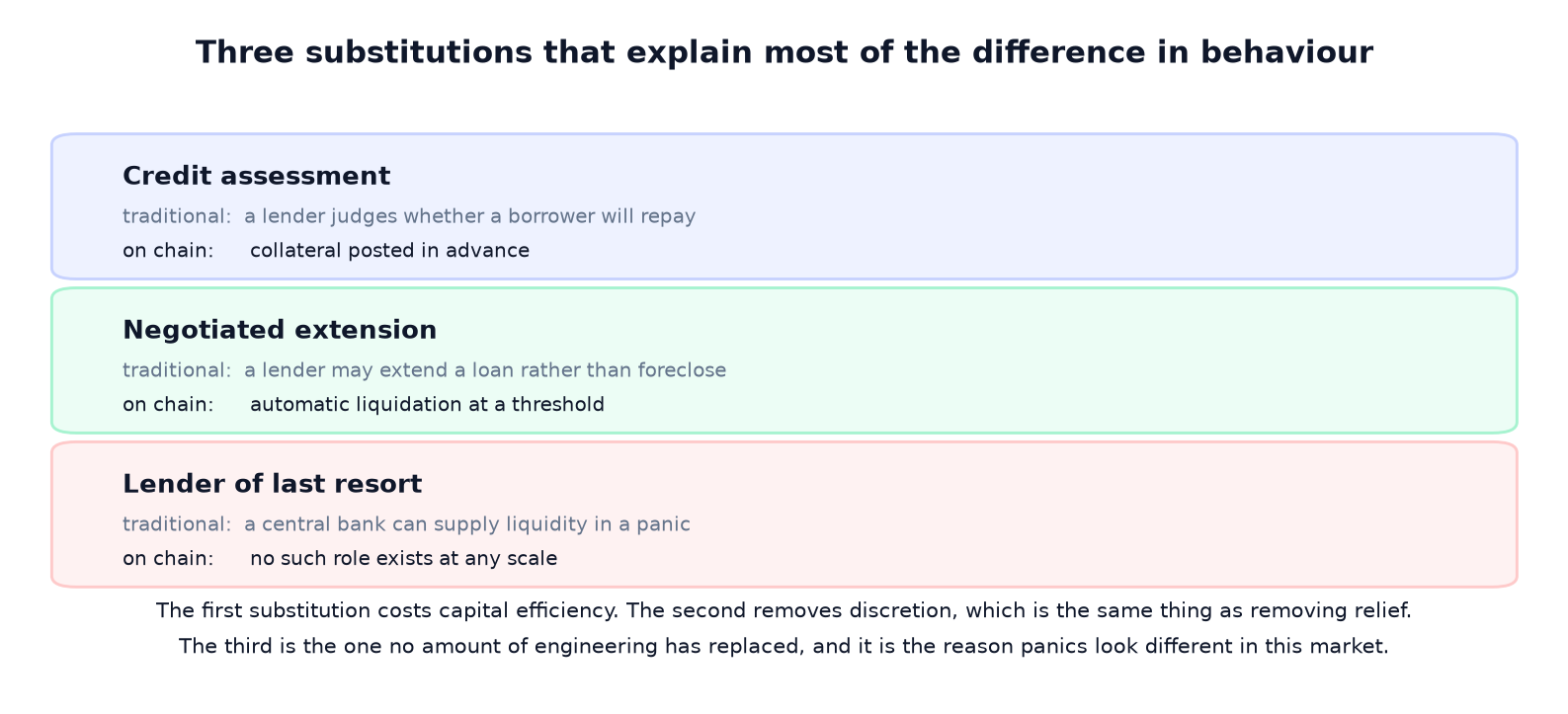
Collateral in place of judgement is the substitution that makes the system permissionless. It also caps how much credit the system can create per unit of capital, and it excludes everyone who needs credit precisely because they do not have assets to post. That is a design position rather than a defect: a protocol that assessed creditworthiness would have to know who you are, which is the thing the design exists to avoid.
Automatic liquidation in place of negotiated extension is the substitution that makes settlement deterministic. A bank extends a loan to a borrower in temporary difficulty because the alternative is a loss it would have to recognise; an engine forecloses at the threshold because it cannot distinguish temporary difficulty from terminal. A program has no category for the cases that make negotiation valuable, and in a falling market that absence is felt as speed rather than as efficiency.
The absent lender of last resort is the substitution nobody chose. It is a consequence of building a financial system on assets that no institution can create at will, and it means that the system’s stress response is always price. Everything else in this article follows from those three differences, and none of them is hidden: they are stated in the documentation of the protocols, in the risk disclosures of the funds, and in the liquidation parameters anyone can read.
What has no counterpart at all
Three properties of the on-chain version do not exist in the conventional system at any price, and they are the honest case for the experiment. The first is composability: because every protocol is a public interface, a loan, a swap and a transfer can occur in one atomic operation with no settlement window and no counterparty consent beyond the code. Building the equivalent in conventional finance takes months of legal negotiation per pair of institutions.
The second is permissionless access. Any address can use the system, at any hour, without an account, a credit file or a jurisdiction, which is a genuine improvement for anyone the conventional system has declined to serve and a genuine problem for the compliance obligations that conventional institutions carry. The third is verifiability: the state, the collateral and the rules are all public, so anyone can reconstruct the position of the whole system without asking an institution for a report.
None of those three requires the others, and the industry’s most common rhetorical error is to treat them as a single package. Composability is available to a permissioned network. Verifiability is available without permissionless access. Access without verifiability is what most historical financial exclusion looked like.
What the bank has and the protocol does not
List the conventional system’s institutional machinery and the missing pieces become specific rather than rhetorical. There is a lender of last resort that can create liquidity against collateral. There is deposit insurance that protects small holders and prices the guarantee through premiums. There is a bankruptcy process that ranks claims and an insolvency regime that decides who takes losses in what order. There is a resolution framework under which a failing institution is wound down without stopping the system. And there is a supervisory apparatus with the power to intervene before failure rather than after.
Each of those exists because the market produced a failure that the previous arrangement could not absorb, and each was paid for by a political decision about who should bear the cost. Reproducing them on chain is not an engineering problem. It is an institutional one: a mutualised default fund requires members with capital and legal obligations, deposit insurance requires a balance sheet standing behind it, and a resolution regime requires an authority with the power to override ownership claims.
The mapping, on one page
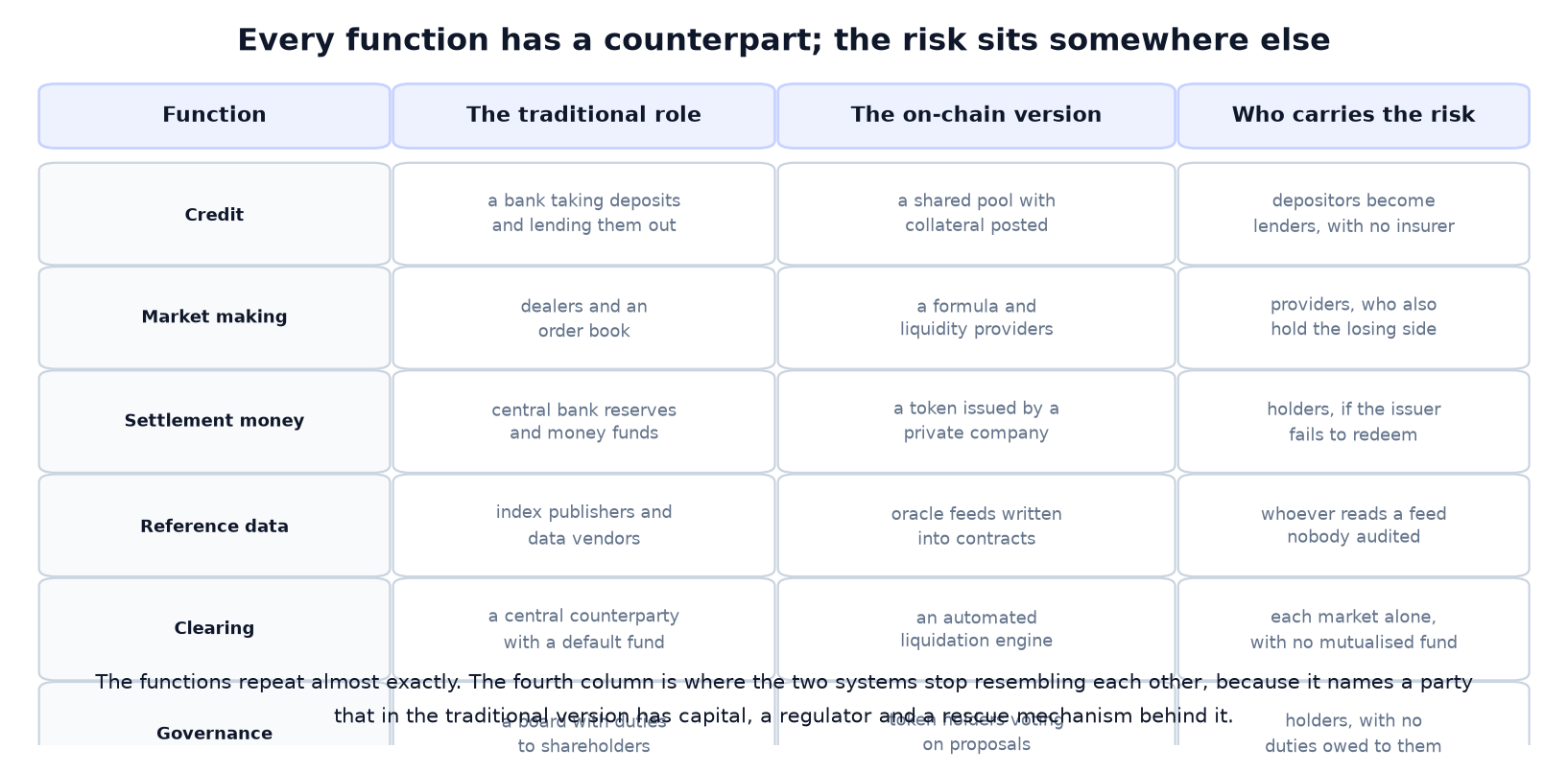
Read the table as a list of questions rather than as a verdict. For each row, the useful question is whether the party carrying the risk has the capital to absorb a bad outcome, the legal obligation to act, and any mechanism for being rescued if it does not. In the conventional column the answer is often yes to all three, which is why those institutions are heavily regulated and why their failures are rare and expensive to resolve. In the second column the answer is usually no to the first two and nothing at all for the third.
That is also why the two systems are converging rather than competing in the way the early rhetoric suggested. Where the on-chain version holds a real asset, an institution with legal personality appears at the boundary: a custodian, a depository, a transfer agent, an issuer subject to rules about reserves. Every institutional mechanism now being deployed keeps a regulated entity in the loop, and the reason is the fourth column of the table rather than any regulatory preference.
Where the two systems already overlap
The comparison is not a contest between two separate worlds, because the two are already stitched together in three specific places.
The first is the tokenised security, where the legal record stays with a depository or transfer agent and the ledger holds a parallel representation. That arrangement was designed by institutions rather than by protocols, and it keeps an entity with legal personality at the boundary precisely so that the fourth column of the mapping table has an answer. The second is payments, where a private dollar token is being tested for corporate settlement by banks and card networks, which moves a function from one column to the other without changing what the function is.
The third is custody, where the same firms appear on both sides: a bank holds cash and administers a fund, a crypto-native custodian holds the coins, and an exchange intermediates for customers who may or may not know where the assets sit. Read across the three, the pattern is that the moving parts are the ones that do not depend on the missing institutions: settlement speed, proof of position, and the ability to move value without a business-hours window.
Three questions that identify what a protocol is
Mapped against conventional finance, any on-chain system can be characterised by three questions, and the answers are usually published even when they are not described as answers.
The first is whose capital absorbs a loss when the first plan fails. In a lending pool it is the depositors; in an automated market it is the liquidity providers; in a derivative it is whoever is holding the position that the liquidation engine reaches first. The second is who has an obligation to act when something goes wrong — not who can act, but who is required to. In almost every protocol the answer is nobody, and where an entity does have an obligation it is because a licence or a contract put it there.
The third is who can stop the system from doing what it is about to do. Some programs are immutable, some have a pause switch controlled by a small group, and some route changes through a token vote. Those three answers describe the same system from different angles than a technical audit would, and they are the ones that determine whether an arrangement is infrastructure that others can build on or a position that happens to be tokenised.
What the mapping predicts
Four predictions follow from the comparison, and each is testable against the next few years rather than rhetorical. First, activity will concentrate where the missing institutions matter least: markets where positions are collateralised, durations are short and settlement benefits most from atomicity. Second, the parts of the system that require credit judgement will stay small or migrate into structures with an institutional party inside them, because the alternative is requiring collateral that borrowers do not have.
Third, stress events will continue to take the form of price cascades rather than liquidity provision, because nothing in the architecture can supply the latter. Fourth, the mechanisms that look most likely to be adopted by the conventional system are the ones that did not require abandoning its institutions: atomic settlement, tokenised collateral, and public verification of positions, all of which can be added to a regulated balance sheet without removing the party that answers for it.
The distinction worth keeping is the one this mapping makes impossible to miss. Two systems can perform identical functions with identical interfaces and differ entirely in who is obliged to act when the first plan fails. The conventional system spends most of its cost budget on that obligation, and the on-chain system has so far chosen to spend almost nothing on it — which is the source of both its efficiency and its characteristic failure.


[…] The failure mechanics referenced here are in what happens to your crypto when an exchange fails, and the general checklist is in ten checks a ranking cannot do for you. For the custody side, see the explainer on private keys and seed phrases and what a crypto wallet actually holds. The difference between a claim and a coin is developed in why a stablecoin is a receipt, and the structure of a decentralised alternative appears in our map of what DeFi reproduces. […]
[…] abstains. That is not unique to this industry, and it is a problem the same industry has studied: the mapping between token governance and corporate governance shows the vote but not the fiduciary duty, and the difference is precisely what makes the layer […]