


Putting a security on a ledger was never the hard part. A token that represents a fund share is a few hundred lines of code, and the standards for representing it have existed for years. The three problems that kept the idea in pilots are the ones nobody solved with code alone: how the holder of a token is identified to the standard a regulator accepts, who can force a transfer when a court orders one, and which authority recognises the record as a real claim on the asset. In the first days of October 2026, five separate groups answered those questions in five different ways, and the answers are what this article compares.

Mechanism one: the depository turns on tokenised settlement
The most consequential launch is the quietest. The Depository Trust Company, the entity that holds the securities side of essentially every American trade, put its tokenisation service into commercial operation in October, after final production stress tests in July on a permissioned network with more than thirty firms participating. Its regulatory basis is a no-action letter issued in December 2025 that permits the depository to run tokenised services for its custodied assets on pre-approved networks for three years.
Two numbers describe why this matters more than any startup announcement. The depository custodies well over one hundred trillion dollars in assets, and the working group attached to the effort includes more than fifty firms: the largest asset managers, the largest banks, the exchanges, the card networks, several custodians and a handful of the crypto-native firms that spent the last decade trying to replace this exact function. When the incumbent runs the experiment, the participants are the market.
The design choices are as informative as the list. Settling on a permissioned network with a fixed set of members keeps the counterparty set identifiable; taking an exemptive letter rather than waiting for a rule keeps the timeline measured in months; and running the service through the depository’s existing platform keeps the legal claim on the underlying asset inside the structure that already holds it. That is the pattern this article will return to: the ledger is new, the institution holding the claim is not.
Mechanism two: a tokenisation vendor plugs into a licensed jurisdiction
The second mechanism solves the recognition problem geographically. A tokenisation platform that reports roughly five billion dollars of tokenised assets under management, up from about four and a third billion at the end of June, integrated its institutional stack with a chain described as the first institutional-grade layer in the United Arab Emirates, built on infrastructure licensed in a financial free zone and recognised by that country’s central bank. The platform’s second-quarter transaction volume was reported at about five and a third billion dollars, up nearly 150 percent year over year, across several hundred active funds.
The significance is in the combination of parties rather than in the technology. A United States-registered, exchange-listed tokenisation company has formally connected to infrastructure inside a Gulf jurisdiction that has its own securities regulator, its own licensing regime and its own central bank, and it did so weeks after signing an agreement with a second regulator in the same region. For an asset manager deciding where to issue, that arrangement answers a question that no public chain can: which court will enforce the record.
Jurisdiction shopping has an unflattering name in some quarters, and the more accurate description here is that tokenised securities are following the path of every other financial instrument. Funds have been domiciled in whichever regime offered the clearest rules since the industry began, and the novel part is only that the ledger makes the domicile visible in the token’s design rather than in a prospectus footnote.
Mechanism three: a public chain writes compliance into the token standard
The third approach moves the compliance logic into the standard itself. A major public layer-two network activated an upgrade that expands its native token standard with tools that used to be the exclusive province of permissioned systems: multiple restrictions per asset, including identity verification, accredited-investor flags and sanctions screening; programmatic corporate actions such as stock splits; forced transfers by an authorised administrator; and conditional orders that remain private until they are included in a block. The same network has been issuing tokenised versions of listed American equities for several weeks, and its roadmap includes cutting block times from two seconds to a fifth of a second and adding protocol-level sponsored transactions.
This is the most technically ambitious of the five and the one with the least legal cover. A restriction embedded in a token is enforceable against anyone who holds the token on that network and unenforceable against anyone who does not, which means the compliance layer is a property of the venue rather than of the asset. For a retail-facing product that is a reasonable trade; for a pension fund it is not a substitute for a licensed transfer agent, and the network’s own documentation is careful to note that its controls are tools rather than approvals.
The upgrade also illustrates a general pattern in standards competition. Once a chain embeds compliance features in a token standard, every application on that chain inherits them without doing anything, which is how a standard becomes a default. The cost is lock-in: a token issued under those rules is legible to every venue on that network and to almost nobody outside it.
Mechanism four: a broker runs a chain for tokenised equities
The fourth mechanism is the one closest to retail. A brokerage with tens of millions of funded accounts runs its own layer-two network built on an existing rollup stack, live since the start of July, with cumulative decentralised-exchange volume reported above seventy-five billion dollars, roughly one hundred and sixty million dollars of deposits locked in its contracts, and about ninety tokenised American stocks and funds available. The stated direction is to make those tokens usable as collateral in lending markets and to expand the product outside the United States.
What makes this different from the first three is that the broker already holds the licences. The customer relationship, the suitability rules, the order handling and the reporting obligations all exist before the chain does, so the token is a new wrapper on a supervised activity rather than a new activity seeking supervision. That is an easier path than the depository’s, and it produces a narrower asset: securities that the broker is permitted to intermediate, held inside accounts the broker already reports on.
The model also creates a dependency worth naming. If the tokens can be used as collateral, then the venue that issues them is also the venue that decides when they can be sold, which is a familiar arrangement in traditional finance and a new one for a chain whose marketing emphasises self-custody.
Mechanism five: a ledger adds institution-only features
The fifth approach adds capabilities rather than standards. A long-running public ledger is activating a set of institution-oriented features: confidential transfers that hide amounts from public view, a permission delegation mechanism, and native batch transactions. Two of those are scheduled for activation in the second week of October and require the support of more than eighty percent of validators over a two-week window, which is the ledger’s own governance mechanism rather than a corporate decision.
The most concrete application of this layer is not American. A national central securities depository in Brazil, responsible for registering assets measured in the tens of trillions of local currency, has begun mirroring shares of a local fund onto the ledger using a multi-purpose token standard, with the first issuance projected in the billions of dollars. A mirrored share is a claim on a fund that continues to exist in the domestic register, which means the token is an additional representation of an asset whose legal home has not moved.
Read together with the first mechanism, the two share a design principle. Both keep the regulated record where it is and treat the ledger as a parallel representation, which is the opposite of the pitch that made this industry famous and much closer to how settlement infrastructure has always worked.
And one attempt at a common standard
Running underneath all five is a sixth effort aimed at making them interoperable. A standards group and a public network launched an open tokenised-asset standard under the stewardship of a foundation known for neutral governance, covering identity, compliance, asset representation and reporting, and explicitly designed for machine-driven collateral management as well as human-facing issuance. The projection attached to the announcement — a thirty trillion dollar tokenised asset market by 2034 — is a forecast rather than a measurement, and the standard is the part worth watching.
The reason is that every mechanism above solves compliance in its own vocabulary. A depository checks its members; a licensed venue checks its participants; a public chain checks the wallet; a broker checks its customer. Without a common way to express who is allowed to hold what, each token remains legible only inside the system that issued it, and the liquidity benefit that tokenisation is supposed to produce stays trapped in islands. That is not a technical problem, which is exactly why a neutral standards body is the plausible place to solve it.
Two cautionary entries from the same fortnight
Not every announcement in this window points the same direction, and the counterexamples are as informative as the launches. One layer-two network handed over the operations of a partner chain to a managed enterprise tier, under which the infrastructure provider runs deployment, upgrades, the sequencer, node operations and incident response. That is a straightforward outsourcing arrangement dressed in the language of decentralisation, and it is the honest direction of travel for corporate chains: someone has to be on call.
The other entry is a shutdown. A smaller layer-two network run by a listed company announced it was winding down, and the reporting around it used the closure as a cautionary example for the sector. Taken with the first, the pair describes the actual shape of this market: a small number of chains with industrial backing and a long tail of experiments that either get absorbed into a vendor’s operations or cease to exist.
The comparison, on one page
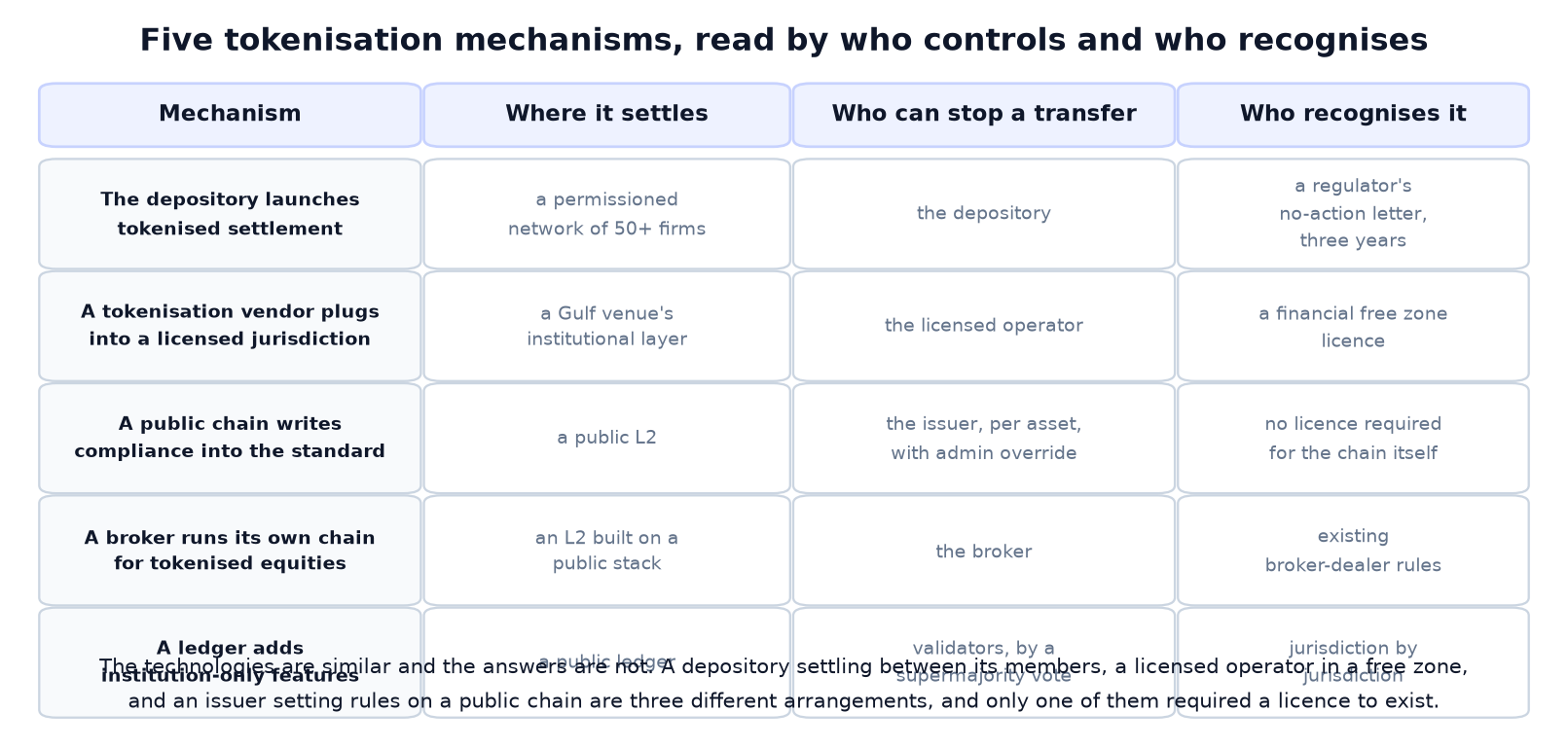
Three observations follow from the matrix. The first is that the only mechanism whose authority is explicitly temporary is the one belonging to the largest institution, because a no-action letter has a stated term and a licence does not. The second is that the mechanism with the strongest compliance tools is the one with the weakest legal recognition, since a token-level restriction binds only inside the network that enforces it. The third is that the two mechanisms with the clearest legal footing are both narrow: a depository settles between members, and a broker intermediates its own customers.
The fourth observation is about what the matrix does not show. None of these five mechanisms competes on settlement speed or cost, because all of them are fast and cheap enough. They compete on who is allowed to say yes, which is a question about licences and memberships rather than about blocks.
What the standards are actually doing
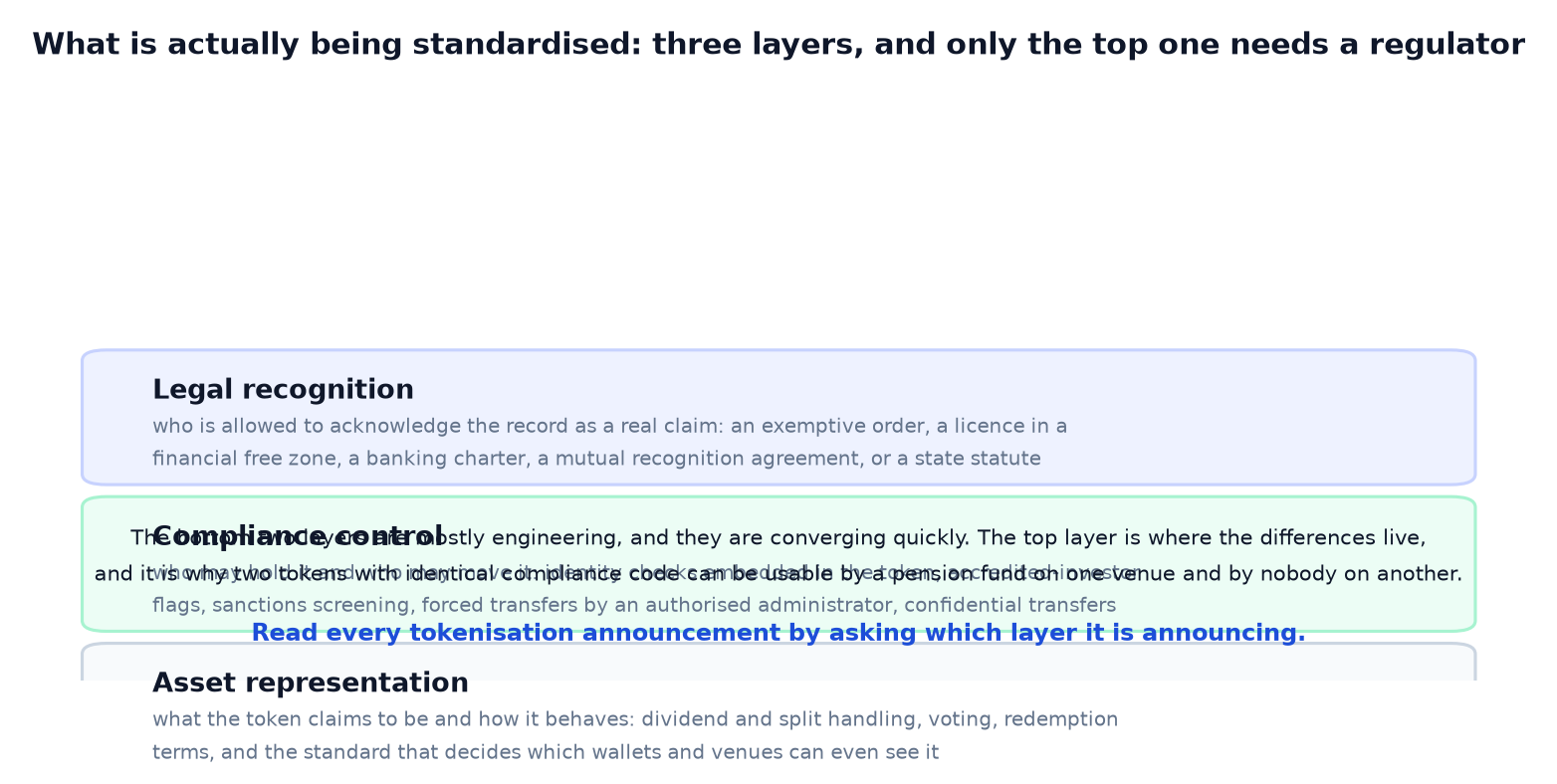
The bottom layer is nearly settled. Standards for representing a fund share on a ledger exist in several flavours, most of them compatible in principle, and the work of specifying dividends, splits, voting and redemption is engineering rather than negotiation. The middle layer is converging faster than most participants expected, because identity checks, investor categories, sanctions screening and forced transfers have all been reduced to features that can be attached to a token.
The top layer is not converging at all, and it is not supposed to. Whether a tokenised share is recognised as a share depends on an exemptive letter, a banking charter, a free-zone licence or a state statute, and those instruments are issued by different authorities with different agendas and different lifetimes. A market where the asset representation is identical everywhere and the legal recognition is local is exactly what the traditional financial system looks like, with one addition: the local differences are now visible in the token itself.
Three different things called a tokenised stock
The phrase covers three arrangements whose legal consequences have almost nothing in common, and the difference is not visible in the interface.
| Arrangement | What the holder actually has | Who handles dividends, splits and votes | Position if the issuer fails |
|---|---|---|---|
| A mirrored share | A claim issued by a licensed intermediary, backed by the real security held in custody | The intermediary and the transfer agent, on the record of the underlying | A creditor of the intermediary, ranked by the structure |
| A synthetic exposure | A contract whose value tracks the price, with a counterparty on the other side | Nobody, because there is no underlying holding | A creditor of the counterparty |
| A collateralised position | A token pledged as security in a lending agreement | The borrower retains the rights unless the pledge is enforced | Dependent on the lending agreement and its liquidation terms |
The distinction matters because products are marketed by the underlying they reference rather than by the claim they carry. A mirror share gives exposure plus the corporate actions attached to a registered holding, which requires a chain of intermediaries that can act on instructions. A synthetic gives exposure and nothing else, so a dividend is a payment adjustment rather than a distribution. A pledged position gives neither, because the borrower keeps the rights until the terms of the pledge are triggered — and when they are, the disposal is governed by a contract rather than by a market.
Reading an announcement therefore requires one question beyond the technology: which of the three is this, and who is contractually obliged when something needs to happen. The same question arises in the tokenised-dollar market, where three designs sit under one word for the same reason: a shared name and a shared interface hide three different assets.
Why the depository’s version carries the most information
Of the five mechanisms running, the one belonging to the incumbent carries the most information per announcement, and the reason is the number of hard problems it touches at once. A settlement pilot that only moved cash would be unremarkable. This one puts tokenised representations of custodied securities through the same infrastructure that handles corporate actions, entitlements and member-level entitlements, which means it has to solve three things simultaneously: netting and finality, the operational events that change a holder’s entitlement, and the identity of who is entitled in the first place.
The participating list is the second reason. A working group of more than fifty institutions is not a technology alliance; it is a roll call of the parties whose back offices would have to be connected for the thing to be useful. When that set includes the largest asset managers, the largest banks, the exchanges, the card networks and a handful of crypto-native custodians, the announcement is a statement about willingness to integrate rather than about capability.
The third reason is the instrument under which it operates. A no-action letter with a stated term sets an experiment’s clock in public, which is unusual in a sector where pilots usually end without a date on which anyone can judge them. If the term expires without a rule or a statute behind it, the largest and most heavily attended tokenisation effort in the market has to be re-authorised, and the fact that the depository’s own service still exists while the permission lapses would be the most instructive event of the whole cycle.
The measurement problem
Anyone trying to size this market encounters the same obstacle: the published numbers do not agree, and the disagreement is not small. Trackers that count distributed asset value report totals in the mid-thirty billions, while a figure often quoted alongside them counts the represented value of the same assets and lands more than ten times higher. Subcategories are worse: the tokenised Treasury market has been reported at both eight and a half billion and about sixteen billion dollars within the same quarter, and one monthly figure published in late October could not be reconciled with the product-level numbers in the same article.
At the product level the numbers are firmer and still contested. The largest tokenised Treasury fund is reported around two and a half to three billion dollars across the period, a second issuer’s equivalent product around two to two and a half billion, a third around eight hundred and sixty million, and a tokenisation platform’s overall book near five billion. The pattern is that fund-level figures are auditable and category-level figures are not, because the category depends on whether wrappers, money market funds, stablecoins and duplicate representations on multiple chains are counted inside it.
The practical rule is the one that applies to any new financial category: use product-level numbers, state which ones, and refuse to aggregate across definitions. A single “tokenised asset market size” figure is a claim about a definition that the person quoting it usually has not read.
What to watch from here
Two things decide how this develops, and neither is a technology question. The first is whether the temporary instrument becomes permanent. A three-year no-action letter that is not succeeded by a rule or a statute leaves the largest participant in the market operating on a permit with a date on it, and the difference between a permit and a licence is the difference between a market that can be planned around and one that has to be renegotiated every few years. The rulemaking calendar described elsewhere is where that question is being answered.
The second is whether a common vocabulary for permissions emerges, because without one every issuer repeats the same integration work for each venue and each jurisdiction. The effort announced this month is a serious attempt at that vocabulary, and its success depends on a detail that has nothing to do with code: which of the incumbents with the most to lose from interoperation decides to adopt it.
What can be said with confidence is that the industry’s self-description has changed. The pitch a few years ago was replacement — a new rail that would make depositories and transfer agents unnecessary. The mechanisms running today are additions to the same institutions, using the same legal claims, with a ledger in the middle and a permission list on top. The most expensive part of a settlement system has always been the part that decides who may write, and the five mechanisms above agree on that even where they disagree on everything else.


[…] a transfer agent or depository in the loop precisely because a court will need someone to address. Every serious tokenisation mechanism running today keeps a regulated entity inside the loop, and the reason is not […]