


An exchange balance feels like a bank balance, and that feeling is the source of most of the damage when an exchange fails. The number in the app moves when you trade, updates when a deposit confirms, and behaves exactly like money you own. It is not money you own. It is a row in a private database that the exchange maintains, and the exchange is free to change it, freeze it or lose it in a way that a coin in your own wallet is not. When the company fails, that row does not turn into a coin you can withdraw. It turns into a claim against a bankrupt estate, and the value of a claim depends on a queue that has nothing to do with how the balance looked on the day the doors closed.
This article is about that queue: who is in it, in what order, what a proof of reserves does and does not prove, and what a depositor can actually do before a failure rather than after it. The short version is uncomfortable and simple. Custody on an exchange is a credit relationship that most users do not know they have entered, and the protections around it are weaker than the ones around a bank account, because the deposit insurance that makes an ordinary bank failure survivable has no automatic equivalent in crypto.

An exchange balance is a database entry, not a coin
When you deposit a coin to a centralized exchange, the exchange gives you a credit in its own books and moves the coin into a wallet it controls. From that moment the coin is not yours in any sense the network recognises. The network sees a transfer to an address whose private keys belong to the exchange. What you hold is a promise, denominated in a coin, recorded in a database, and honoured only while the company is able and willing to honour it.
This is why two users who each “own” one bitcoin on the same exchange can exist at the same time while the exchange holds fewer than two coins in reserve, and why that situation is invisible from the outside until withdrawals stop. The internal ledger is not the blockchain. It is a faster, cheaper and more private database that happens to be run by one company, and unlike a blockchain it does not reconcile itself against reality on a fixed schedule.
The distinction shows up in the one moment that matters. A withdrawal is the exchange agreeing to reduce your credit and send a real coin from its own custody. If the exchange is solvent and honest, the two movements cancel and nothing is lost. If it is neither, your credit is a claim on an estate that is smaller than the sum of all credits, and the withdrawal is the door that closes first.
What custody means when the custodian is a company
The word custody suggests a vault, and the reality is closer to a warehouse receipt. A warehouse can hold your goods, but the receipt is only as good as the warehouse, and if the warehouse has sold your goods and replaced them with paper promises, the receipt does not create goods out of nothing. An exchange that holds customer coins in an omnibus wallet, with no per-customer separation and no per-customer keys, is a warehouse of exactly that kind.
Whether the coins are legally yours or the company’s property is the question that decides almost everything in a failure. If the terms of service and the local law treat customer assets as held on trust, kept separate and not available to the general creditors, then customers have a strong claim to be paid from those assets first. If the terms instead describe the balance as a general obligation of the company, then customers are unsecured creditors like any supplier, and they share whatever is left with everyone else in the queue. The same app, the same chart and the same balance can be one or the other depending on a paragraph most users never read.
This is the first practical lesson of exchange failures: the custody model is a legal arrangement more than a technical one. Two exchanges running identical software can have completely different outcomes for their customers, because one keeps customer assets in a segregated structure that a court will recognise and the other does not. Reading the terms is dull, and it is also the difference between a balance that survives a bankruptcy and a balance that becomes a fraction of a claim.
The order in which a failed firm pays its creditors
Bankruptcy is a queue, and the queue is not sorted by who needs the money most. It is sorted by a legal hierarchy that mostly predicts who gets paid, and the practical answer to “what happens to my crypto” is a position in that hierarchy.
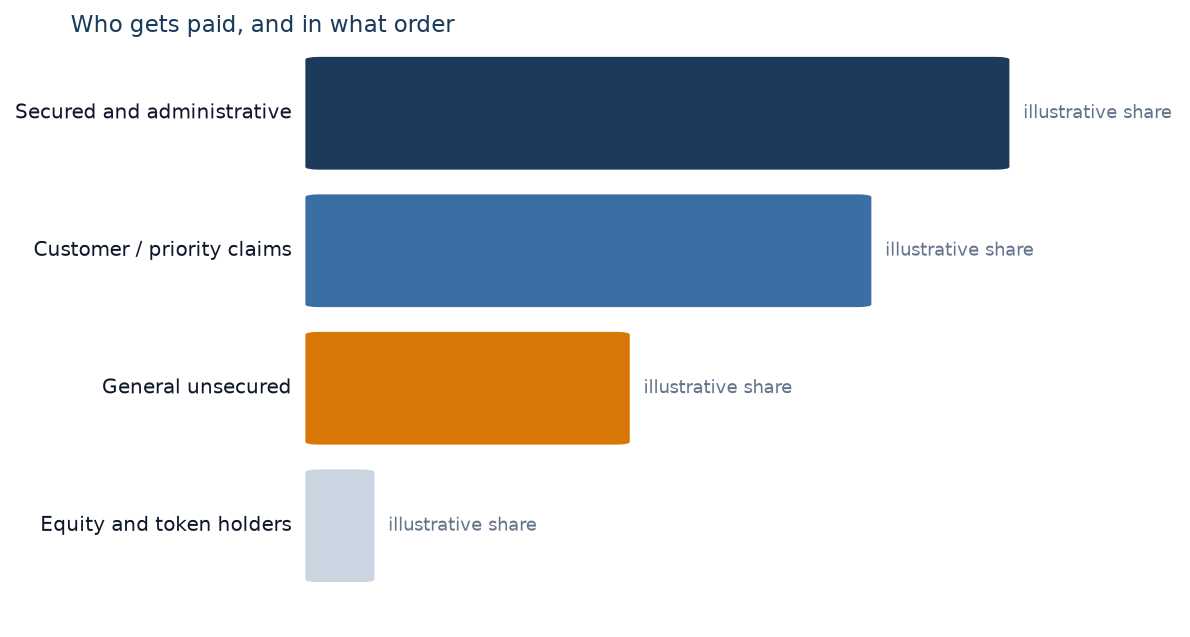
At the top sit secured creditors and the administrative costs of the bankruptcy itself, which include lawyers, accountants and the professionals who run the process. That last point surprises people: the cost of the failure is paid before the victims are, and in a large case those costs run into hundreds of millions. Below them sit the creditors the law ranks as priority, which is where customers land if the law or the terms put them there. Below those sit the general unsecured creditors, an enormous and slow-moving class. At the very bottom sit equity and token holders, who are usually paid last and usually paid nothing.
The practical consequence is that a recovery is a percentage, not a refund. A customer who is a priority claimant in a well-separated estate may recover most of a balance over several years. A customer who is an unsecured creditor in a case with a large hole may recover a small fraction, or a fraction of a fraction after the professionals are paid. The headline number on the day of the filing is almost never the number that arrives.
Why customers land at the front or the back
The position of customers is decided by a combination of the terms of service, the law of the jurisdiction and, sometimes, the willingness of a court to look past the paperwork at what actually happened. When a platform holds customer assets in a segregated, auditable structure and the terms say so, a court is far more likely to treat those assets as belonging to customers and outside the general estate. When a platform has mixed customer assets with its own, lent them out or used them for its own trading, that separation collapses, and customers fall back into the general queue.
The revealing part of most large failures is not the bankruptcy itself but the months before it. If customer assets were being moved to cover the company’s own positions, the money is already gone by the time the filing is public, and a court can only distribute what it can still find. This is why the recovery percentages across different failures vary so widely: the queue is the same in each case, and what differs is how much is left in the estate when the queue is finally called.
The mechanics of a failure: run, freeze, filing
Failures look different from the inside, and they follow a remarkably consistent sequence from the outside. Suspicion builds, some participants withdraw, withdrawal times lengthen, a public statement denies a problem, withdrawals are suspended entirely, and a filing follows. The interval between the first frozen withdrawal and the first legal filing is often only days, which is why “I will move my coins next week” is a plan that can fail before it is executed.
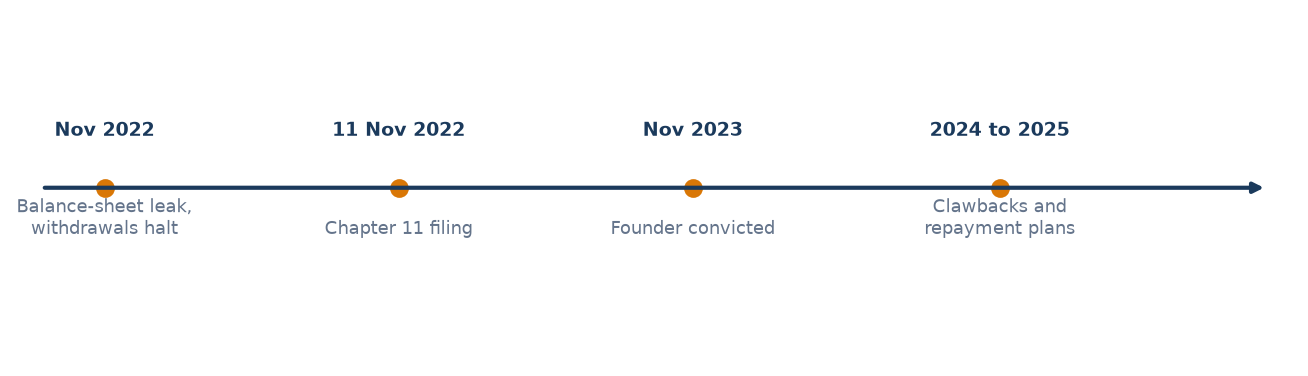
Several details of that sequence are worth internalising. Withdrawal delays are a signal, not a nuisance; a venue that used to pay in minutes and now takes days has a liquidity problem it is managing in public. A sudden change in terms, a new tier of fees or a quietly added condition on withdrawals is a signal of the same kind. And a public reassurance issued by the platform itself is the weakest possible evidence, because the party with the most to lose is the least reliable narrator of its own solvency.
Proof of reserves, and what it does not prove
Proof of reserves is the industry’s answer to the trust problem, and it is a genuinely useful tool that is routinely oversold. The mechanism proves that a set of addresses controlled by the exchange holds a certain amount of assets at a certain moment. It does not, on its own, prove anything about liabilities, because a firm can hold a large pile of assets and a still larger pile of customer credits.
Two problems follow directly. The first is the net-assets gap: without a matching proof of liabilities, a reserve report is half a balance sheet, and half a balance sheet can be made to look healthy by showing the better half. The second is the snapshot problem: a report proves a moment, and a firm that expects to be measured can borrow assets for the moment, publish the proof and return them afterwards. A reserve report dated a single day is therefore much weaker than one published continuously, with a stable set of addresses and a reputation for never moving them. If you want the general framework for judging a venue, our checklist on why a top-ten ranking is not due diligence covers the questions that a ranking cannot answer.
None of this makes proof of reserves useless. It makes it a component of due diligence rather than a certificate of safety, and it belongs in the same list as segregated custody, audited financials and a track record of honouring withdrawals under stress. A cryptographically clean proof of assets is a good sign and a far cry from a guarantee.
Clawbacks: the money you already withdrew can be pulled back
The part of a failure that almost nobody expects is the reversal of withdrawals that happened before it. Bankruptcy law in many jurisdictions allows the estate to recover payments made in the period before the filing if they unfairly favoured one creditor over others, and a rush of withdrawals in the final days is exactly the kind of preference the rules are designed to unwind. The window is typically measured in months, not days.
The consequence is counter-intuitive and worth stating plainly. Getting your coins out a few days before the freeze does not necessarily make them safe. In a large case, the professionals running the estate can demand the return of withdrawals made in the run-up to the failure, and a customer who refuses may face legal action. The people who are safest are not the ones who withdrew last, but the ones who never left their assets in the venue at all, or who had a documented claim that fits a priority tier.
What a depositor can actually do
The useful advice is all on the before side of the failure, because by the time withdrawals are frozen the options have narrowed to waiting. The following measures do not make a venue safe, and together they move a depositor from “completely exposed” to “exposed in ways that are understood”.
Treat an exchange as a place to trade, not a place to save. The longer a balance sits on a venue, the longer it is exposed to the venue’s solvency, and a balance that sits there for years is an unsecured loan with no interest and no paperwork. Keep only the working balance on the platform and move the rest to self-custody, which is a different risk rather than the absence of risk. Diversify across venues if you must hold on several, and remember that correlated failures are common, because a shock that breaks one exchange often breaks the ones with the same exposure.
Watch the operational signals rather than the marketing. Withdrawal times, the tone of support responses, changes to terms and the frequency of reserve attestations are all observable, and they degrade before the failure becomes public. Read the custody terms once, carefully, and ask which of the two models the venue uses: segregated customer assets on trust, or a general obligation of the company. Test a withdrawal of a small amount periodically, because a venue that cannot pay a small amount quickly is telling you something about the large amount.
Self-custody is the other side of the same trade
Holding your own keys removes the counterparty and replaces it with personal responsibility. The failure modes transfer from the exchange’s balance sheet to your own practice, which is the subject of what a crypto wallet actually holds and why a wallet is a tool for keys rather than a container for coins. That is not a free upgrade and it is not the right answer for everyone, but it is the only arrangement in which a third party’s bankruptcy cannot take the asset, because no third party is involved.
There is a middle ground worth naming, because the argument is often framed as a binary. Multisignature and collaborative custody arrangements split control between the user and a provider, so that neither a single lost key nor a single failed company moves the money on its own. They reintroduce a counterparty, and they narrow the specific failure that destroys most users, which is a total loss caused by leaving everything on one venue. The honest framing is a menu of risks rather than a search for the risk-free option.
The distinction worth keeping
A balance on an exchange is a claim against a company, not a coin in a wallet, and the two behave identically until the company cannot pay. When it cannot, the claim is sorted by a legal hierarchy, paid from whatever is left, and reduced by the cost of the process itself. A proof of reserves speaks to the asset half of the balance sheet and is silent about the liability half. A withdrawal in the final days is reversible. None of these facts is hidden; they are simply outside the part of the interface that a balance displays.
The reasonable conclusion is not that exchanges are fraudulent, because most are not and they provide real services. It is that the deposit is a credit decision, and it should be made with the same scepticism as any other credit decision. The venue that looks safest in a top-ten ranking is not thereby safe, and the user who understands the queue they are standing in is the user who can decide, calmly and in advance, how much of that queue they are willing to join.
Three failures, and what each one taught the market
The modern rules around exchange custody are the residue of a small number of failures, each of which exposed a different assumption. Reading them as a set is more useful than reading any one of them alone, because the lesson is not that a particular venue was dishonest but that three weaknesses recur: commingled assets, a mismatch between customer withdrawals and the firm’s own holdings, and a legal structure that leaves customers in the general queue.
| Failure | What broke | What the market changed |
|---|---|---|
| 2014, a large early exchange | Customer coins sat in a single pool that was drained over years, with the shortfall hidden inside an internal ledger | The idea that an exchange balance is a database entry rather than a coin stopped being a technicality and became a headline |
| 2022, a large lending platform | Customer deposits were lent into long-dated, illiquid positions, so a wave of withdrawals could not be met | Withdrawal delays became a monitored signal, and the difference between a deposit and a loan was stated in plain language |
| 2022, a large exchange | Customer assets were used to support the firm’s own trading, and the failure of a related entity pulled the whole group down | Proof of reserves, segregation and custody terms moved from specialist reading into mainstream coverage |

The pattern across the three is worth naming. The failure that became public was rarely the first problem; it was the point at which the internal ledger could no longer be reconciled with the assets on hand. By then the gap was large, the withdrawals were already slow, and the remaining decisions belonged to lawyers. A depositor who waits for public confirmation of a problem is waiting for the confirmation that comes last.
Why there is no deposit insurance here
The strongest protection an ordinary bank customer has is not the bank’s honesty; it is the insurance that stands behind the deposit and the central bank that stands behind the institution. A failed bank’s customers are made whole up to a statutory limit quickly, and the mechanism is funded in advance and backed by the state. That arrangement is what makes a bank run survivable, and it is precisely the arrangement a crypto exchange does not have.
There is no statutory insurance on an exchange balance, and no lender of last resort will create liquidity against an exchange’s collateral to stop a run. The industry has experimented with self-funded protection funds, and those funds share a structural weakness: they are sized for ordinary losses, and a correlated failure among the members can empty the fund exactly when it is needed. A crypto exchange balance is therefore closer to an uninsured corporate bond than to a bank deposit, and the amount a person is willing to leave on a venue should be sized by that fact rather than by the confidence the interface conveys.
Frequently asked questions
Do I still own my crypto if it is on an exchange?
You own a claim, not the coin. The exchange holds the keys and the coins, and it records a balance for you in its own database. Whether that claim is legally secured against specific assets depends on the custody terms and the local law, and it is very often a general unsecured claim.
What happens first when an exchange starts to fail?
Withdrawals slow down and then stop. Suspicion, lengthening withdrawal times, denials, a suspension and a legal filing tend to occur within a short window, which is why the practical time to act is well before the problem is public.
Does proof of reserves mean my funds are safe?
No. It shows assets at a point in time and says nothing about liabilities, so it is half a balance sheet. Read it as one input among several, alongside segregated custody, audited accounts and a track record of paying withdrawals under stress.
Can a withdrawal be reversed after a bankruptcy filing?
Yes, in many jurisdictions. Payments made to one creditor shortly before a filing can be recovered by the estate as a preference, and the lookback window can be months. Getting out days before the freeze does not guarantee the money stays out.
Where do customers rank when an exchange is liquidated?
It depends on the terms and the law. Where customer assets are segregated and held on trust, customers can rank near the front; where the balance is a general obligation, they join the unsecured creditors and share whatever remains after secured claims and the costs of the process.
Is self-custody the only safe option?
It is the only option in which a third party’s bankruptcy cannot take the asset, and it replaces that risk with personal responsibility for keys. Multisignature and collaborative custody sit in between, splitting control so that neither a lost key nor a failed company moves the funds alone.
Sources and further reading
The bankruptcy process described here follows the general structure of corporate insolvency in major jurisdictions, in which secured and administrative claims are paid before priority and unsecured claims. The specific treatment of customer assets varies by venue and by the wording of the custody terms.
For related reading, see our note on the ten checks a top-ten ranking cannot do for you, and our explainer on why a stablecoin is a receipt rather than a coin. The settlement race between issuers is covered in one chain per issuer, and the fundamentals of holding keys yourself are in what a crypto wallet actually holds.


