


Binance is the largest cryptocurrency exchange in the world, and the phrase is doing most of the work in that sentence. A ranking by trading volume tells you that a great many people route orders through the venue. It does not tell you whether the company is solvent, whether the coins behind the numbers exist, whether the venue will still be there when you want them back, or what the failure of a related entity would do to the account you are looking at. Those are the questions that matter, and none of them is answered by size.
This article takes Binance apart the way you would take apart any financial intermediary: what the business actually is, where the revenue comes from, what the custody arrangement is, what the historical record shows, and which of the slogans that surround it survive contact with the mechanics. The aim is not to grade the exchange. The aim is to replace a vague feeling of safety or danger with a short list of things you can actually check.
What Binance actually is
Binance launched in 2017 and grew, in the space of a few years, into the venue that most other venues measure themselves against. Its scale is real: it processes a large share of global spot trading and an even larger share of derivatives volume, and it runs a token, a chain, a payments product and a custody business alongside the trading desk. That breadth is the first thing to understand, because it means the word “Binance” refers to several different entities, several different risks and several different regulators depending on which product you are using.
It is also a company with an unusual corporate geography. For years it operated without a single declared headquarters and with a deliberately distributed structure, which made it hard to say which jurisdiction’s rules applied to which activity. That ambiguity was a feature during a period when few jurisdictions had clear crypto rules, and it became a liability once regulators started asking who was responsible for what. The 2023 settlement with United States authorities, in which the company agreed to a multi-billion-dollar penalty and its founder stepped down as chief executive, is best read as the moment that ambiguity was priced.
The distinction worth holding from the start is between the exchange as a place to trade and the exchange as a place to store. The trading function can be excellent and the custody function can still be the part that decides whether you are made whole in a crisis. Those are different businesses running on the same brand.
A brand is not a business
The most useful way to think about a large exchange is as a set of business lines that happen to share a logo. Each line answers a different customer question, and each carries a different failure mode.
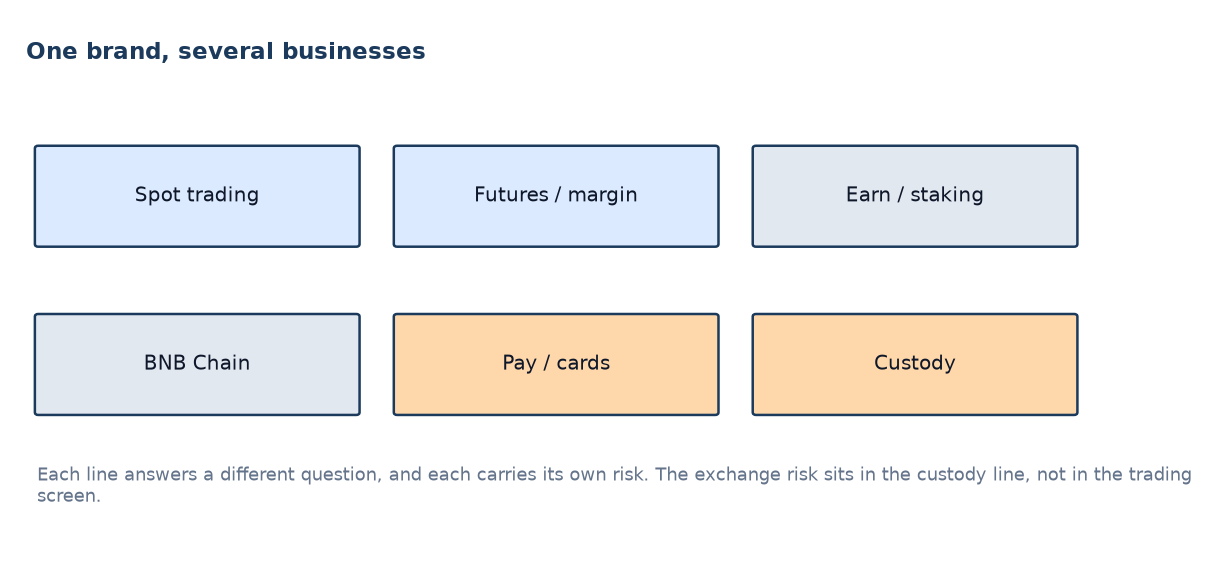
Spot trading is the simplest line: the venue matches a buyer and a seller and takes a fee. Margin and futures trading adds leverage, which adds liquidation, which adds a book of customer positions the venue has to manage. The earn and staking lines, where a customer deposits an asset to receive a yield, are the line that most resembles a bank deposit and the line where a depositor’s assets are most clearly being put to work by somebody else. A payments product and a card turn the balance into a spending balance. A custody product is the purest form of the same question that has haunted every exchange failure: who holds the key, and what happens when the holder cannot or will not return it.
The reason to separate them is that a failure can be local. A settlement of a regulatory matter in one country can close one line while the others keep running. A problem in a related lending entity can freeze withdrawals across every line at once, which is exactly what happened in the 2022 cascade, where one firm’s trouble pulled on the others through shared exposure. Knowing which line your money sits in tells you which of those scenarios applies to you.
Where the fees actually come from
Exchange pricing is more layered than the headline number suggests, and the layers are where the margin hides. The first distinction is between maker and taker fees: the order that rests in the book and gets filled adds liquidity and is charged less, while the order that crosses the spread takes liquidity and is charged more. A venue that advertises a very low taker fee is often competing on the visible number, and the effective cost depends on how often you post rather than take.
The second layer is the tier structure. Fees fall as thirty-day volume rises, which means the headline rate applies to a small trader and a large one pays less, and it means the effective fee depends on your own trading pattern rather than on the sign in the window. The third layer is a native token discount, where holding the exchange’s own token reduces the fee. That discount is real, and it is also a soft lock: to keep it, you hold more of the exchange’s token, which concentrates your exposure to the exchange in the exchange’s own balance sheet. The discount is a rebate paid in counterparty risk.
The fourth layer is the one people forget: withdrawals and deposits. A trading fee is paid on activity, and a withdrawal fee is paid when you try to leave. In a stressed venue, a withdrawal fee can quietly rise, or the withdrawal can be delayed, and the fee becomes a way of managing the queue rather than a way of pricing a service. When you compare venues, the number that matters most is not the maker fee but the cost and speed of getting your asset out.

The balance sheet question
Every exchange holds assets and owes liabilities, and the two are not the same thing. The assets are the coins in wallets the venue controls. The liabilities are the customer balances the venue records in its internal database. A reserve report, of the kind most large exchanges now publish, shows the asset side: it proves that a set of addresses controlled a certain amount at a certain moment.
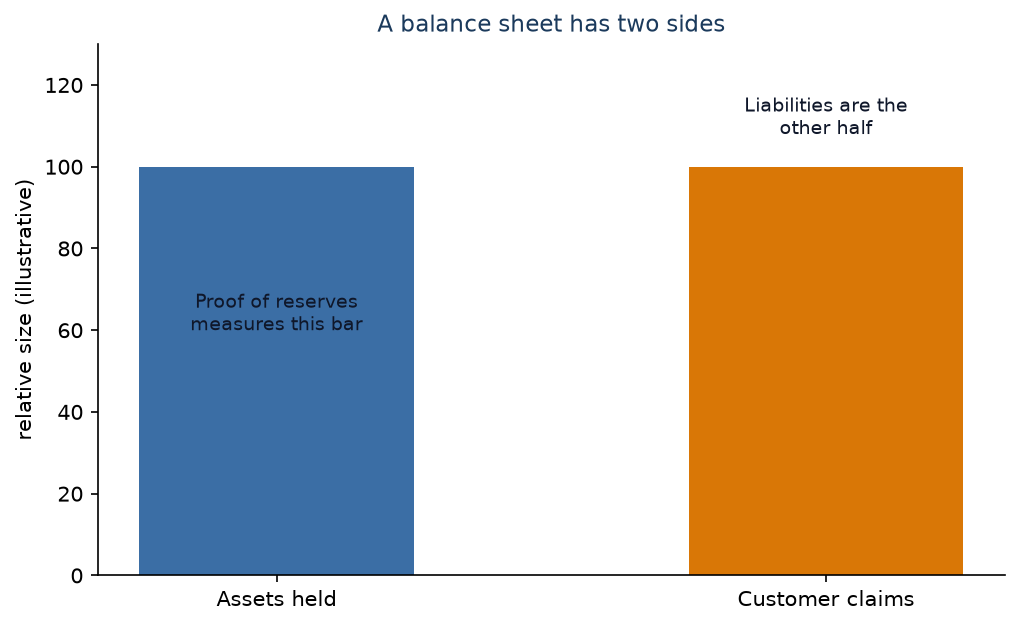
That leaves two problems that no cryptographic proof fixes by itself. The first is the difference between the two sides: a venue can hold a large pile of assets and a larger pile of customer claims, and a proof of assets says nothing about the gap. The second is the moment in time: a report proves the state of affairs on the day it was published, and a firm that expects to be measured has an incentive to look its best for that day. The stronger version, which some venues have moved toward, is a continuous attestation over a stable set of addresses, published on a schedule rather than as a single snapshot.
None of this makes reserve reporting worthless. It moves it from a certificate into a component, and it belongs on the same list as segregated custody, audited financial statements and a track record of paying withdrawals under stress. A clean cryptographic proof is a good sign and a long way from a guarantee. For the general framework, see our checklist on why a top-ten ranking is not due diligence.
The record, read as a pattern rather than a score
Binance has a public history, and reading it as a sequence is more useful than reading any single event. In 2019, the venue lost a large amount of bitcoin to a security breach and covered the loss from a reserve fund, which is the honest use of such a fund and also a reminder that the security of a large venue is a target, not a settled property. In 2023, it briefly stopped dollar transfers through a banking partner, which showed how much of an exchange’s day-to-day operation depends on access to the traditional banking system rather than on the blockchain. And in late 2023, it settled a set of United States enforcement actions with a substantial penalty, and its founder resigned as chief executive, which moved the company from a mode of operating around regulation to a mode of operating inside it.
The pattern across those events is the one that applies to every large venue. The technical risk is real and mostly defended against; the operational risk sits in a dependency that is not obvious from the interface, such as a banking partner or a related entity; and the legal risk is the one that can change the whole company at once. An exchange that has survived these three is safer than one that has not faced them, and none of the three can be ruled out by a clean trading screen.
Regulation as a product feature
For a global venue, regulation is not a single status. It is a patchwork, and the experience of using the exchange depends on where you are. A customer in one country may have access to a licensed local entity with a formal complaints process and segregated client assets; a customer elsewhere may be routed to an offshore entity with far fewer obligations. The same brand, the same app, two very different sets of rights.
This is why two people can have opposite experiences of the same exchange and both be telling the truth. The one in the regulated jurisdiction describes a process; the one routed offshore describes an account with few of the protections they imagined. If you are going to hold a balance anywhere, the first question is not “is this exchange safe” but “which legal entity am I a customer of, and what does its rulebook actually promise me”.
What “is Binance safe” really asks
The question is usually asked as if it had one answer. It has at least four, and separating them is the whole exercise.
The first is the security of the platform against theft: whether the venue’s keys, code and people can be attacked, and how it responds when they are. The second is the safety of the assets as a claim: whether the coins behind your balance exist, whether they are segregated, and whether a court would treat them as yours or as a general claim on the company. The third is the operational safety of the venue itself: whether it has the banking, liquidity and related-entity arrangements to keep running under stress. The fourth is your own behaviour: how much you leave on the venue, for how long, and whether you have a plan to move it that does not depend on the withdrawal queue being open. A venue can score well on the first three and still cost you money because of the fourth.
The distinction worth keeping
Binance is a large, technically capable institution that holds a significant share of the world’s crypto trading, and a customer balance on it is a claim against that institution rather than a coin in a wallet. The scale is genuine and it is not a form of insurance. The reserve reports are useful and they cover half of the balance sheet. The fee schedule is competitive and the exit cost is the number that decides what you actually keep. If there is a single sentence to take away, it is that the venue deserves to be judged on the same four questions any depositor would ask a bank, and that a ranking by volume answers none of them.
What follows from that is not a recommendation to avoid the exchange or to trust it, but a discipline: hold on the venue only what you intend to trade, understand which legal entity holds the rest, read the reserve report as half a document, and treat the withdrawal door as the part of the building that matters most. The next time you check a balance, it is worth asking which of the four questions above you have an answer to. For the mechanics of what happens when the answer turns out to be none of them, see our article on what happens to your crypto when an exchange fails.
The native token, and why an exchange has one
Binance issues a token, and the existence of that token is worth understanding rather than dismissing. A native token does several jobs at once: it is a discount mechanism on trading fees, a unit of account for a launch platform, a gas token on the exchange’s own chain, and a marketing instrument that ties a customer’s attention to the venue’s valuation. Each of those jobs is legitimate on its own, and together they create a circularity any depositor should be able to see.
The circularity is simple. If you hold the token to earn a fee discount, part of your net worth tracks the health of the exchange, because the token’s value depends on demand for the exchange’s services. The stronger the venue, the more the token is worth, and the more the venue struggles, the more both the token and any balance you keep on the platform fall together. A concentration invisible in an ordinary portfolio view becomes very visible in a stress event, because the two positions are the same position.
There is a second consideration that is easy to overlook. A token that also functions as a gas token on the exchange’s chain is exposed to the adoption of that chain, and a chain is a long, expensive project whose success is not guaranteed by the exchange’s trading volume. This is not an argument against holding the token; it is an argument for counting it as exposure to the exchange rather than as a separate asset, which is exactly the calculation the exchange’s own marketing is least likely to encourage.
Where the revenue comes from when trading is quiet
A common assumption is that an exchange earns only when customers trade, and the assumption is wrong in a way that matters for judging solvency. Trading fees are the visible line, and they are cyclical: volume falls in quiet markets, and a venue that depends on them has a revenue stream that shrinks exactly when its customers are most nervous.
A large venue therefore has several other lines. Listing fees, where a project pays to be listed, are often paid in tokens and can be substantial. The earn and staking products take a spread between what the customer is paid and what the underlying asset yields. Lending and margin generate interest. A custody business charges a fee for safekeeping. And a large venue holds its own treasury, a portfolio with its own returns and its own risks. The result is a business with many small streams rather than one big one, which is generally a strength, with one caveat: several of those streams are opaque from the outside, and opacity is the thing a depositor cannot price.
What a customer can check in fifteen minutes
Most of the analysis above collapses into a short list, and the list is more useful than a rating because you can actually run it.
First, identify the legal entity: look at the terms and find which company you are a customer of and which country’s law governs the agreement. Second, find the deposit and withdrawal terms, and in particular the stated processing times; a venue whose stated time is minutes and whose practice is days is telling you something. Third, read the reserve report and check whether it is a snapshot or a continuous attestation, and whether it covers the assets you hold. Fourth, test the exit with a small withdrawal, because a venue that cannot pay a small amount quickly will not pay a large amount in a hurry. Fifth, decide how much you are willing to leave, and write it down, because the decision is much harder to make honestly in the middle of a run. None of these five replaces the others, and together they turn a vague sense of safety into a set of facts you have actually examined.
Frequently asked questions
Is Binance the largest crypto exchange?
By spot and derivatives volume it is the largest venue in the market. Size measures how much trading flows through the venue, and it does not by itself say anything about solvency or about the strength of your claim on a balance.
Is Binance safe to keep coins on?
That depends on four separate things: platform security, the legal status of your claim, the venue’s operational resilience, and how much you leave there. A large exchange can be strong on the first and weak on the second, and no exchange is strong on the fourth except by your own discipline.
What is a proof of reserves at Binance worth?
It shows the asset side of the balance sheet at a point in time. It does not prove liabilities, so it is half a document. Read it alongside segregated custody, audited accounts and a track record of paying withdrawals under stress.
Why does holding BNB lower my fees?
A native-token discount reduces trading fees for holders of the exchange’s own token. The discount is real and it is a soft lock: it concentrates your exposure to the exchange inside the exchange’s own balance sheet.
What did the 2023 United States settlement change?
It resolved a set of enforcement actions with a substantial penalty and led to a change of chief executive. The practical effect was a move from operating around regulation to operating inside it, which changes the company’s risk profile more than any single product feature.
Should I move my coins off the exchange?
If the balance is not there to trade, it is an unsecured claim with no interest, and moving it to self-custody replaces the venue’s risk with your own key management. That is a trade, not a free upgrade; the mechanics are covered in what a private key actually is.
A note on the numbers in this article
You may have noticed that this article avoids quoting specific fee percentages and reserve totals, and the avoidance is deliberate. Exchange fee schedules change with promotions, VIP tiers and token holdings, and a number copied from today’s marketing page is stale within weeks. Reserve totals are published by the venues themselves, at intervals of their choosing. What does not change quickly is the structure: maker versus taker, tiered volume pricing, a token discount that is really added exposure, a reserve report that covers half a balance sheet, and an exit cost that decides what you keep. Those are the things worth memorising, and the current figures are worth checking against the primary source on the day you act.
Sources and further reading
The custody and failure mechanics referenced here are set out in our explainer on exchange failure and the order of claims, and the general checklist for judging a venue is in ten checks a ranking cannot do for you. For what it means to hold keys yourself, see the explainer on private keys and seed phrases, and for why a wallet is not a container of coins, see what a crypto wallet actually holds.


