
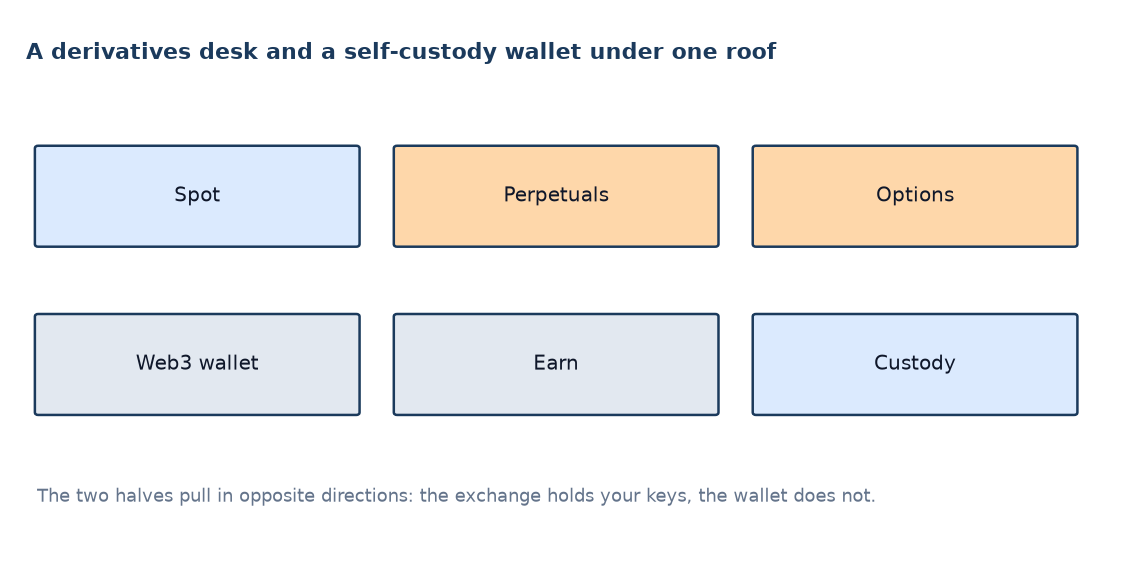
OKX began life as a derivatives venue and still looks like one, which is the most important fact about it. A derivatives exchange is a different machine from a spot exchange: it runs a book of leveraged positions, it collects and pays a funding rate between longs and shorts, and it has to manage the risk of liquidating customers whose collateral has run out. That machinery sits underneath the same clean app that also sells spot trading, and it shapes the venue’s incentives, its revenue and its failure modes.
There is a second half to OKX that makes it unusual. Alongside the exchange it ships a self-custody wallet, a product that holds the user’s keys rather than the venue’s, and a browser for on-chain applications. Two businesses with opposite custody models live under one brand, and the interesting question is not which one is better but which one you are actually using at any given moment. This article sets out what OKX is, how the derivatives engine works, where the fees and the funding rate come from, and which parts of the pitch survive contact with the mechanics.
What OKX is, and where it came from
OKX is the current name of a venue that traded for years as OKEx, which itself grew out of an older Chinese exchange. The rebranding came with an expansion: from a venue known mainly for contracts into one that also offers spot markets, an earn product, a custody business and a consumer wallet. It is now one of the handful of exchanges that a serious trader would name when asked who the largest global venues are, and it competes most directly with the venue described in our piece on what happens when an exchange fails, in the sense that the two are usually measured against each other.
The lineage matters because it explains the product emphasis. A venue that spent its early life on contracts has a matching engine, a risk engine and a liquidation system built for leverage, and those systems are expensive and hard to replicate. When the same company later adds spot markets and a wallet, the derivatives engine remains the core competence, and the rest of the product line is layered on top of it.
The corporate geography has the same distributed shape as its peers, with the customer-facing entity depending on where the customer is. The practical consequence is the one that applies to every global venue: the same brand can mean different legal rights in different countries, and the terms of service, not the marketing, are what define those rights.
A derivatives desk is a different machine
The product that defines OKX is the perpetual future, a contract with no expiry that tracks an underlying price and is kept tethered to it by a funding rate. Understanding the funding rate is understanding most of what makes a derivatives venue different from a spot market.
A perpetual contract has no settlement date, so nothing forces its price back to the index the way an expiring future converges at expiry. The mechanism that does the forcing is a periodic payment between the two sides of the book: when the contract trades above the underlying, longs pay shorts, and when it trades below, shorts pay longs. The rate is usually set from the difference between the contract price and the index, with a cap. The effect is a market where the cost of holding a leveraged position is a moving number paid every few hours, and where a position that is right on direction can still lose money on funding if it is held long enough.
Leverage is the second half of the machinery. A margin position is a loan secured by the position itself, and when the value of the collateral falls below a threshold the venue closes the position without asking. This is not cruelty; it is the only way to keep one customer’s loss from becoming the venue’s loss and, through the venue, every other customer’s loss. But it means the liquidation price is a real feature of the product, and it means a wick in the price can close a position that would have been profitable an hour later. Margin is a tool that converts a volatility risk into a timing risk.
Self-custody inside an exchange
The unusual part of OKX is that the same company that runs a custodial derivatives desk also runs a non-custodial wallet. In the exchange account, the venue holds the keys and the balance is a claim. In the wallet, the user holds the keys and the balance is on-chain. The two are not the same product with different skins; they are different legal and technical arrangements that happen to share a company.
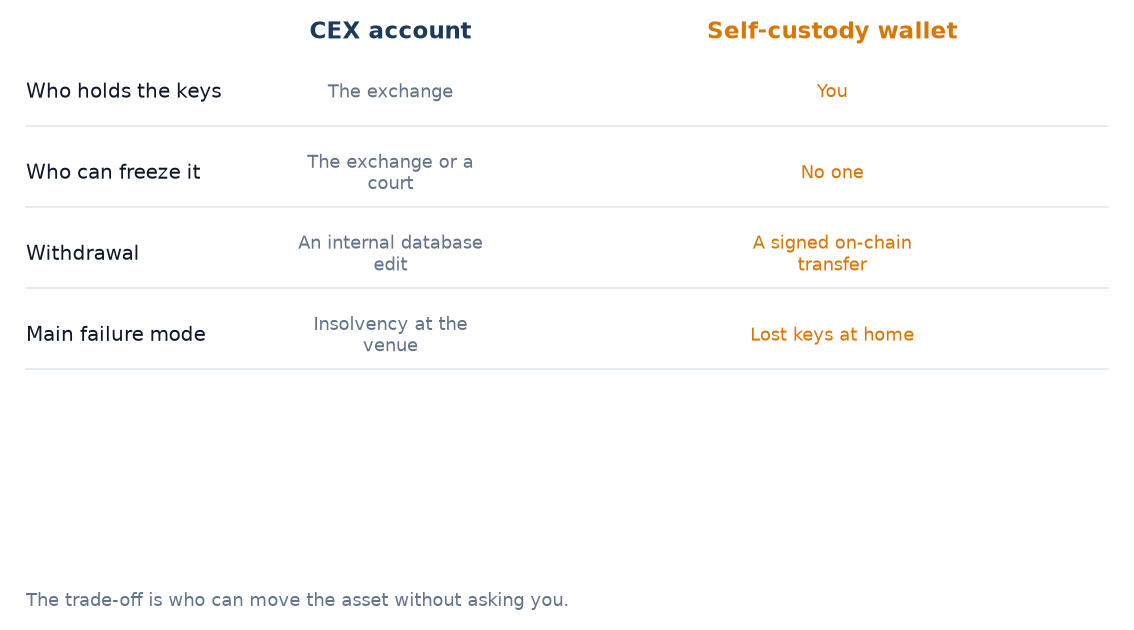
It is worth being precise about why a company would offer both. A wallet brings users who would never open an exchange account, keeps them inside the brand, and creates a funnel toward the exchange for the subset who later want to trade. For the user, the wallet is genuinely self-custodied, which means the exchange’s solvency does not affect it, and it also means the exchange cannot help if the seed is lost. The security model moves from “trust the venue” to “trust yourself”, and the second is not a smaller burden; it is a different one. For what that burden actually involves, see our explainer on what a private key is and why a seed phrase is not a password.
The practical risk of the dual model is confusion. A user who holds coins in the wallet and also trades on the exchange now has exposure to two different things under one login habit, and it is easy to believe a balance in the wallet is protected by the exchange or a balance on the exchange is protected like the wallet. Neither is true. The two accounts are as different as a bank deposit and cash under a mattress, and the interface does not always make it obvious which one you are looking at.
Where the fees and the funding come from
OKX prices its products the way its peers do, with the details doing the real work. Spot trading uses a maker-taker structure, where the order that rests in the book pays less than the order that crosses the spread, and the rate falls as thirty-day volume rises. Derivatives add their own schedule, and the fee is only part of the cost, because a leveraged position also pays or receives funding every few hours and is exposed to the liquidation engine. The full cost of a trade is the sum of the fee, the funding and the slippage, and the headline fee is the smallest and most advertised of the three.
The venue also issues a token, which like its peers serves several purposes at once: a discount on fees, a unit inside the surrounding ecosystem, and a way to tie the customer’s attention to the venue’s valuation. A fee discount paid in the exchange’s own token is a rebate received in exposure, because to keep the discount you hold more of the asset whose value depends on the venue. That is not a reason to avoid it; it is a reason to count the token as a position in the exchange rather than as a separate holding.
The cost people forget is the exit. Deposit and withdrawal fees, and the time they take, are the numbers that matter when something goes wrong, and a venue that is fast and cheap to leave is safer in practice than one that is fast and cheap to enter. When you build the case for or against a venue, weigh the withdrawal path as heavily as the trading schedule, because that is the door you will be standing at when it counts.
The record, read as three questions
OKX has a public history worth reading as a set of answers rather than a score. The first question is technical: has the platform been attacked, and how did it respond? The second is operational: has the venue ever stopped customers from withdrawing, and what did that reveal? The third is legal: which regulator governs which customer, and how has that changed over time? A venue that has experienced each of these and is still operating has priced a risk that a newer venue has not yet met, and none of the three can be inferred from a clean interface.
The one event that is worth naming is the 2020 episode in which the venue suspended withdrawals for a period while a related matter was resolved. It is the clearest illustration of the general rule that a crypto exchange’s ability to return your coins depends on things outside the blockchain, such as a founder, a company structure or a legal process. No amount of on-chain transparency fixes a door that is closed for reasons that have nothing to do with the chain. For the mechanics of what happens in the meantime, see our article on the order in which claims are paid when an exchange fails.
What “is OKX safe” really asks
As with any venue, the question hides four separate ones, and OKX adds a fifth because of the wallet. The first is platform security: whether the venue’s keys and code can be attacked. The second is the legal status of a balance: whether it is segregated and how a court would treat a claim. The third is operational resilience: whether the venue can keep running when banking, liquidity or a related entity is stressed. The fourth is your own conduct: how much you leave and for how long. The fifth, unique to the dual model, is which product you are actually in, because the wallet and the exchange have opposite custody arrangements and are not protected by each other.
The distinction worth keeping
OKX is a derivatives-first venue with a self-custody wallet bolted onto the same brand, and the two halves should be evaluated separately. The derivatives engine is the core competence and it brings leverage, funding and liquidation into the cost of a trade. The wallet is genuinely non-custodial and moves the risk from the venue to the owner’s own key management. The fee schedule is competitive and the funding rate and the exit cost matter more than the headline. The single sentence worth keeping is that a venue which runs both custody models at once is asking you to be clear about which one you are using, and the clarity has to come from you because the interface will not insist on it.
None of that is an argument for or against the venue. It is a checklist that any depositor would apply to any intermediary, and the useful move is to answer the five questions above with facts rather than impressions. The next section gives the questions in the form you can act on, and the references at the end point to the underlying mechanics.
How the funding rate actually reaches your account
Funding is the part of a perpetual contract that traders most often learn about after it has cost them money, so it is worth walking through once. The venue publishes a funding rate, usually every eight hours, computed largely from how far the contract price has drifted from an index of the underlying. When the contract trades at a premium, the rate is positive and longs pay shorts; when it trades at a discount, the rate is negative and shorts pay longs. The payment is taken from the margin balance of one side and credited to the other, without any trade being executed.
Three consequences follow. The first is that a perpetual position has a running cost measured in hours, not in a single transaction, so a trade that looks profitable at the entry price can be a loss by the time it is closed. The second is that the rate is itself information: a persistently high positive rate says that leverage is crowded on the long side and that people are paying to stay there, which is often a late-stage signal rather than an early one. The third is that the rate creates a trade of its own: a position that is neutral in direction, holding the contract and the underlying in offsetting amounts, can collect funding when the rate is favourable, which is how the cash-and-carry trade in this market works.
None of this is hidden, and all of it is quiet. The number lives on a page most traders never open, and it is the reason two people can hold the same view on price and get very different results, because one holds for an hour and the other holds for a week. If you trade derivatives at all, the funding page is the second screen you should have open, after the order book.
Liquidation, insurance funds and auto-deleveraging
Behind the customer-facing order book is a risk engine whose job is to keep one account’s losses from spreading. When a leveraged position’s collateral falls below the maintenance requirement, the engine closes it. If the market moves so fast that the position cannot be closed at a price that covers the debt, the shortfall has to go somewhere, and how a venue handles that shortfall is one of the more revealing things about its design.
The first line is an insurance fund, a pool the venue accumulates from liquidation penalties and, in some designs, from its own contributions. Its purpose is to absorb the losses of positions that could not be closed at a good price. The second line, used when the fund is insufficient, is a mechanism that socialises the shortfall across the winners of the opposite side, sometimes called auto-deleveraging. Read together, the two mechanisms are an honest statement that in a violent enough move, the venue cannot promise every winning position will be paid in full, and the plumbing that decides who absorbs the difference is worth understanding before, not during, a market event.
The practical lesson is not that these mechanisms are unfair. They exist because leverage creates positions whose losses can exceed their collateral, and something has to be the backstop. The lesson is that a leveraged position is a contract with the venue’s risk engine as much as with the market, and that the engine’s rules are part of the product you are buying.
Two checklists, because there are two products
Because OKX runs both a custodial exchange and a non-custodial wallet, the honest way to evaluate it is with two separate lists rather than one blurred impression.
For the exchange side: identify which legal entity you are a customer of; read the withdrawal terms and their stated times; check whether the reserve report is a snapshot or a continuous attestation; test the exit with a small withdrawal; keep only the working balance on the platform; and treat the venue’s own token as exposure to the venue rather than as a separate asset.
For the wallet side: confirm that the keys are genuinely held by you and not escrowed by the company; write the seed down before the first deposit and store it offline; understand that no support desk can recover it; and accept that the failure mode has moved from the venue’s solvency to your own key management. The two lists share almost nothing, which is exactly the point. A person who is careful about the exchange and careless about the wallet has moved the risk rather than reduced it, and a person who is careful about the wallet but leaves a large balance on the exchange has done the same in reverse.
Frequently asked questions
Is OKX the same as OKEx?
OKX is the current name of the venue that traded for years as OKEx, which grew out of an older exchange. The rebranding came with an expansion from contracts into spot trading, an earn product and a consumer wallet.
What is a perpetual future, in one paragraph?
A contract with no expiry that tracks an underlying price and is kept close to it by a periodic funding payment between longs and shorts. When the contract trades above the index, longs pay shorts; when it trades below, shorts pay longs. Holding a leveraged position is therefore a cost that moves every few hours.
Is the OKX wallet the same as my exchange account?
No, and the difference is custody. The exchange account is a custodial arrangement where the venue holds the keys and your balance is a claim. The wallet is non-custodial, where you hold the keys and the venue’s solvency does not affect the assets. The wallet is not protected by the exchange, and the exchange is not protected by the wallet.
Can I lose money on a position that is right on direction?
Yes. Funding is paid periodically on perpetual contracts, and it can exceed the move in price over the holding period. A leveraged position also carries a liquidation price, and a short spike in the wrong direction can close it before the thesis plays out.
Does a proof of reserves mean my balance is safe?
No. It shows the asset side of the balance sheet at a point in time and says nothing about liabilities, so it is half a document. Treat it as one input alongside segregated custody, audited accounts and a record of paying withdrawals under stress.
Why does the exchange have its own token?
The token discounts fees, serves as a unit inside the surrounding ecosystem and ties customer attention to the venue’s valuation. A discount paid in the exchange’s own token is a rebate received in exposure, because keeping the discount means holding the asset whose value depends on the venue.
A note on the numbers in this article
This article avoids quoting specific fee percentages, funding rates and reserve totals, and the omission is deliberate. Funding rates change every few hours, fee tiers change with promotions and token holdings, and reserve totals are published by the venue at intervals of its own choosing. What does not change quickly is the structure: a maker-taker split, tiered pricing that punishes small accounts, funding as a running cost of leverage, a liquidation engine with an insurance fund and a socialised-loss backstop, a token discount that is really added exposure, and an exit cost that is the number deciding what you keep. Memorise the structure and check the live figures at the source on the day you act.
Sources and further reading
The mechanics of exchange failure and the order in which claims are paid are set out in our explainer on what happens to your crypto when an exchange fails, and the general checklist for judging a venue is in ten checks a ranking cannot do for you. For self-custody, see the explainer on private keys and seed phrases and what a crypto wallet actually holds. The distinction between a claim and a coin runs through why a stablecoin is a receipt.


