


In the first week of October, a British banking group and a card network moved three quarters of a million dollars across a border using a stablecoin, over seven days, as a live pilot. The number is small enough that it could be a rounding error in a correspondent bank’s ledger, and the composition of the participants is large enough that the pilot is worth reading carefully rather than dismissing. The story is not the amount. It is who chose to test the rail, and what the test does and does not establish.
Pilots of this kind are the least glamorous and most informative events in payments. They are small by design, because the point is to exercise the plumbing rather than to move value, and they are run by institutions that would face serious consequences if the mechanism failed under load. Reading one properly means separating three questions that the headline blends together: what was executed, what was proved, and what the participants now know. This article takes them in order.

What actually happened
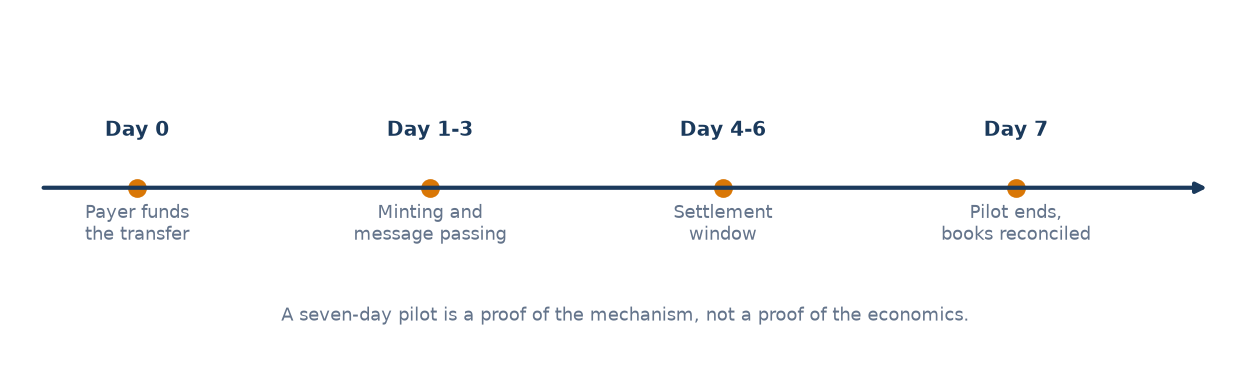
The reported facts are narrow and specific. A British banking group and a card network ran a live, seven-day cross-border settlement pilot using a dollar stablecoin, moving roughly seven hundred fifty thousand dollars. The transfer settled through the stablecoin rail rather than through the correspondent banking network that normally carries such a payment, and it has been described as the first stablecoin settlement trial between the card network and a major United Kingdom banking group.
Several details of that description are doing real work. The rail was a stablecoin, which means the value moved as a token on a public ledger rather than as a message between bank accounts. The instrument was a dollar stablecoin, which is why the settlement asset was one that neither participant issues. The duration was seven days, which is long for a demo and short for an infrastructure. And the participants were a bank and a network, which are two different animals with two different motivations for being there.
What a settlement pilot is, and what it is not
A pilot of this kind tests whether a mechanism works end to end: whether the participants can hold the asset, whether the transfer settles, whether the counterparties reconcile, and whether the compliance paperwork survives contact with a real transaction. Those are the hard parts, and a pilot that clears them has proved something real.
What it does not test is the economics, and the distinction is worth stating plainly. A seven-day pilot moves a fixed, small, pre-agreed amount between parties who have chosen to be there, under terms that were negotiated in advance, at a time of the participants’ choosing. It does not test what happens when ten thousand customers want the rail at once, when the issuer of the stablecoin pauses redemptions, when the network fee spikes into the tens of dollars, or when a regulator somewhere decides the arrangement needs a licence. The mechanism and the market are different questions, and a pilot answers only the first.
Why correspondent banking is the thing being replaced
To understand why a bank would bother, you have to see the rail it is trying to improve. A cross-border payment in the traditional system does not travel from the payer’s bank to the payee’s bank. It travels through a chain of correspondent banks, each of which holds an account for the next, each of which takes a fee and a spread, and each of which has its own cut-off times, compliance checks and holiday calendars.
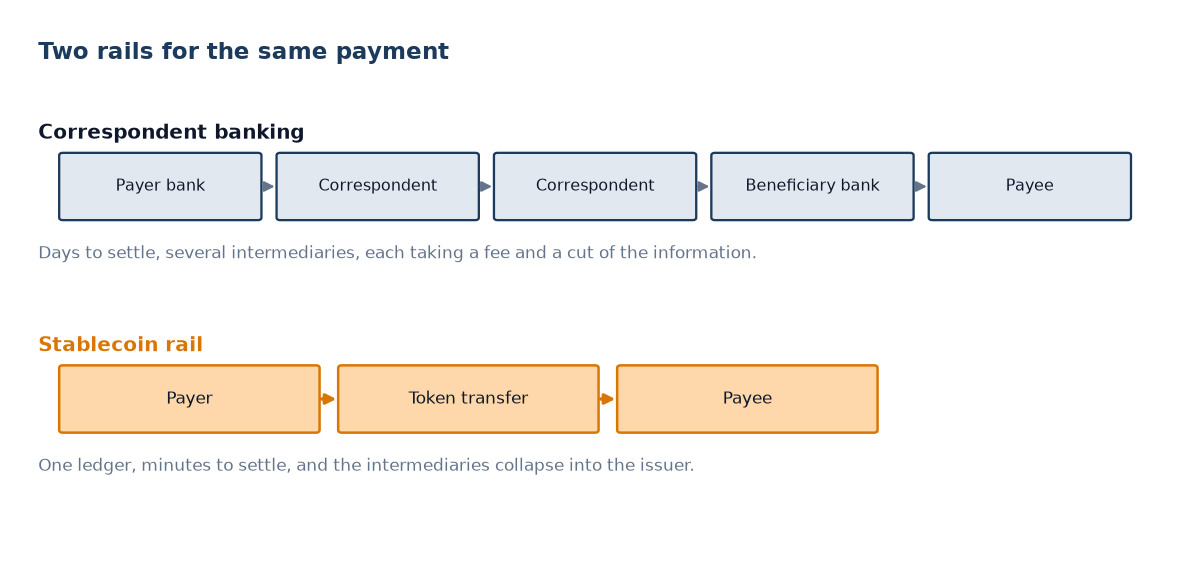
The consequences of that structure are well known and boring, which is precisely why the industry keeps trying to replace it. A payment can take days because each hop adds latency. The cost can be several percent because each hop takes a margin. The final amount is uncertain because each hop applies its own charges. And the visibility is poor because the payer’s bank frequently cannot see where the payment is once it leaves. Every one of those problems is a structural property of the rail, not a failure of any particular bank, and every one of them is the reason a bank would test an alternative that settles in minutes with fewer hands on it.
What the stablecoin rail actually collapses
The attraction of the stablecoin rail is that it turns a chain of bilateral correspondent relationships into a single shared ledger, and the intermediaries collapse into the issuer. Instead of five institutions each holding an account for the next, the payer sends a token to the payee, the transfer is recorded once, and the settlement asset is a liability of one company rather than a claim circulating through several.
That is a genuine improvement in speed, cost and transparency, and it comes with a genuine transfer of trust. The old rail spreads the risk across several regulated banks, each of which is supervised and each of which has failure procedures; the new rail concentrates the settlement-asset risk into a single issuer, whose promise to redeem at par is the thing that makes the token worth a dollar. The chain is shorter and the single link is more important. Whether that is a net improvement depends on the issuer, on the reserves behind it and on the regulation around it, and those are the questions the pilot did not answer because it did not need to.
The worth of the settlement asset is the same question we set out in why a stablecoin is a receipt rather than a coin and in the three designs behind the word stablecoin, and the commercial race around it is the subject of one chain per issuer. A bank that adopts the rail is choosing the issuer as its new counterparty, whether or not the press release says so.
The parts the headline leaves out
Three omissions are worth naming, because each is where a later failure would come from.
The first is size. A pilot of three quarters of a million dollars is a test, and the cost structure of a stablecoin transfer does not scale linearly into the volume a real settlement business needs. Network fees, issuance and redemption, on-ramps and off-ramps, and the liquidity to convert the token into local currency all change character at scale, and none of those is exercised by a single small transfer.
The second is timing. Running a pilot over seven days at a moment of the participants’ choosing tests the happy path. It does not test the rail under stress: high network fees, a congested ledger, a redemption pause, or a weekend when the issuer’s banking partners are closed. Those are exactly the conditions in which a settlement rail has to work, and they are exactly the conditions a pilot is designed not to include.
The third is the legal and regulatory layer. A cross-border payment is subject to sanctions screening, anti-money-laundering rules, local licensing and the tax treatment of the instrument on both ends. A pilot between two sophisticated institutions who have agreed on the paperwork in advance tests the technology and assumes the compliance. The regulatory questions around stablecoins as settlement assets are still being written, which is the subject of the deadlines now running through the United States and the United Kingdom, and none of that is settled by a single bank’s trial.
Who bears the risk on the new rail
Every rail allocates risk somewhere, and the useful exercise is to name where. On the stablecoin rail, the risks that used to be spread across a correspondent chain land on four parties.
The first is the issuer, which now carries the credit risk and the operational risk of the settlement asset and whose failure would stop the rail. The second is the bank, which has swapped its counterparty exposure to other banks for exposure to a non-bank issuer and, in some designs, to the token’s smart contract. The third is the customer, who in a payment context may be shielded from the issuer entirely and in a settlement context is fully exposed. The fourth is the regulator, which now has to decide how to treat an asset that behaves like a deposit but is issued outside the deposit-insurance perimeter.
Naming the parties is more useful than scoring the rail, because the failure mode of each is different. A correspondent chain fails by delay and cost; a stablecoin rail fails by the issuer, and the whole point of a pilot run by serious institutions is to work out how much of that single point of failure they are willing to accept.
Why the pilot matters anyway
Given all of the above, it would be easy to file the pilot under marketing. That would be a mistake for one reason: the participants. A card network and a major bank group do not run a live cross-border pilot to generate a press release; they run it because they are deciding whether to build. The signal in an announcement of this kind is not the amount or the duration but the identity of the parties and the fact of a live test, which together say that the question has moved from whether to how.
That is why the honest reading is cautious but not dismissive. The mechanism works, on a small amount, over a short window, with willing participants, which is exactly what a first live test should establish. The economics, the stress behaviour and the regulatory perimeter are still open, and those are the questions the next round of pilots will be designed to answer. The right response is to watch the second and third pilots rather than to treat the first as a verdict.
The distinction worth keeping
A bank and a card network moved real money over a stablecoin rail for a week, and the pilot proved that the mechanism works end to end at small scale. It did not prove that the rail is cheaper at volume, that it holds up under stress, or that the settlement-asset risk has moved somewhere harmless. The rail’s genuine advantage is that it collapses a chain of intermediaries into a shared ledger; its genuine cost is that the same collapse concentrates the trust into one issuer. Reading the pilot for those two facts is more useful than reading it for the number.
What follows is the same discipline any infrastructure choice deserves. Name the participants, name the amount, name the window, and then ask what was not tested. A pilot is a laboratory result, and the field is where it either holds or does not. For the mechanics of the asset at the centre of it, the references below are the place to start.
What a bank gets from a rail it does not control
The obvious objection to a bank adopting a public blockchain for settlement is that the bank does not control it. There is no operator to call, no scheduled maintenance window, no one to reverse a mistake, and the transaction fees are set by a market rather than by a contract. For an institution whose entire business rests on predictable operations, that sounds like a step backward, and the reason it is nevertheless attractive is worth spelling out.
The first gain is reach. A correspondent network is built one bilateral relationship at a time, and each relationship takes years, legal work and a balance sheet. A public ledger has no onboarding for the network itself; any party that can hold the token and can satisfy the compliance of its counterparty is reachable, which collapses the time to establish a new corridor. The second gain is the record. A settlement on a shared ledger produces a single, timestamped, mutually visible receipt rather than two sets of internal books that must later be reconciled, and reconciliation is one of the larger hidden costs of cross-border payments. The third gain is composability: once value is a token, it can be programmed, which is how a payment can be made conditional on a delivery or split automatically among participants.
The cost of those gains is exactly the loss of control, and it concentrates in three places. Because no one can reverse a transfer, a mistake is permanent and a fraud is permanent, which is why the compliance layer cannot be relaxed. Because the fees are set by a market, the cost of settlement is not a line item a bank can negotiate, which is fine at low volumes and less fine during congestion. And because the rail is public, the transaction is visible to everyone, which is a benefit for auditability and a problem for confidentiality, and it is the reason many bank pilots use permissioned chains rather than the open ones the marketing usually names.
The comparison the pilot invites: three ways to settle
The pilot is best understood by placing it beside the two systems it sits between, because each is optimised for something different.
Real-time gross settlement systems, the domestic rails that move central-bank money, settle instantly and finally within a jurisdiction, and they are the gold standard for finality. They are also domestic by construction, which is why a cross-border payment leaves one and then travels through a correspondent chain to reach another. Correspondent banking is the bridge between those domestic systems, and its whole cost structure comes from the fact that it is a chain of bilateral promises rather than a shared ledger. A stablecoin rail is a third thing: a shared ledger that is global by default but whose settlement asset is a private liability rather than central-bank money.
Read that way, the pilot is an attempt to get the reach of the ledger and the speed of real-time settlement while accepting a settlement asset that is neither central-bank money nor a bank deposit. That is the trade, stated plainly, and it is why the regulatory treatment of the settlement asset matters more than the technology of the rail. A payment rail is only as good as the thing it uses to discharge the obligation, and a token is only as good as the issuer’s promise to redeem it.
How to read the next payments pilot
The next announcement of this kind will look similar and can be read with a short list that separates signal from marketing.
First, identify the participants and their roles, because a bank, a card network, an issuer and a market maker are there for four different reasons and only some of them are making a commitment. Second, find the amount relative to the participants’ normal transaction size, since a pilot that is small for the payer tests less than one that is normal. Third, find the duration and the number of corridors, because one corridor over a week is a demo and several corridors over a quarter is a decision. Fourth, ask who held the stablecoin overnight, because that is the party carrying the issuer risk and it is almost never named in the release. Fifth, look for what the participants said they would do next, since a pilot that is followed by a production commitment is a different event from one that ends with a thank-you note.
The value of the list is that it turns an announcement into a set of answerable questions, and this particular pilot answers the first one well and the rest partially. That is not a criticism; it is the correct reading of a first live test between serious institutions.
Frequently asked questions
What did the Lloyds and Visa pilot actually do?
It moved roughly seven hundred fifty thousand dollars across a border using a dollar stablecoin over a seven-day live pilot, settling through the stablecoin rail rather than the correspondent banking network. It has been described as the first such trial between the card network and a major United Kingdom banking group.
Does the pilot prove stablecoins are cheaper for settlement?
No. It tests the mechanism at a small, fixed amount chosen by the participants. Cost structure at real settlement volume, network fees under stress, and the liquidity to move between the token and local currency are all untested by a pilot of this size.
Why use a stablecoin instead of a bank transfer?
Because a cross-border payment normally travels through a chain of correspondent banks, each adding latency, a fee and a cut of the information. A stablecoin rail collapses that chain into one shared ledger, which settles in minutes with fewer intermediaries.
What is the risk of the new rail?
Concentration. The correspondent chain spreads settlement risk across several regulated banks; the stablecoin rail concentrates it into a single issuer whose promise to redeem at par is what makes the token worth a dollar. A shorter chain makes the single link more important.
Is a seven-day pilot meaningful?
It is meaningful as a first live test and not as evidence of scale, stress behaviour or economics. It exercises the happy path between willing institutions; the conditions a settlement rail must survive are the ones a pilot is designed to exclude.
What happens next with stablecoin settlement?
The single most useful thing to watch is the second and third pilots rather than the first, along with the regulatory deadlines for stablecoin issuance. Together those answer the open questions the first pilot deliberately left aside.
Sources and further reading
The pilot’s facts, the amount and the participants are as reported in payments and crypto coverage in early October 2026. Details of live pilots change as they conclude, so treat the figures as of that reporting date.
For related reading, see why a stablecoin is a receipt rather than a coin, the three designs under the word stablecoin, and the settlement race and the issuer that sat it out. The mechanics of a claim rather than a coin recur in what happens to your crypto when an exchange fails.


