


Conclusion first: prediction markets booked a record $20.4 billion of weekly volume at the start of October 2026, the first week above $20 billion, and that number gets read two ways that are both wrong on their own. It is not evidence that information markets have arrived, because sports contracts are roughly 81 percent of the volume on the largest venue. It is also not a measure of money at risk, because the venue counts every contract at one dollar of notional regardless of the price paid for it. Strip both effects and what is left is a gambling business with a derivatives wrapper, a settlement machine, and a legal question that three appeals courts have now answered three different ways.
The record week, and the two venues that produced it
The week topped $20.4 billion across venues, above the peak set during the World Cup, with Kalshi at about $15.8 billion, roughly 77 percent of the total, and Polymarket at about $3.6 billion. The mix of drivers is worth listing because each one is seasonal: the NFL and college football seasons opening, positioning ahead of the 3 November midterms, and the Federal Reserve’s September rate decision, which spawned a cluster of economics contracts.
| Measure | Kalshi | Polymarket |
|---|---|---|
| Record week, early October 2026 | $15.8 billion | $3.6 billion |
| 30-day rolling volume | $14.1 billion | $3.1 billion |
| Combined two-venue share | 82% | 18% |
| Reported valuation under negotiation | about $40 billion | above $20 billion |
The valuations moved faster than the volumes. Kalshi was negotiating a round at about $40 billion against $22 billion in March and $11 billion in December 2025, with an initial public offering discussed as early as 2027, while Polymarket was raising above $20 billion. A category that did not legally exist in the United States two years ago now has two venues valued as a large exchange and a mid-cap company.
Roughly 81 percent of the volume is sports, so this is a sportsbook
The category composition is where the “information market” framing loses contact with the data. Sports contracts grew to about 81 percent of Kalshi’s daily volume in 2026, up from roughly 22 percent in the middle of 2025, while crypto fell to about 9 percent. Year to date through late August, Kalshi traded about $174.5 billion against Polymarket’s $64.9 billion, and Kalshi’s sports book alone accounted for $127.2 billion of that, or 73 percent of its own total and nearly double Polymarket’s entire year-to-date volume. Polymarket’s franchise is the mirror image: it holds about 97.3 percent of the two venues’ political volume.
The revenue split follows the same shape. Blockworks Research estimated Kalshi’s revenue at about $263 million last year and on track for roughly $1.3 billion in 2026, with 80 to 90 percent coming from sports, and Bank of America put sports at about 79 percent of the venue’s exchange volume with a long-run total addressable market it sizes at $1.1 trillion.
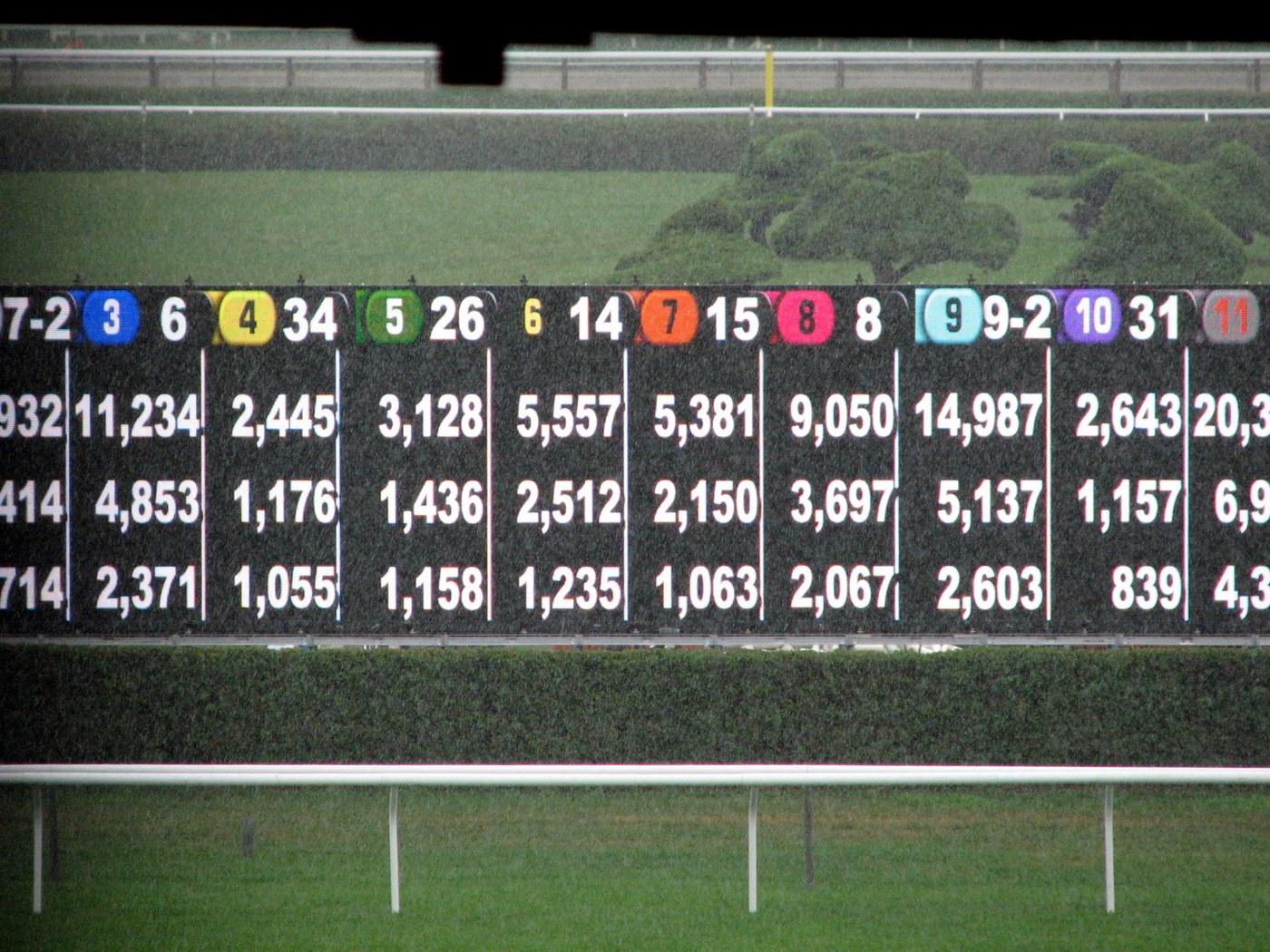
None of that makes the product illegitimate. Sports betting is a real, large, legal industry in most of the United States, and a venue that intermediates it well deserves a valuation. What it means is that the word prediction was never the business. The business is a sportsbook whose contracts happen to be structured as exchange-traded derivatives, and every strategic question about the category follows from that: the seasonality, the state licensing fights, the incentive programs, and the marketing spend on football weekends.
The notional is one dollar a contract, and it is not capital at risk
Every headline number in this sector comes from a convention that inflates it. Kalshi counts $1 of notional per contract regardless of the price that contract trades at, so a contract quoted at three cents still contributes a dollar to reported volume. Low-probability contracts, and combination tickets that stitch several of them together, therefore register many times their economic weight. There is a legitimate reason for the convention, because it matches how the exchange lists a fixed-payout contract, but it also means that dollar volume and money at risk are different quantities on a scale that nobody restating the number in a headline is going to mention.
| Measure | What it counts | Latest reading |
|---|---|---|
| Notional volume | One dollar per contract, whatever its price | Above $40 billion a month for Kalshi |
| Open interest | Capital committed to unresolved positions | About $1.8 billion across venues in June 2026, up from under $200 million in late 2025 |
| Cross-venue open interest | Each venue’s own definition | About $926.6 million on Polymarket against $827.0 million on Kalshi |
The open interest line is the one that behaves like a capital measure, and it grew about eightfold from under $200 million in the autumn of 2025 to roughly $1.8 billion by the end of June 2026, with a record $1.48 billion in the week to 15 June. Even comparing that series carefully needs care, because the venues publish it on different bases: Polymarket’s figure is pool liquidity, Kalshi’s is outstanding contracts, and the two numbers sit side by side in trackers without being the same quantity.
Early in October 2026, CNBC reported that about half of one day’s dollar volume in Kalshi’s ether perpetual futures came from trades sized between $5,495 and $5,505, and flagged the relationship between volume and open interest; Polymarket’s offshore venue showed outsized volume in very low-probability contracts. Both firms denied wash trading. Whatever the explanation, the reporting is a reminder that a venue’s own volume reporting is an input into its valuation, which makes it the least neutral number on the page.
The reward programs paying for volume
Part of the growth was bought, and the receipts are public. Polymarket has paid out roughly $128 million in trading rewards, about 54.3 percent of the fees it collected, while Kalshi pre-emptively ended its volume incentive program with effect from October 2026. The Commodity Futures Trading Commission opened an investigation into prediction market reward and incentive schemes after an advisory opinion in August 2026, examining both misleading promotion and the possibility that incentivised trading distorts reported activity, and its chairman, Michael Selig, said the agency has zero tolerance for manipulative trading including wash trading.
This matters beyond compliance. When volume is subsidised by the venue, volume stops being a clean proxy for demand, and a category whose growth story is told in volume multiples has to be read with the subsidy in mind. A $20 billion week is a fact. What fraction of it would have happened at zero rewards is an open question the venues are not required to answer.
Three circuits, one question: derivative or bet?
All of the above rests on a legal classification that is currently in flux. On 30 September and 1 October 2026, the CFTC sent two proposals to the White House Office of Information and Regulatory Affairs: a rule to define event contracts formally as swaps, and an interim final rule to exclude casino-style gambling products. The interim rule would take effect without the usual notice-and-comment process, and gaming lawyers have already signalled that this route invites litigation under the Administrative Procedure Act.
The courts have not settled the underlying question either, and they are not converging. The Third Circuit sided with Kalshi on exclusive CFTC jurisdiction in April 2026; the Ninth Circuit held in August 2026 that states may regulate prediction markets as gambling; and on 25 September 2026 the Sixth Circuit ruled that Ohio and Tennessee may enforce their gambling laws against Kalshi’s sports contracts. New York sued Polymarket for unlicensed gambling in September 2026, New Jersey’s attorney general asked the Supreme Court to take the issue, and the CFTC and the Department of Justice have countersued states including Arizona, Connecticut and Illinois. Abroad the trend ran the other way: Romania ordered internet service providers to block Polymarket as an unlicensed betting site, with similar actions in Brazil and Argentina.
Read the fight through the product rather than the politics and the shape is clear. If event contracts are swaps, the CFTC is the only regulator, sports contracts are legitimate financial derivatives, and the states lose both the revenue and the authority. If they are bets, the states retain their licensing regimes, and a venue that spent 2026 opening football-season contracts has to comply with fifty gambling codes instead of one derivatives regime. The interim final rule is the most consequential single document in the sector right now, because it settles the first half of that question on its own authority while the courts work through the second.
What the numbers actually support
Two measurements survive the noise. Open interest is the capital measure, and it is approaching the low single-digit billions, not the tens of billions that the volume figures suggest. And the product mix is entertainment rather than forecasting: sports on one venue, politics on the other, with crypto and economics as the smaller fixtures that generate the industry’s press.
That is not a criticism of the category, and it should not be read as one. It is a description of what is being valued at $40 billion: a fast-growing, well-engineered, legally contested sportsbook with an exchange wrapper, a real settlement machine, and a court calendar that matters more to its future than any single week of volume. Anyone pricing that business should start from open interest and the states’ gambling statutes, and treat the headline notional as what it is — a count of contracts at a dollar apiece.


